Some of my earliest memories are of getting lost in a book. I read on the school bus until the motion made me queasy but I never quite wanted to stop. Books have always been my favorite escape into bigger worlds. That love of stories has shaped much of who I am today.
Now, as a parent of two—my curious six-year-old son and my energetic two-year-old daughter—reading has taken on new meaning. It’s no longer just a solitary escape; it’s a shared experience, a daily rhythm that brings us back together. Whether it’s a quiet bedtime story or an impromptu library trip on a rainy afternoon, I want them to see reading not as a chore, but as something joyful and full of possibility.
During one of our library visits, we found Great Lakes Ghost Stories perched on top of a shelf. It felt like it had been placed there, waiting for us to grab it. Living near Lake Michigan, my son has a fascination with shipwrecks and ghost stories, so the book was an instant hit. We’ve been working our way through it a little each night. We imagine the waves, the fog, and the echoes of the past as we read. It’s a story that captures us both, which makes that time feel even more special.
Of course, there’s still plenty of toddler-friendly reading mixed in. My daughter adores Dragons Love Tacos—especially the part where the dragons accidentally burn down the house. She throws her arms in the air and pretends to breathe fire every time, her giggles filling the room. Those moments remind me that the love of reading isn’t just about the stories themselves but about how they bring laughter, wonder, and connection into our home.
Reading has also become my own kind of reset. After long days, there’s comfort in sitting beside my children with a book in hand, letting the day fade as we turn the pages. Books remind me that curiosity is ageless and that stories have the power to grow with us. Watching my children surrounded by them feels like passing down a quiet kind of magic—one that never loses its spark.
What book are you reading right now? Tell me about it in the comments!
And if reflections like this resonate with you, subscribe for more moments of intentional parenting.
If you could live anywhere in the world, where would it be?
Before dawn, I awoke to toddler kisses on my cheeks and the faint crow of a rooster calling the day to begin.
The scent of coffee drifted through the kitchen as my husband and I eased into the morning. Our six-year-old son stirred under his blanket, still half-dreaming, and soon began retelling the Great Lakes ghost ship story we’d read the night before. Our two-year-old daughter tugged at my sleeve, eager to gather eggs from the chicken coop. Outside, the sky hung pale gray, the world quiet except for the rustle of animals waking.
In that stillness, surrounded by the people I love, I felt an unshakable peace—the kind that reminds me I could never imagine living anywhere else.
If I could live anywhere in the world, I would choose to be right here—with my family and our small but lively homestead. Together, we’ve shaped a life that’s rooted in rhythm and purpose, surrounded by gardens that feed us and animals that fill our days with energy and laughter.
Pigs snuffle in the mud, turkeys strut proudly in their corn crib enclosure, and chickens announce each new egg as if it were an accomplishment worth celebrating. Our home isn’t grand, but it hums with life.
Our community, too, has become an extension of that home. When we start a renovation project, chase a runaway chicken, or need an extra hand keeping the kids busy, help is never far away. Friends arrive with tools, spare time, and easy smiles. That kind of closeness doesn’t come from a picture-perfect place. It grows from shared effort, trust, and the understanding that we rise and thrive together.
I could wake up to a mountain sunrise or fall asleep to the lull of the ocean, but it wouldn’t compare to mornings like this one. The warmth of my daughter’s tiny hands, the echo of my son’s laughter, and the smell of coffee mingling with fresh earth from the garden. For us, home isn’t measured by scenery or luxury; it lives in the laughter, labor, and love that fill each day.
And as the first light spills across our field, I feel her tiny kiss still warm on my cheek. In this moment, I know this truly is the most beautiful place in the world.
If reflections like this resonate with you, subscribe for more small moments of gratitude and intentional living.
Out in the pasture, instinct moves faster than thought. The herd already knew what I hadn’t yet seen: today was a day of renewal.
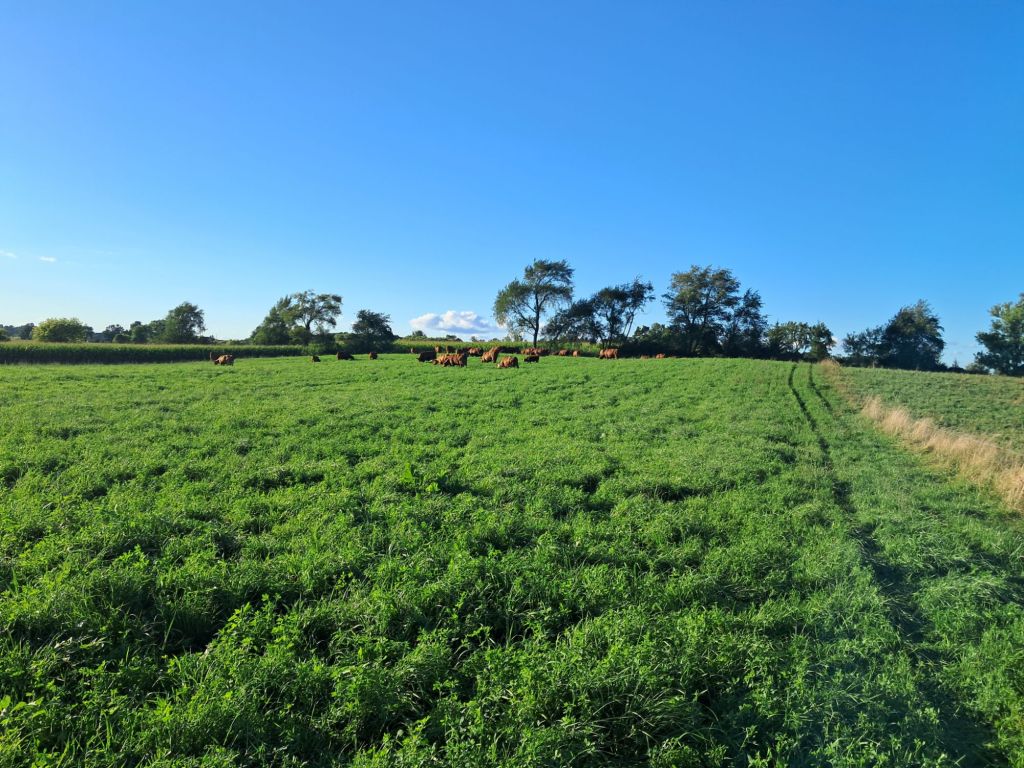
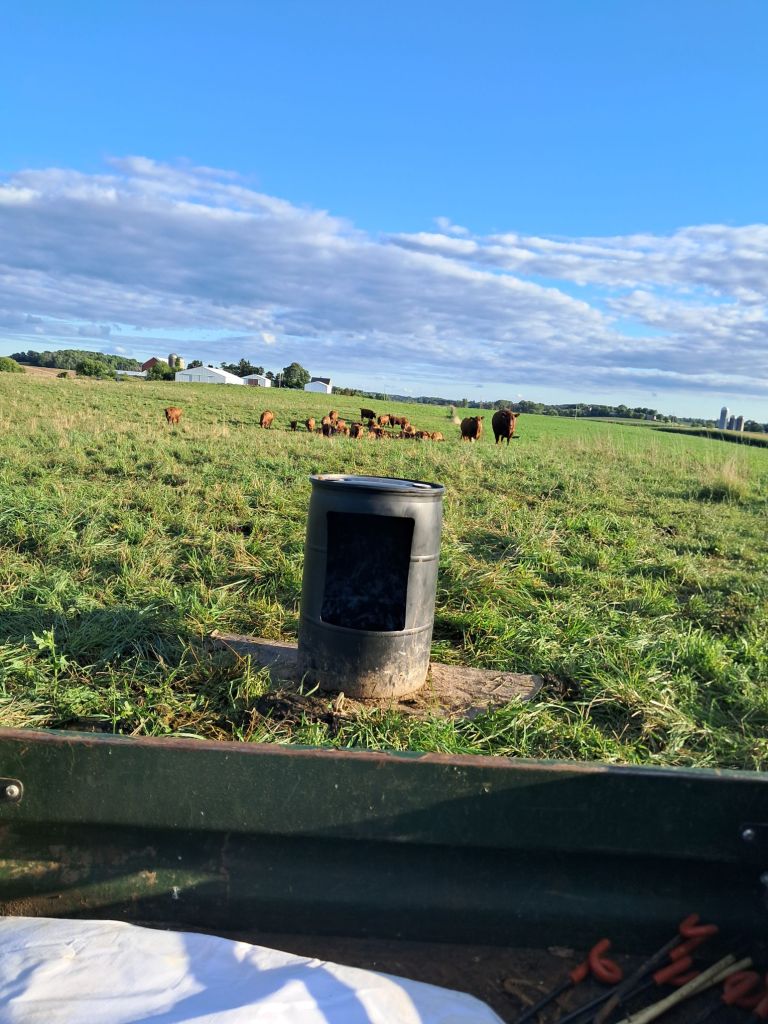
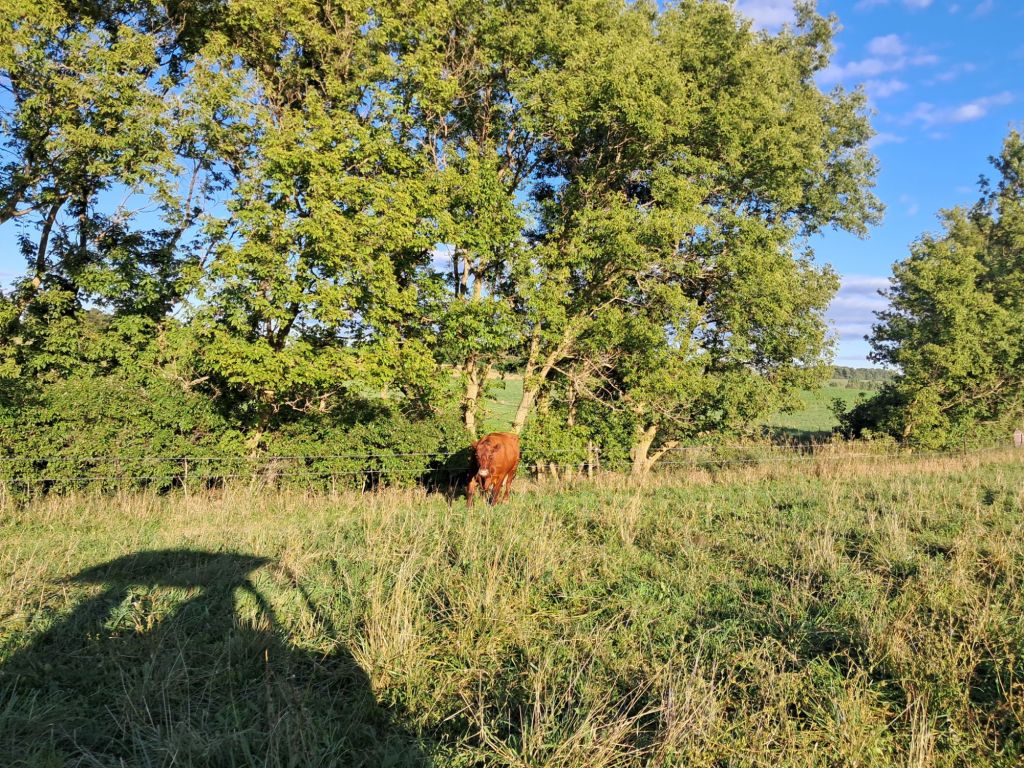
The moment our UTV rolled across the pasture, forty Red Angus beef cattle lifted their heads in unison. Mothers stood shoulder to shoulder, calves pressed between them, and the lone bull kept watch a few steps behind. They had gathered tight against the slender electric wire that marked the edge of their world, eyes wide and ears twitching—already waiting. They sensed what I had yet to see: fresh pasture was coming.
A Dance Between Herd, Land, and Hand
My sister didn’t waste time with explanations. She tipped the empty water tank, wrestled it into the adjoining paddock, and clipped on the hose. With a metallic clink, she fastened the UTV to the mineral feeder and dragged it through the open gate like a sled over grass. Over the hum of the engine, her practiced voice carried, bright and firm: “Here, bahsy!”
For a heartbeat, the herd froze. Then one bold cow stepped forward. In an instant, the rest followed like a living tide. All except one.
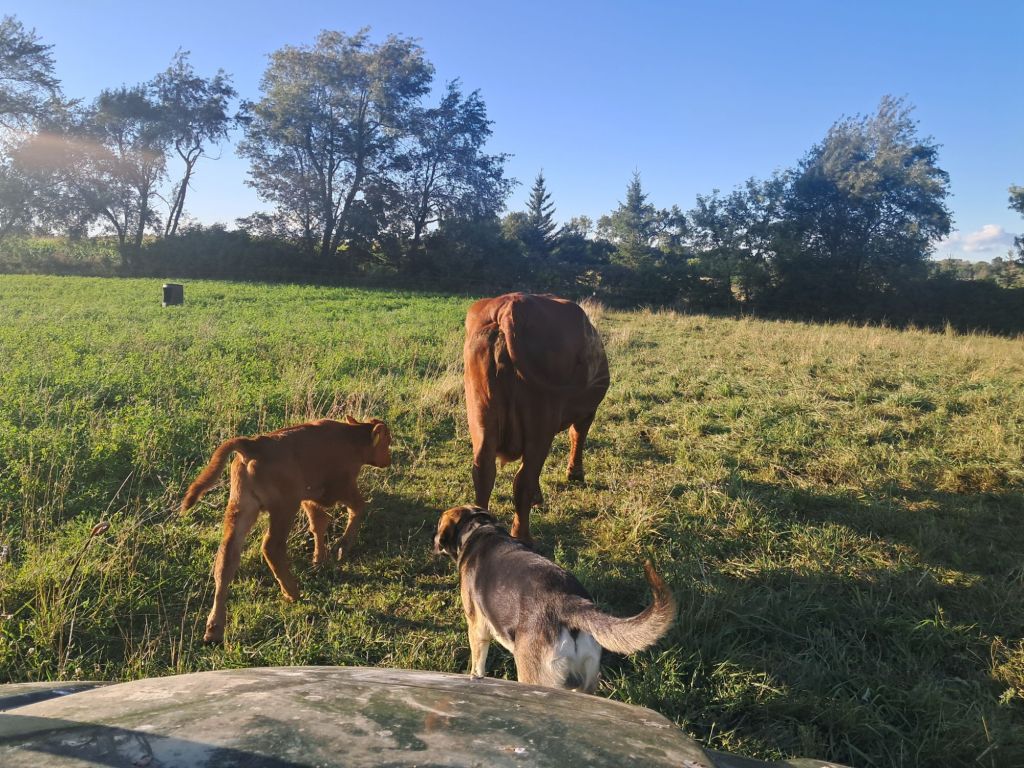
The new mother lingered. A week ago she had calved, and her baby—small enough to slip beneath the wire—now stood stranded on the wrong side. The cow lowered her head and called, a deep-throated sound stitched with both command and worry. We had just started toward the calf when his spindly legs carried him scrambling back under on his own. The tension melted. She met him with a fierce gentleness, nosing his flank until he steadied beside her. My sister laughed, remembering a calf that roamed for three days before finally wandering home. “Guess they all want adventure,” she said, amused, half exasperated.
The dog launched next, circling fast and sharp to tuck mother and baby back into the surge. Together they flowed through the gate, spreading across the new paddock where muzzles dropped at once into the alfalfa. They tore off lush green mouthfuls while a few calves sprang into stiff-legged kicks, joy breaking loose through their bodies as they danced across their “salad bar.”
Roots, Renewal, and the Rhythm of Stewardship
What looked like routine was closer to choreography—people, animals, and land moving in time with one another. The cattle grazed, and with each mouthful they scattered fertility. The brief stress of grazing forced the plants to drive roots deeper, bringing resilience and storing carbon. Each careful rotation became a small act of renewal, stitched into a larger cycle of grass, growth, and gratitude.
In winter, the family feeds them hay—baled and wrapped, fermenting sweet and sour until the animals nose into it gladly. Another verse in the same song. But that afternoon, under sun and grass, what struck me most was satisfaction made visible: forty animals, content and humming with life, heads bowed as if in prayer.
The calf pressed against his mother then, reaching to nurse. And as I watched, it dawned on me—this wasn’t just work or habit. It was stewardship, connection, and gratitude rooted in motion.
Your Turn
What everyday work have you seen or done that revealed something deeper than ‘just a chore’? Share your stories in the comments below!
Read, Reflect, and Share
If this story brought you into the pasture for a moment, tap Like. Follow for more stories of land and livestock in harmony. Share it with someone who understands the quiet art of caring for what grows. Your support helps this space grow and reach others with similar interests.
What’s the coolest thing you’ve ever found (and kept)?
The first time I saw the map, I was nauseated and overwhelmed.
It was March 2023, and my husband and I were touring the house that might soon become our home. At nine weeks pregnant, I’d skipped breakfast, and the wave of queasiness matched the swirl of emotions inside me—a baby on the way, a new house, a new life I wasn’t sure I was ready for. The place overflowed with decades of forgotten possessions, each room crowded with remnants of someone else’s story.
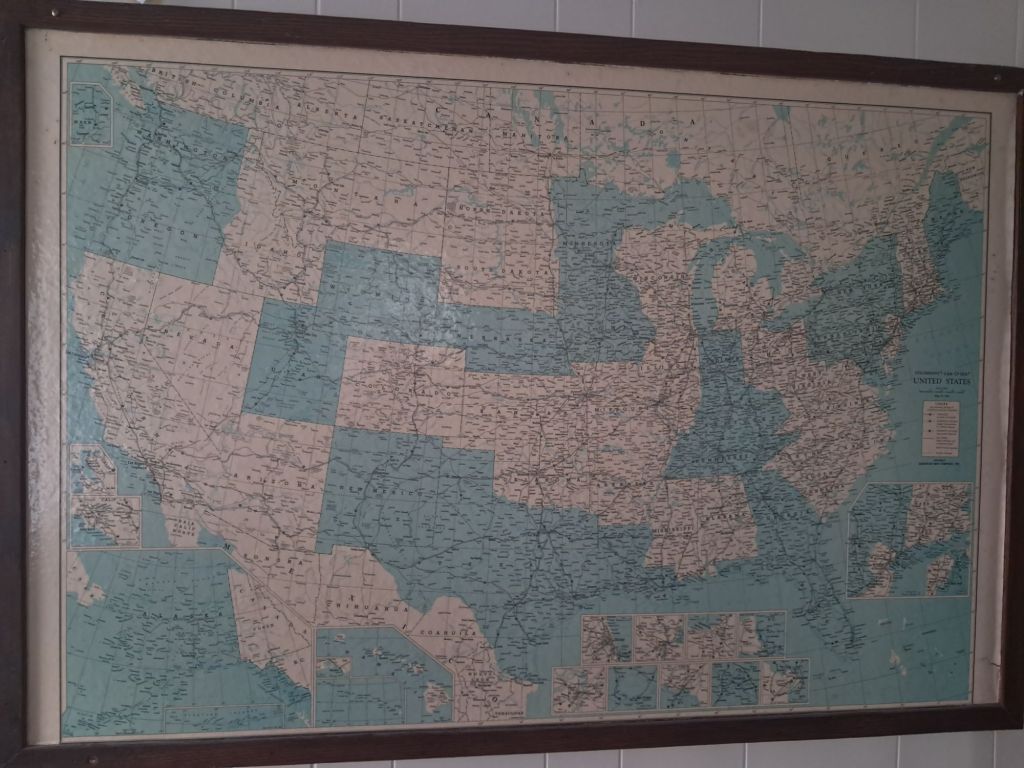
Upstairs, something leaning against the wall caught my attention. It was a large vintage map of the United States, the kind once used in classrooms to chart railroads and planned highways. The paper was yellowed and curled at the edges, faint marker lines tracing routes that never came to be. Despite my dizziness, I knelt to study it, drawn in by the faded colors and the quiet sense of history. Even in its worn state, I saw potential—a story still waiting to be told.
Two months later, after closing on the house, we returned to begin the long process of cleaning. Much of the clutter remained, but the map was still there, patient and waiting in the same spot, as if it belonged to me. My husband and in-laws spent weeks scrubbing, painting, and repairing walls. Amid the chaos, they carefully cleaned the map, framed it, and hung it in my future home office—a space I would soon inhabit every day. It was a small gesture, but one of the kindest and most meaningful I’ve experienced.
Now, two years later, that map still hangs on the wall of my office. Its faded lines have become a steady companion to my workdays, a window to imagined landscapes beyond the screen. When someone on a call mentions a city or a road trip, I glance over, tracing their route and picturing their corner of the country. It reminds me not just of place, but of the path we’ve taken—from that cluttered, dizzy morning to the life we’ve carefully mapped within these walls.
If reflections like this resonate with you, subscribe for more small moments of gratitude and intentional living.
What part of your routine do you always try to skip if you can?
Most mornings start with a quiet choice—whether to honor my intentions or give in to my excuses.
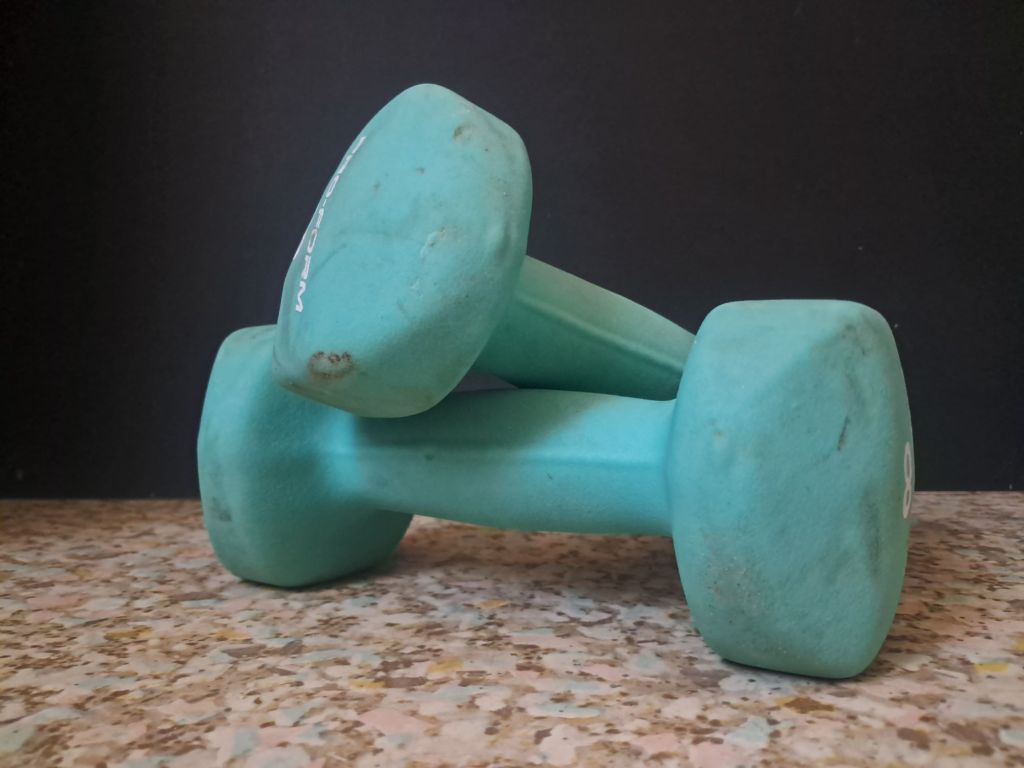
My routine isn’t rigid; it shifts with the rhythm of life at home. But on the best days, I carve out a few minutes for movement. Ten or twenty minutes of exercise to clear my head and reconnect with myself.
Still, it’s the part I’m most likely to skip. When sleep is scarce, when the kids need me, or when the day feels heavy before it even begins, it’s too easy to let it go. The promise of “later” becomes a gentle lie I tell myself, one that always fades as the hours slip by.
But when I do keep that promise, even briefly, the reward is unmistakable. My breath deepens, my pulse steadies into rhythm, and a thin sheen of sweat gathers on my forehead. In that moment of effort, I feel a quiet awareness settle in—a reminder that I’m capable, present, and alive. The energy lingers, carrying me into the rest of the day with a small spark of pride that I showed up for myself.
My kids see it too—that persistence matters more than perfection. It’s an ordinary act, but one that steadies me, a reminder that discipline often begins in the smallest, most unremarkable moments.
If reflections like this resonate with you, subscribe for more small moments of honesty and intentional living.
Who is the most famous or infamous person you have ever met?
It’s funny how one small moment can stick with you for years—the conversation you didn’t have, the voice you didn’t use.
Some might say I live a quiet, even isolated life. The most well-known person I’ve met—depending on your politics—is Representative Glenn Grothman, who serves in the U.S. House of Representatives for our district.
It was a Friday night in 2017 at a local fish fry—few things capture Wisconsin life better. I saw him come in, greeting neighbors, easygoing and familiar, waiting for his order just like everyone else.
I wanted to walk up and introduce myself. A few weeks earlier, I had written to him about net neutrality, and his response made it clear he disagreed with me. Still, I wanted to talk, to bridge that gap. But at twenty-something, I didn’t trust my voice enough. I stayed seated, the chance passing with the scent of fried perch and buttered rye bread. I regretted it as soon as he left.
Eight years later, that hesitation is gone. Confidence, I’ve learned, isn’t about agreement—it’s about showing up with sincerity and respect. If the same moment came today, I’d thank him for his service, share my views without fear, and know that my voice deserves space in the conversation.
I’m no longer the uncertain young woman sitting quietly at the fish fry. I’m the woman who speaks up and knows she belongs.
If you like this answer, please check out my related posts below, and subscribe for lessons that I’ve learned!
I have pets, though not the kind most people picture.
I live on a homestead with my husband, where we raise pigs, chickens, and turkeys, plus one outdoor cat.
None of them come inside, but they play a big role in our lives. They turn food and garden scraps into nutritious protein rich in vitamins and minerals.
Along the way, they delight us with their antics—the chickens strut like tiny dinosaurs, the turkeys lumber on their pterodactyl legs, and the pigs act like oversized dogs, barking included.
Caring for them has given our lives a deeper sense of meaning. We work to give them a good life, and in turn, they provide for us in a way that feels both natural and rewarding.
If you like this answer, please check out my related posts below, and subscribe for more homestead-related content!
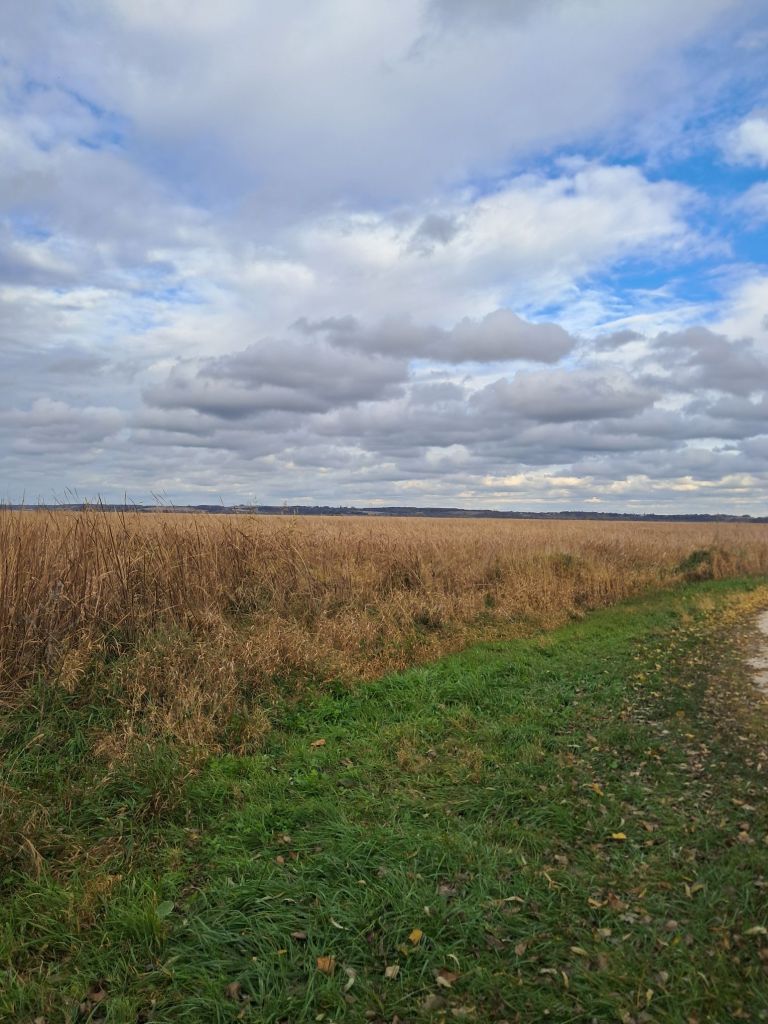
I live just a couple of miles from the largest freshwater cattail marsh in the United States. It’s a vast expanse that shifts with the weather, the seasons, and sometimes, by design. In the mornings and evenings, I hear the call of geese and cranes as they migrate to and from the marsh.
A Living Landscape Shaped by Water and Time
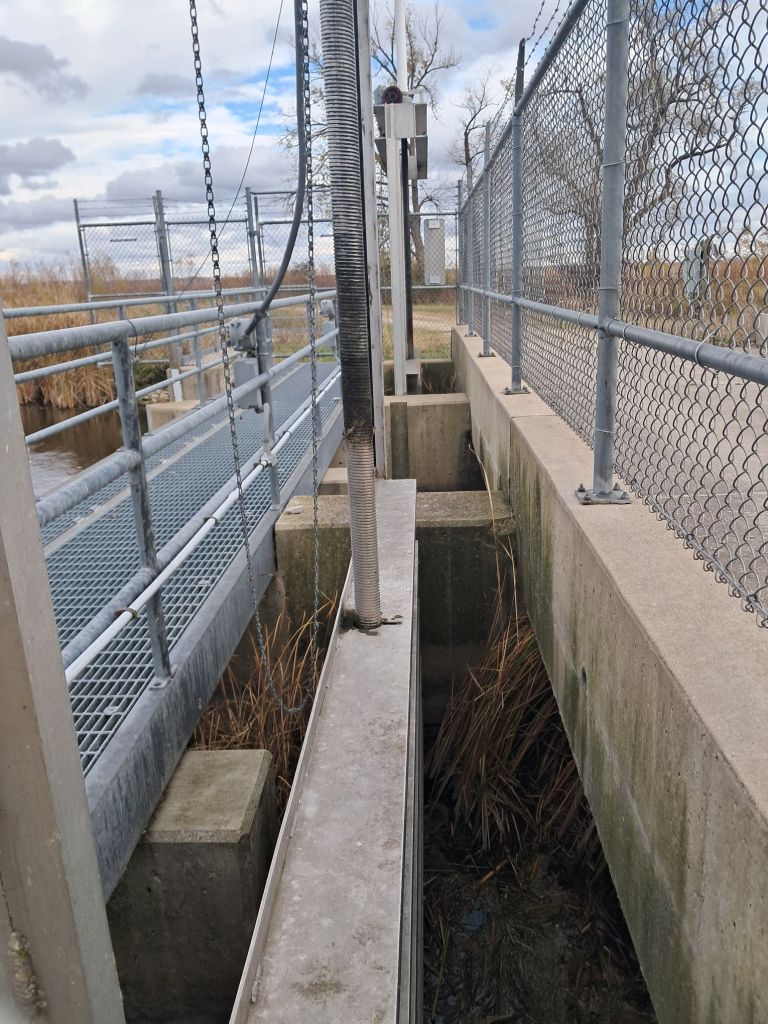
Those voices mark the edge of a world shaped as much by intention as by instinct. This wetland lives by the rhythm of weather and season, and at times, by the gentle design of those who tend it. The water level here is not entirely left to nature. State and federal agencies jointly oversee its management, adjusting the flow through a network of old dikes and channels that date back more than a century.
Those structures, once built to drain and reclaim the land for farmland, are now used to preserve it. By opening or closing sluice gates and culverts, managers can mimic the natural rhythm of flooding and retreat. Those small adjustments shape everything from fish spawning to the growth of cattails along the shallows.
The result is a dynamic landscape, alive with movement and sound. In spring, meltwater floods the pools, drawing thousands of migrating waterfowl. Terns, teal, and cranes return to the shallow stretches that glimmer in the sunlight.
By midsummer, the cattails thicken into dense green walls, sheltering red-winged blackbirds, marsh wrens, and bitterns. Autumn brings a shift to rust and ochre. The drying stalks rattle in the wind and the air smells faintly of peat and decay.
When winter comes, ice seals the pools and the marsh rests under a crust of snow, waiting to breathe again when the thaw returns.
When Marshland Was “Wasted Land”
More than a hundred years ago, settlers and local developers viewed these wetlands through a different lens—as wasted land that could be reclaimed. During the early 1900s, drainage projects swept across Wisconsin, promising to turn marshland into productive farmland. They labored through the muck with horse-drawn dredges. Gravel and timbers followed, forming thin roads and channels raised above the water. Their intent was to tame the water—to make way for crops, pasture, and easier travel. But the marsh resisted. Water seeped back through the cracks in their work, reclaiming what it could. Over time, as floods persisted and wildlife declined, attitudes shifted. People began to see that the marsh’s value lay not in what it could yield, but in what it preserved—water, soil, and life.
The Quiet Return of Balance
Today, those old dike roads form the spine of the refuge. They still divide the cattail stands. They also serve as passageways for biologists, birdwatchers, and anyone curious enough to walk into the heart of the wetlands. Driving slowly along them, you can see decades of restoration at work. This is where human effort meets natural rhythm, each shaping the other in quiet negotiation. Each culvert, each measured release of water, is part of a broader effort to keep the ecosystem healthy amid pressures beyond its borders.
Walking the Edge of Intention and Instinct
When I walk those trails, the marsh feels both engineered and wild. The red-winged blackbirds still call from the reeds as they have for generations. Their songs rise over the damp, earthy scent of mud and decaying stems. The cranes drift across the horizon, their calls echoing over the water that now moves by both gravity and intent. It’s a place shaped by design but ruled by natural law—a reminder that stewardship is participation, not control. Living beside this marsh means keeping pace with its rhythm, in a landscape that remembers and endures.
Your Turn
Have you ever visited a place that felt both wild and human-shaped? I’d love to hear about your experiences in the comments.
Keep the Story Going
If places like this move you, please click the like button. Share your own story of restoration. Subscribe for more reflections on the ways nature and people shape each other. Your support helps this space grow and reach others with similar interests.
Name the most expensive personal item you’ve ever purchased (not your home or car).
I’m racking my brain for what I could have bought. I’m incredibly frugal, I wouldn’t have bought anything on impulse, or because others had something. Before kids, I liked to spend my money on travel, but I’ve even found a way to save on that.
If I had to guess, the most expensive thing I’ve ever purchased would be my stand mixer. I make a lot of food at home, and the stand mixer helps immensely in making that happen. Every time I use it, I feel a bit of joy.
Six years. A lifetime and a blink all at once. It’s hard to imagine my tall, curious six‑year‑old as the little baby who once fit perfectly in my arms. Yet some days, it feels like only yesterday. As his birthday approaches, I find myself reflecting—not just on how much he’s grown, but on how much I’ve changed too.
Before motherhood, I was an adventurer. I loved travel, new experiences, and the freedom of not knowing what came next. My job and life took me across the country, and I chased opportunity with excitement. But as thirty approached, another kind of calling began to whisper. Parenthood. I knew that if I waited too long, it might be harder to step into that new identity. With my husband’s encouragement, we leapt into the unknown together.
The Lessons of Change
Pregnancy came easily. A touch of morning sickness, a few sleepless nights, but otherwise, it was smooth. I exercised right up until my water broke. I don’t share that to boast—only to show how everything shifted the moment he arrived. Nothing prepared me for the intensity of that change.
When labor began, I shook uncontrollably—terrified of the pain, the sleepless nights ahead, the loss of freedom I’d always cherished. That fear slowed everything down. Twenty‑one long hours passed before he was born. Later, I learned that anxiety floods the body with adrenaline, making labor harder. But in hindsight, that physical slowing mirrored something deeper: my fear of what it meant to become someone’s mother.
I was afraid of failing him, of not knowing enough, of being unequal to the task. That fear didn’t just tighten my muscles—it tightened my sense of self. It made every decision feel heavier, every moment charged with doubt. I thought “harder” meant only the literal—long labor, sleepless nights, feeding struggles—but parenting revealed its metaphorical weight too. Fear made everything take longer: the acceptance, the confidence, even the joy.
In time, I learned that fear wasn’t an enemy. It was a mirror. It showed me what mattered most, where I still needed to grow, and what I was willing to face for love. The same fear that once froze me taught me grace, patience, and surrender.
Finding Strength
Returning to work after parental leave was another reckoning. I cried every day that first week, missing him in a way that words can’t fully capture. The ache didn’t disappear—it only softened with time.
And then, just as I was finding my footing, the world changed again. Six weeks after returning to work, COVID arrived. Suddenly, I was balancing deadlines with diaper changes, spreadsheets with nap schedules. The days felt endless, looping between exhaustion and small, quiet triumphs. Yet amid the chaos, we found a rhythm—working during naps, finishing tasks after my husband got home, creating pockets of peace wherever we could.
Through it all, I discovered something unexpected: strength in letting go. Parenting isn’t meant to be done alone. It takes a village—not just helping hands, but willing hearts. When family, friends, and neighbors dropped off meals, shared advice, or simply listened, I experienced the power of community. That kind of support transforms everything. But living far from family meant we only had so much of it, and that ache for connection stayed with us.
Building Community
Perhaps that season of isolation made our next decision clear—it was time to move closer to family. We wanted the support we’d missed, not only for ourselves but for our children. It wasn’t an easy decision, and it took a couple of years, but it was the right one. By the time his little sister arrived, we were settled, and our son was starting preschool. Watching him become a big brother—gentle, silly, protective—has been one of the greatest joys of my life.
What I didn’t anticipate was how deeply our sense of belonging would bloom. For the first time, people weren’t just offering help—they were eager to be part of our world. Family members plan afternoons filled with backyard discoveries, storytelling, and unhurried laughter. Cousins race through the house, inventing games, sharing snacks, and building the kind of bonds that belong entirely to childhood. Our son now has the freedom to spend time with people who love him independently of us. He’s learned that family extends far beyond the walls of home.
For my husband and me, that has been a blessing beyond measure. We now have people we can count on—family who arrives without being asked, friends who show up simply to share time, a network that steadies us. Parenting no longer feels like a fragile balancing act. It feels shared, supported, deeply rooted. There is peace in knowing our children are surrounded by people who delight in them and find joy in being part of their story.
A New Kind of Adventure
Adventure still has a place in my life, but it looks different now. It’s not plane tickets and new cities—it’s beach trips, museum visits, and long walks through the park. It’s watching my children encounter the world: splashing in waves, chasing balls, collecting shells. The wonder on their faces brings more joy than I ever could have anticipated.
My adventures have changed, but I’ve learned this, too, is a season. The world will still be waiting, and when the time comes, new journeys will find their way to me. For now, I’m grateful to be here—growing, learning, loving, and finding beauty in this quieter kind of voyage.
My son shares my love of history and stories. He’s a curious little traveler at heart, always ready to laugh and explore. As he steps into middle childhood, I can’t wait to see where his curiosity leads him next. And maybe, if I’m lucky, he’ll still want me along for part of the ride.
Perhaps that’s what motherhood truly is—learning that the greatest adventures begin not in faraway places, but in the heartbeat of home.
Closing Note
Writing this reminded me that every stage of life carries its own kind of adventure. The early years of motherhood can feel all‑consuming, but they’re also fleeting and filled with meaning. This season—messy, joyful, exhausting, extraordinary—is one I can’t hold onto forever, and one I’ll always treasure. To any parent reading this: wherever you are in your story, remember that adventure doesn’t disappear—it simply changes shape.
Your Turn
What season of life are you in right now, and how has your idea of adventure changed along the way? I’d love to hear your thoughts and stories in the comments.
Keep the Story Going
If this story resonated with you, please take a moment to like it. Share this story as well. Subscribe for more reflections on parenthood, change, and the beauty of everyday life. Your support helps this space grow and reach others walking a similar path.





 Practical Homesteading