Category: Celebrations

  • Life by Stratigraphy

    The first sound I remember from that trip wasn’t birdsong or the crackle of firewood—it was my professor’s baritone voice drifting through a soft Michigan mist. Waking to that unlikely serenade, I understood for the first time that geology wasn’t only about rocks. It was about connection.

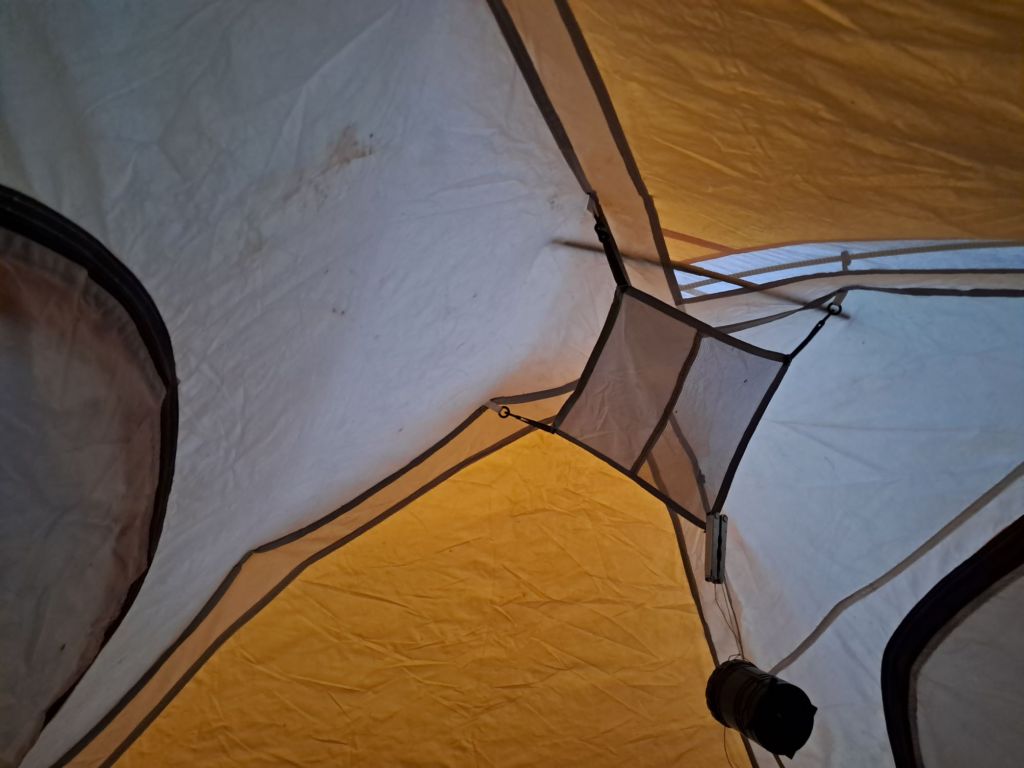
    I was a sophomore then, half-frozen in an April campsite among classmates who still felt like strangers. We shivered through fog, stumbled through tent poles, and passed trail mix in squeaky vans that smelled of sunscreen and coffee. By the time we gathered around cast-iron pots of jambalaya that evening, laughter had cracked the surface. Those strangers were already turning into companions.

    That weekend held a dozen firsts—my first field notes, my first tent pitched incorrectly, my first realization that landscapes told stories. Stratigraphy became a language: layers pressed with memory, stone turned to archive. We spent days trudging through mud, tracing formations in notebooks, learning to see the earth as something alive. Nights filled with smoke and banjo chords, the kind of tiredness that makes everything simple, everything good.
    Fifteen years later, the same circle still gathers—different campsite, different season, same warmth. We no longer ride in university vans. Now we drive in caravans of minivans and hybrids, dogs panting in the back seats, children singing off-key. Some arrive with spouses, children, and dogs, others with partners who share different rhythms of life. Each presence matters.  The ones without kids often become the fresh energy in the group—playing with children, keeping traditions, reminding us that life is not only about caretaking but also about curiosity, independence, and joy on one’s own terms.

    The jambalaya has been replaced by pudgie pies browned over coals, each stuffed with cheese, vegetables, and pepperoni. Mornings rise with a tangle of sounds—an infant crying, kids chasing dogs, coffee sputtering in a percolator. The hikes are shorter, the pace slower, but the laughter feels unchanged. We talk about work, gardening, art, and aging parents. Between stories of milestones and mishaps, the old tales surface too—professors coaxing us to read the earth, tents blown loose in South Dakota, the mud and sand that never washed out of our journals.

    Geology taught me that layers never vanish; they shift and hold. Those early days formed the base layer of my life: dusty trails, notes stained with wonder, campfires burning into friendship. Above them, new layers rise—my child tugging tent cords, friends trading stories across the fire, dogs circling the light.

    Sometimes I still hear my professor’s voice through the morning hush, calling across time. It echoes now in the laughter of friends, the shouts of children, the quiet gratitude of belonging. Like the rocks I once studied, I carry every layer within me. Together, they form not just a good life—but a whole one.

    What places or experiences have left layers in your life—ones you still carry years later? I’d love to hear your story in the comments.

    If reflections like this speak to you, subscribe below to join a circle of readers who believe in the quiet beauty of memory, connection, and time—one layer at a time.

    #Storytelling #Nostalgia #GeologyOfLife #FriendshipThroughTime #OutdoorMemories #Reflection #NatureWriting #LifeLayers #CampfireStories #WritingCommunity

  • Guns, Smoke, and Summer Steel

    Guns, Smoke, and Summer Steel

    If you’ve spent any time in farm country, you know that summer is a season steeped in tradition: sweet corn roasting on the grill, fireworks bursting above open fields, and parades weaving through small-town streets. Another tradition that perfectly captures the spirit of summer for me is the roar of engines and the gritty spectacle of a tractor pull.

    This fascination goes back generations. Our grandparents told stories of the early days when tractors were just transforming American agriculture:  mechanical workhorses that symbolized grit, self-reliance, and progress. What began as casual farmyard boasts over who had the stronger machine has since evolved into something far more ceremonial: a celebration of horsepower, heritage, and the unbreakable threads that tie country communities together.

    That’s why, on a sun-drenched Sunday afternoon, I find myself heading to the local gun club, an unexpected but oddly fitting venue, to catch this year’s edition of the Farmersville pull, colorfully named the Guns, Smoke, and Beer Tractor and Truck Pull.

    I find a spot along the chain-link fence, close enough to feel the rumble. Behind the scenes, tractors line up like gladiators awaiting their turn:  some lovingly restored antiques with curved fenders and hand-lettered paint jobs, others futuristic behemoths fitted with exposed engine blocks, massive rear tires, and vertical stacks that shimmer like weapons under the noonday sun. Each machine has its own name, its own backstory, its own fan club.

    The PA system crackles and the announcer wastes no time bringing the crowd to life. The first competitor is already strapping on a helmet. There’s a hush. The green flag lifts.

    Then:  ignition.

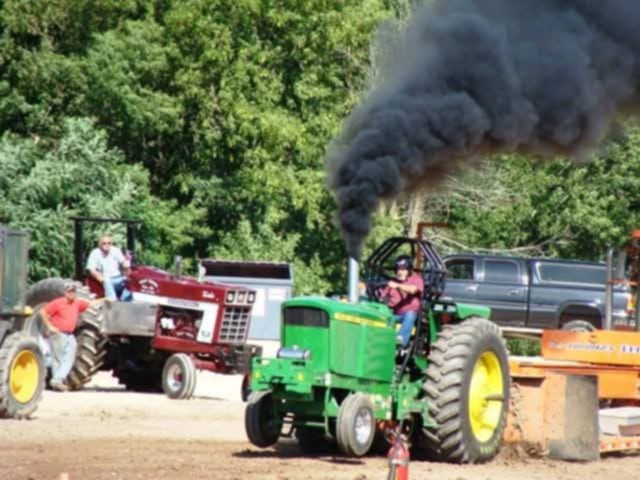
    A bellow of power splits the silence. The tractor lurches forward, chained to a sled ominously named The Eliminator. The front wheels lift clean off the clay. Dust flares as the driver leans in, holding the machine straight as the sled ratchets its weight forward, sinking deeper into the earth with every passing foot. The engine howls. My chest vibrates with it.

    That tractor is really working! Photo by Hillary S.

    Instinctively, my hands tighten on the fence. Cheers rise. For a few heartbeats, it feels less like a pastime and more like a proving ground:  man and machine battling inertia in unspoken defiance of gravity and time.

    When the tractor finally grinds to a halt and lets out a victorious hiss, the crowd roars approval. The driver remains still in the cab just long enough to savor it.

    Between runs, the rhythm slows but never stops. A blade-toting grader drags the track smooth again. Kids sprint along the fence pretending to drive their own invisible rigs, engines sputtering gleefully. Neighbors swap guesses on winners while sipping sweating cans of beer and soda. Raffle volunteers roam the crowd with plastic buckets and tickets. From the speakers, the announcer plays local DJ:  blending stats and wit with hometown shout-outs. All the while, the tension builds toward the next burst of combustion.

    And as the event rolls on, camaraderie deepens. Nostalgia mingles with anticipation. Every round adds to a growing patchwork of shared memory:  anecdotes of legendary pulls from years past and parents pointing out last year’s champion to wide-eyed children.

    By early evening, as the final competitors rumble down the track and the engines begin to cool, golden light falls across the dispersing crowd. A breeze kicks up, lifting grit into the sky like smoke from a burn pile. People linger, reluctant to let the day end. No one’s in a rush. Kids hang off the backs of UTVs. Parents gather chairs and grass-filled blankets. There’s laughter, hugs, and long goodbyes.

    Driving home, dust clinging to my shoes and the growl of engines still echoing in my ribs, I realize this wasn’t just a distraction or a show. It was a testament:  to tradition, to craftsmanship, to communities that still gather not just to watch, but to belong.

    And as the countryside stretches before me, each field burnished by the fading sun, I already know: I’ll be back next year, same track, same dust, same roar. Some rituals are worth waiting for.

    Have you ever been to a tractor pull? Comment below, and subscribe to join a community of like-minded people.

  • The Heart of Knowles: Fourth of July Traditions

    The Fourth of July has always been my favorite holiday, no contest. There’s something magical about sun-drenched parades, the smoky drift of cookouts on the breeze, and fireworks crackling against a velvet sky. I’ve always cherished tradition, and for me, nothing says “summer” quite like the annual Fireman’s Picnic in Knowles.

    The Knowles Volunteer Fire Department is legendary: a group of unpaid neighbors who protect our patch of the world from fires and emergencies. The picnic isn’t just fun; it’s a lifeline, funding the equipment and training that keep us safe.

    One summer, the fire department saved our family’s barn. My dad had stored hay that was too wet; days later, it started to smolder. The firemen arrived in force, helping us haul out the hay before disaster struck. I still remember his voice, rough with relief, as he shook each fireman’s hand. After that, our family threw ourselves even more into supporting the picnic and the department.

    Ma always baked chocolate cake with white frosting for the dessert sale. She’d hum as the kitchen filled with the scent of cocoa and sugar, while my sisters and I licked the beaters and squabbled over who’d get the coveted corner piece. My dad, after morning chores, headed to the hamburger stand, donning his money belt and frying up brats and burgers, his face flushed from both heat and pride. When she came of age, my oldest sister joined the fire department.

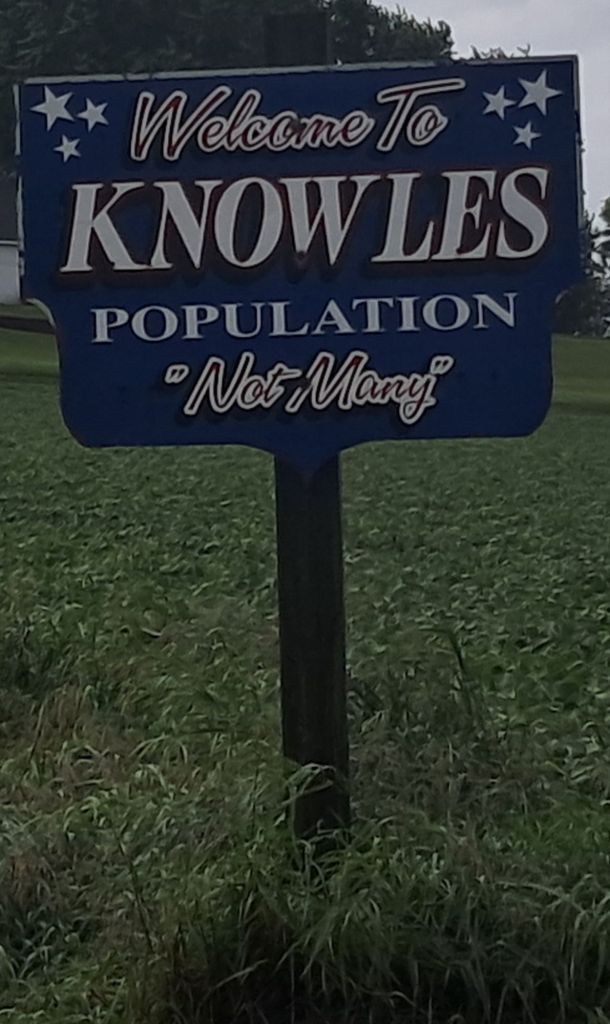
    Knowles is the kind of tiny town that jokes about its size. “Not many,” the sign reads, and they mean it. The main attractions: a farm equipment dealer, a single church, and two bars that double as gathering spots for miles around. But on the Fourth, Knowles transforms. The population swells as people from neighboring towns descend, armed with lawn chairs, faded blankets, coolers, and sticky popsicles for the kids.

    Knowles is honest about its population.

    Usually, the streets are so quiet you can hear the wind in the cornfields and birds in the trees. But on this day, laughter and music fill the air. Familiar faces blend with distant relatives, old classmates, and newcomers, all drawn together by the promise of celebration.

    The parade route is simple:  a single road, maybe half a mile, sloping downhill in two gentle steps. But for that hour, it feels like the center of the universe.

    The parade kicks off with a bang: the fire department leading in crisp uniforms, the American flag held high. The crowd falls silent; hats come off, hands press over hearts. A volley of blanks cracks through the air, firemen’s cheers bouncing down the street, shaking off the summer’s lull. My heart jumps as the fire trucks rumble past, horns blaring like thunder.

    High school bands follow, their music weaving through the warm air: “America the Beautiful,” then “Sweet Caroline.” I sing along quietly, amazed the band kids don’t melt in those wool uniforms. The color guard spins flags skyward, sequins flashing like tiny fireworks.

    Candy flies next: Tootsie Rolls, root beer barrels, and, if you’re lucky, a “Cow” candy—my favorite, caramel and chocolate (gone now, sadly). Plastic bags in hand, we dart into the street, laughing and dodging tractors and floats, our bags filling with sugary treasure.

    “Got your eye on the ‘Cow’?” my sister whispers, grinning as she snags one. I nod, already plotting my next move.

    Confetti toss during 2024 parade. Photo by Angie H.

    Donnie Feucht (may he rest in peace) pilots his father’s ancient stock truck, honking an extra time just for me. Restored antique tractors chug along, their paint gleaming in the sun as neighbors toss candy. Bigger tractors follow:  massive and modern, though quaint compared to today’s behemoths.

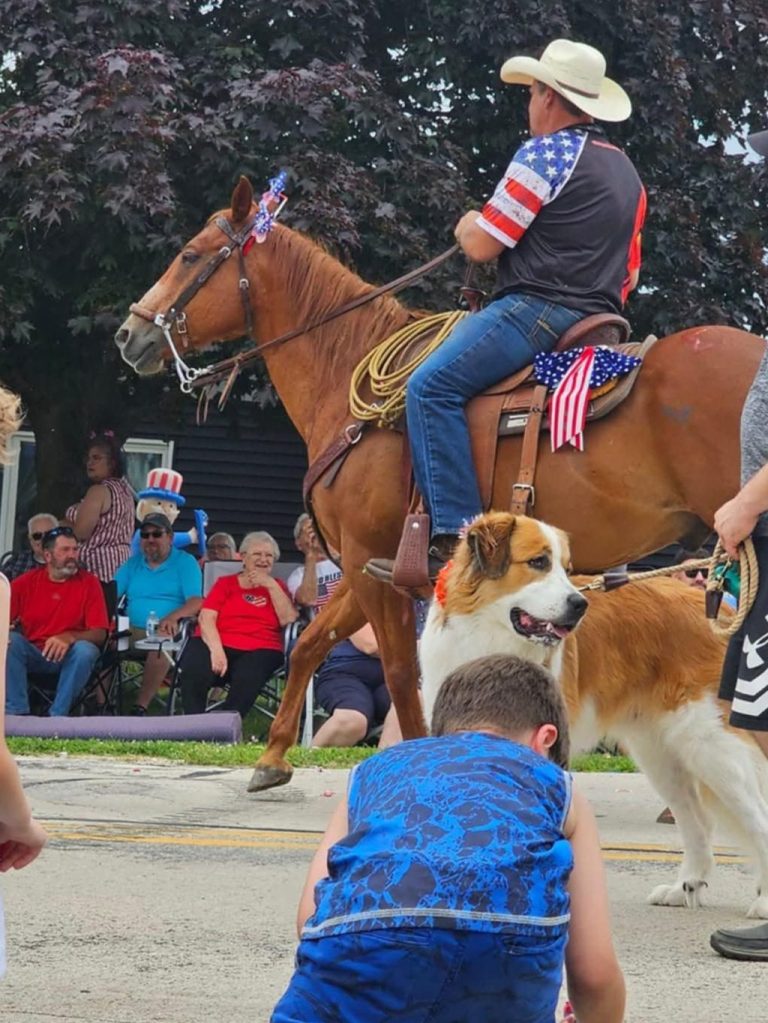
    Horse and rider, and gathering candy during 2024 parade. Photo by Kayla M.

    Horses and farm animals make an appearance. Line dancers perform on a moving hay wagon, their feet steady from many summers stacking bales. State senators stroll by, passing out frisbees and flyers, hoping for votes in the fall. A four-wheeler signals the end, with a “The End” sign tacked to the back, just in case.

    After the parade, we drag our overflowing bags and lawn chairs to the hamburger stand. I watch my dad serve lunch, pride swelling every time he hands a burger to a neighbor. The smell of grilled meat is irresistible; nothing tastes better than a brat with mustard and caramelized onions, washed down with ice-cold soda. Adventurous souls wander to the beer tent, where laughter and music spill onto the grass.

    The picnic has something for everyone: carnival rides for the kids, a toy tractor pull, the ever-popular dunk tank where you can try to soak your favorite fireman. Ring tosses and raffles offer prizes from frozen meat to cash. By the time we trudge back to the car, sunburned and sticky, our hearts are full. The sugar rush fades, but the memories linger.

    As I grew older, life got busier. The Fourth became an excuse for road trips and new adventures. But last year, my husband and I returned to Knowles, this time with our own children in tow. We joined his extended family, feeling again like we had an “in.” Their tradition started years ago with his grandparents, who sat on the same lawn and befriended the homeowner over time. Every year, we sit on that same lawn in their honor.

    Though the parade didn’t start until 11, we arrived late—10:30—and forgot the golden rule: get there by 10. Our punishment was a long trek from the highway, kids in tow, weaving through the crowd. I scanned faces for old friends, hoping for a spark of reconnection. As I set up, my brother-in-law handed me a cold beer with a grin. “It’s five o’clock somewhere,” he said, and everyone laughed, the ice broken instantly.

    Watching the parade through my children’s eyes, beer in hand, I felt the old magic return. The experiences I’d loved as a child were now theirs to discover. I knew we’d be back. As the parade wound down, my son clutched his bag of Tootsie Rolls and root beer barrels, cheeks flushed from darting after candy in the street. My daughter, face sticky with popsicles, clutched a frisbee given to her by a state representative. I glanced at my husband, lawn chair tipped back, and watched my children’s eyes widen as the fire truck’s horn echoed through the town. The “The End” four-wheeler passed by, and my son’s sticky hand found mine. For a moment, the world was just laughter, music, and the shimmer of sequined flags:  a perfect day, passed from one generation to the next.

    What is your favorite Fourth of July tradition? Share your thoughts below, and subscribe to join a group of like-minded people.