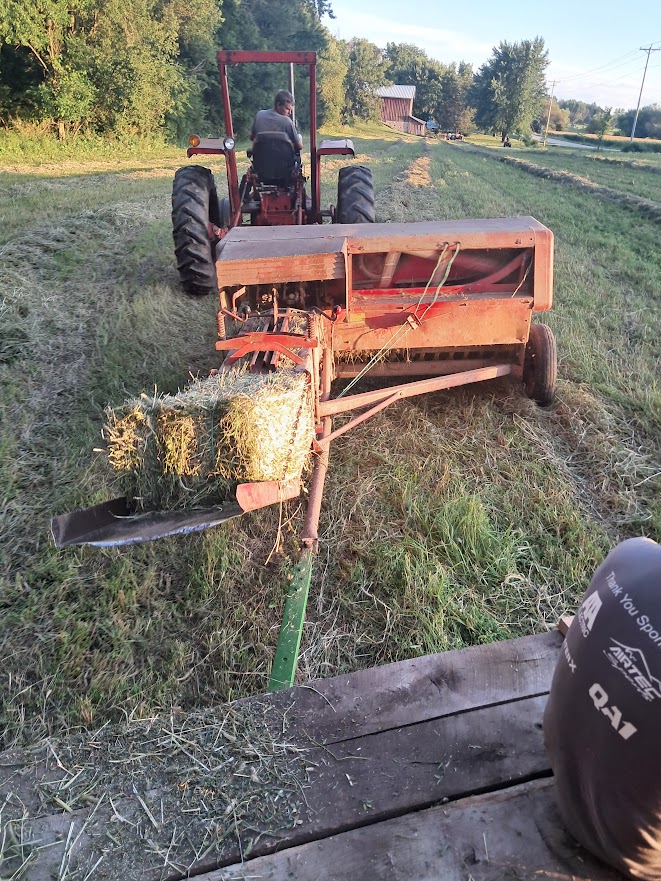
The baler rattles across the field, kicking up dust in its wake. Each stroke of the plunger on our old New Holland baler strikes a rhythm I’ve known for as long as I can remember, growing up on a hay farm. To most, it’s just an old machine grinding through another hay crop. To me, it’s the steady heartbeat of family history.
My grandfather was born in 1911 and grew up working with horses in the field. He didn’t fully retire the horses until after World War II. In 1951, he bought his own farm, and in 1977 he purchased the farm next door—the place where I would grow up, and the one I hope to someday manage.
Somewhere in the middle of all that change, he bought this New Holland baler new in 1964. Sixty-two years later, under my father’s care, it’s still knotting twine and spitting out hay bales—stubborn as ever.
A tool that old doesn’t survive by luck. It lasts because hands refuse to let it quit.
I think of frantic shear pin replacements in the field before storms, grease-slicked wrenches, evenings spent tightening chains or swapping bearings as clouds pushed in.
Each repair was more than maintenance; it was a promise that the baler would see another hay harvest. Its clatter is proof of care passed from one set of hands to the next.
What I value most isn’t only its reliability, but the story etched into every dent and weld. Farming has changed in ways my grandfather never could have imagined—mammoth tractors, bigger bales, GPS-guided rows—but this old New Holland baler remains, a bridge tying his summers to mine. Each bale it drops is more than forage; it’s a small monument to persistence, tangible proof that his investment still pays forward.
There’s a quiet pride in watching it work—steady, unassuming, framed by sun and dust. I sometimes imagine my grandfather and father standing beside me, hearing that same hum carry across the field, nodding at the machine they once trusted with a season’s livelihood.
And as long as the chute spits out hay beneath the summer sky, their legacy endures. Someday, when I hand the lines to the next set of hands, I hope they’ll listen closely. If they do, they won’t just hear an old clatter in the field. They’ll hear the rhythm of persistence, the echo of care, the sound of a haying legacy worth continuing.

I’d also love to hear from you: is there a piece of equipment, a tool, or a sound that instantly takes you back to your own family’s farm story?
If this little glimpse into our haying history resonated with you, would you share it with someone who loves old equipment or grew up on a farm?
Read Next: Buying Meat from a Farmer: A Complete Guide to Bulk Meat, Freezers, and Butchers