Category: Food

  • Bridging Time: Meeting the Courage of My Ancestors

    Bridging Time: Meeting the Courage of My Ancestors

    If you could meet a historical figure, who would it be and why?

    If given the chance to meet any historical figure, I would choose not a famous leader or thinker.

    I’d choose to meet my own ancestors in both Germany and Austria between the 1850s and 1870s. These were ordinary people facing an extraordinary choice-to leave everything familiar behind and journey into the unknown by migrating to the United States.

    I imagine sitting with them around a simple wooden table lit by flickering candlelight. We’d share a modest meal of bread, butter, and cheese. The scent of wood smoke would fill the room as we would gaze out at the garden beyond. In that humble setting, I would listen intently to their stories, carried across time with quiet strength.

    Their decision was not made lightly, fueled by hope yet shadowed by uncertainty. I see cold, harsh winters; backbreaking labor; and political unrest shaping their daily lives. They were bound by tradition and faced limited opportunity. They risked everything—their homes, their communities, their ways of life. They crossed a vast ocean in search of freedom and a new beginning.

    What fears kept them awake at night? What sacrifices did they endure silently? Hearing their firsthand accounts would reveal the resilience and courage that anchored their journey.

    This connection would deepen my gratitude for the life I live today. Their sacrifices laid the foundation for my family’s present and inspire me to face my own challenges with courage. Knowing they braved the unknown encourages me to take risks of my own. I dare to put my words to the page. I push forward even in moments of fear and uncertainty. My ancestors did not seek to change history; they aimed to build a future. Their journey teaches me that true growth often requires stepping boldly into the unknown.

    Meeting my ancestors would mean more than satisfying curiosity—it would strengthen my roots and nourish my spirit. Their legacy reminds me who I am and empowers me to write my own story. Hope, resilience, and gratitude will flow through every word.

    If you could meet an ancestor or historical figure from your own family history, who would it be? What would you most want to ask or learn from them? Share your thoughts and stories in the comments below.  I’d love to hear about the journeys and courage that inspire you!

    And if this story of courage, sacrifice, and connection resonated with you, please like and share it with others who appreciate the power of family history. Don’t forget to subscribe for more reflections that honor our roots and inspire us to face our own journeys with hope and resilience.

    Related Posts

  • The Choreography of Cattle and Grass: An Afternoon of Rotational Grazing

    The Choreography of Cattle and Grass: An Afternoon of Rotational Grazing

    The Cattle Knew Before I Did

    Out in the pasture, instinct moves faster than thought. The herd already knew what I hadn’t yet seen: today was a day of renewal.

    Out in the pasture, instinct moves faster than thought. The herd already knew what I hadn’t yet seen: today was a day of renewal.

    One afternoon, I joined my sister to help move the cattle into fresh pasture on her family’s farm. It was part of their rotational grazing routine—moving the herd between paddocks while the grazed ground rested.

    The moment our UTV rolled across the pasture, forty Red Angus beef cattle lifted their heads in unison. Mothers stood shoulder to shoulder, calves pressed between them, and the lone bull kept watch a few steps behind. They had gathered tight against the slender electric wire that marked the edge of their world, eyes wide and ears twitching—already waiting.

    Fresh pasture was coming.

    Moving the Herd to Fresh Pasture

    My sister didn’t waste time with explanations. She tipped the empty water tank, wrestled it into the adjoining paddock, and clipped on the hose. With a metallic clink, she fastened the UTV to the mineral feeder and dragged it through the open gate like a sled over grass.

    Over the hum of the engine, her practiced voice carried, bright and firm: “Here, bahsy!”

    For a heartbeat, the herd froze. Then one bold cow stepped forward. In an instant, the rest followed like a living tide.

    All except one.

    The new mother lingered. A week earlier she had calved, and her baby—small enough to slip beneath the wire—now stood stranded on the wrong side. The cow lowered her head and called, a deep-throated sound stitched with both command and worry.

    We had just started toward the calf when his spindly legs carried him scrambling back under on his own. The tension melted. She met him with a fierce gentleness, nosing his flank until he steadied beside her.

    My sister laughed, remembering a calf that roamed for three days before finally wandering home.

    “Guess they all want adventure,” she said, half amused, half exasperated.

    The dog launched next, circling fast and sharp to tuck mother and baby back into the surge. Together they flowed through the gate, spreading across the new paddock where muzzles dropped at once into the alfalfa.

    They tore off lush green mouthfuls while a few calves sprang into stiff-legged kicks, joy breaking loose through their bodies as they danced across their “salad bar.”


    Rotational Grazing and the Rhythm of Stewardship

    What looked like routine was closer to choreography—people, animals, and land moving in time with one another.

    The cattle grazed and returned nutrients to the soil through their manure. Behind them, the previous paddock began its rest. That recovery time mattered: leaves could regrow, roots could maintain their strength, and the pasture could prepare for the herd’s return. With careful management, rotational grazing can help protect ground cover and support healthier soil.

    Each careful rotation became a small act of renewal, stitched into a larger cycle of grass, growth, and gratitude.

    In winter, the family fed them wrapped bales of fermented forage, sweet and sour until the animals nose into it gladly. Another verse in the same song.

    But that afternoon, under sun and sky, what struck me most was satisfaction made visible: forty animals, content and humming with life, heads bowed as if in prayer.

    The calf pressed against his mother then, reaching to nurse. And as I watched, it dawned on me—this wasn’t just work or habit.

    It was stewardship, connection, and gratitude rooted in motion.

    Read more: Buying Meat from a Farmer: A Complete Guide to Bulk Meat, Freezers, and Butchers

  • Biggest Garden Yet: Lessons, Laughs, and Pig-Approved Produce

    Biggest Garden Yet: Lessons, Laughs, and Pig-Approved Produce

    We grew onions the size of softballs, harvested mushrooms from straw, and accidentally bred watermelons that tasted like cucumbers. It wasn’t perfect—but it was unforgettable.


    There’s something grounding about tucking a garden in for winter. As we wrap up the 2025 season, I can’t help but look back on all the experiments. There were victories and “well, that didn’t work” moments from our biggest garden yet. From one-pound onions to hybrid mishaps, it’s been a year full of growth in more ways than one.

    Strong Starts and Small Wins

    This year, we tried something new—consistent weeding. Just fifteen minutes each evening turned the chaos of past summers into tidy, thriving rows. It wasn’t perfect, but it felt like real progress. Small, steady habits made a big difference.

    The Stars of the Season

    Our onions stole the show. Started from seed, they matured into hefty red and yellow bulbs, some weighing over a pound. They’ll serve us well through the winter. It’s hard not to feel proud knowing how far they came from those tiny seeds.

    Onion sprouts

    We also are running a few fun experiments. Carrots will overwinter right in the garden under a thick layer of straw. The celery turned out beautifully—tall, green, and crisp—and I’m exploring ways to preserve it for soups and sauces. We even grew oyster mushrooms on straw, then added the spent substrate to enrich our Three Sisters garden beds.

    Natural Harmony: The Three Sisters Garden

    The corn, beans, and squash worked together like old friends. The corn stood tall. The beans climbed gracefully up the stalks. The squash spread wide, shading the soil and keeping weeds away. Watching that ancient partnership in motion felt like seeing teamwork at its best.

    Tomato Chaos and Watermelon Surprises

    Of course, no season is without its blunders. Our tomato patch turned into a jungle. Skipping the trellis was a rookie mistake, and by midsummer, the plants were an impenetrable mass of green. The cherry tomatoes only added to the chaos.

    Tomato jungle

    And then there were the watermelons—except they weren’t just watermelons. Somehow, they crossed with cucumbers, resulting in fruits that looked beautiful but tasted dismal. Definitely not something we’ll repeat, but it gave us a good laugh and another lesson in garden genetics.

    Beauty, Abundance, and a Helping Hoof

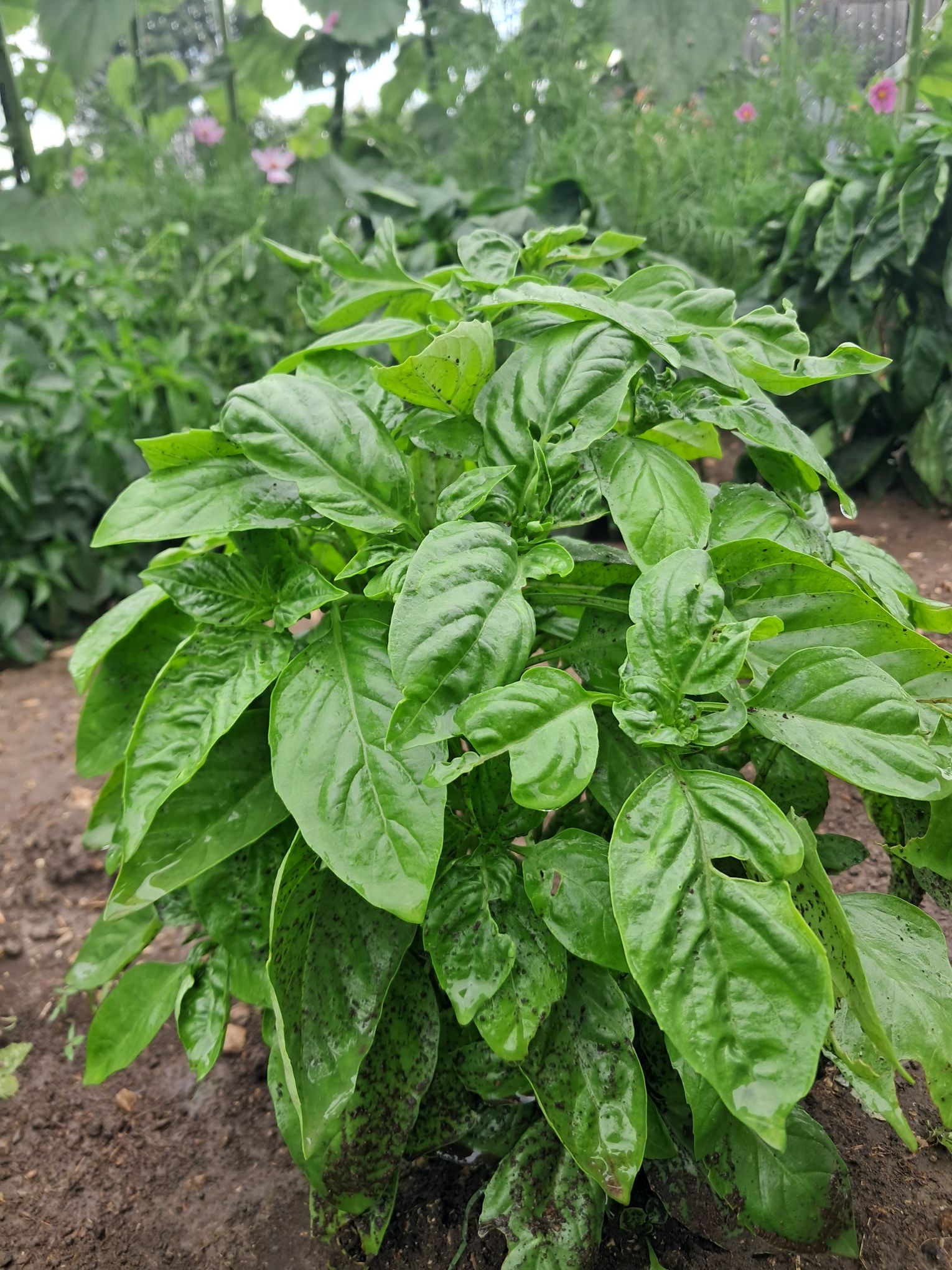
    The basil overflowed this year, so we got creative—pesto, basil salt, and enough dried leaves to last till next summer. It was fun sharing armfuls with friends and neighbors.

    Cosmos, marigolds, and sunflowers framed the whole garden, drawing pollinators and adding a cheerful backdrop to every harvest. And when our produce exceeded what we could use, our pigs were more than happy to indulge. Nothing went to waste; every harvest found its purpose.

    Lessons That Stick

    Every season teaches something new. This one reinforced patience, balance, humor, and gratitude. From those oversized onions to the watermelon-cucumber mystery, the garden reminded us that even the oddest outcomes have value.

    As we close the gate on this season, I’m thankful for muddy hands. I appreciate the full baskets and the quiet wisdom that comes from working close to the soil.


    Planning a garden that works for your real life?

    Download the free Grow What You’ll Use planner to map out your crops, expected harvests, and how you hope to use them.


    Your Turn

    What garden surprises or “oops” moments stood out for you this year? Did something unexpected turn into a favorite memory? Share your stories in the comments below!

    Keep the Story Going
    If you enjoyed this peek into our growing season, give this post a like. Share it with your fellow gardeners. Subscribe for more garden updates, experiments, and lessons learned along the way.

    #gardening #garden #gardeninspiration #plants #nature #growyourown #homegrown #vegetablegardening #gardenlife #flowers #plantlover #springgardening

  • The Attic That Remembered the Harvest

    A quiet corner of the house becomes a window into the rhythm of old farm life


    The Secret History in the Rafters

    There are places in a home that carry silence differently. Our attic is one of them. The floorboards creak with memory, and dust glows like soft smoke in the afternoon sun. At first glance, it’s just old timber and rusted hardware—until you notice the nails. Thousands of them, hammered deep into the beams.

    Three thousand, give or take. They jut out like punctuation marks in a story written by hands who walked within these walls but I’ll never meet. Each nail represents a note of effort, a record of someone’s steady persistence. I remember asking my husband about them the first time I followed him upstairs. He smiled and said simply, “Corn drying nails.”

    Rediscovering an Old Tradition

    I had no idea what he meant. Then autumn arrived, and our blue dent corn ripened in our garden. We carried the harvest up the narrow attic stairs, a banana box full of bright, heavy ears. Instead of looping the husks and hanging them as I had envisioned, my husband pressed the cobs straight onto the nails.

    It was slow, almost ceremonial work. The corn slid onto the metal with a satisfying scrape. One by one, the wall filled with color—deep blue, sun-gold, and flickers of red silk. In that dim, quiet light, the attic became a mosaic of patience and practicality.

    For generations before hybridization transformed agriculture, this was how families saved their seed stock. The previous year’s corn dried high above ground, away from moisture and rodents, until it was ready to be shelled in spring and replanted. Every cob represented not just a meal, but a promise for next year’s planting—a steady thread of survival and renewal.

    The Weight of Time and Work

    Sometimes, when I’m up there alone, I imagine those who lived here before me. Maybe a farmer with calloused hands, wiping sweat from his temple as he climbed the attic stairs. Maybe a child trailing behind, helping to hold the basket. The air would have smelled like a granary, of earth, timber, and ripened grain—a hand-me-down scent that tied one harvest to the next.

    Now the nails stand empty, gleaming faintly in the warm shadows. They hold no corn, but they still anchor something larger: a memory of endurance, a rhythm of life that didn’t depend on abundance but on balance, care, and steady effort.

    Every time the wind hums through the eaves, I think of those nailed-up seasons—how work once lingered in simple materials, how love was measured in continuity, not convenience.

    What Stories Live in Your Home?

    Look around your own space. Maybe there’s a scuffed tabletop, a patch of paint that doesn’t quite match, or a worn stair tread that speaks of every footstep before yours. What places in your home hold quiet stories of labor and love?

    Keep the Story Going

    If this glimpse into an old farming tradition resonated with you, please show your support: Like, share, and subscribe for more reflections on rural living, heritage, and the small acts of abundance that fill ordinary days. Let’s keep these stories alive—because sometimes, the past is only a floorboard away.

    #FarmLife #HomesteadHeritage #RuralStories #TraditionAndCraft #CornHarvest #SustainableLiving #CountryWisdom #SlowLiving #StorytellingSunday #CountryRoots

  • How to Make Homemade Venison Jerky: Smoked vs Dehydrated

    Looking for a way to turn fresh venison into something truly delicious and shelf-stable? You’re in the right place! In this post, we’re walking through how we took a deer we recently processed and transformed it into mouthwatering homemade venison jerky—a high-protein, low-fat snack that’s perfect for hunters, hikers, and anyone who loves wholesome, from-scratch food.
    If you’ve ever wondered what goes into making jerky from scratch or whether smoking or dehydrating tastes better, read on—because we tested both methods side by side and have the results for you!

    Processing the Venison
    After harvesting the deer, my husband handled the messy part—removing the hide and quartering the meat. While I didn’t snap photos of this step, it’s essential for breaking the animal down into workable portions. Once the meat was ready, we began deboning—a labor-intensive process!

    But here’s the payoff: processing your own game ensures quality and freshness with the satisfaction of providing your own food. Plus, venison is leaner and lower in fat than beef, while being packed with protein, iron, and essential nutrients. It’s an excellent, heart-healthy meat to keep in rotation alongside veggies, fruits, and other proteins.

    Grinding and Seasoning the Meat
    Once the bones were removed, we ground the tougher cuts and trimmings using our trusty meat grinder. (Ours has been a solid investment—it’s strong, doesn’t clog easily, and is simple to clean. If you’d like a product recommendation, drop a comment below!)

    For seasoning, we used a Fleet Farm Original Flavor jerky seasoning mix, which offers a balanced blend of savory and slight sweetness—perfect for venison’s natural richness. We mixed the seasoning thoroughly, ensuring every bite would be flavorful, then refrigerated the seasoned meat overnight to let all those seasonings work their magic.

    Shaping and Drying the Jerky
    The next day, we got creative with our setup. Instead of a dedicated jerky gun, we improvised with our meat grinder using a sausage tube narrowed down with a vice grip. Sometimes, homesteading means working with what you have, and this hack worked beautifully!

    After shaping the jerky strips, we placed them on racks and divided our batch in two for a taste test: smoked vs dehydrated.

    • Smoker: Applewood chips, 160°F, for 6 hours
    • Dehydrator: 160°F, for 12 hours

    The Verdict: Smoked vs. Dehydrated Venison Jerky
    Both batches turned out delicious, but slightly on the dry side—a note for next time!

    The applewood smoked jerky, however, stole the show. The smoky aroma, subtle sweetness, and depth of flavor make it hard to beat. If you’re on the fence about getting out the smoker, trust me—it’s worth it.

    Smoked or dehydrated, homemade venison jerky tastes incredible, packs well for adventures, and gives you that satisfying “I made this!” pride every time you open a bag.

    Final Thoughts and Tips
    Making homemade venison jerky takes time, but it’s incredibly rewarding. You know exactly what’s going into your food, it’s healthier than store-bought, and it captures the true flavor of the hunt.


    If you’re new to jerky-making, I recommend experimenting with both smoking and dehydrating to see which method suits your taste best. Adjust drying time slightly to achieve your ideal texture.

    Join the Conversation!
    Have you made venison jerky before? What seasoning blend or wood smoke do you swear by? Comment below—I’d love to hear your tips! And if you enjoyed this post:
    👉 Like, share, and subscribe for more homesteading, cooking, and DIY food adventures. Your support helps us keep creating helpful content for folks like you!

    Follow us on social for daily kitchen and homestead inspo.

    #VenisonJerky #HomemadeJerky #WildGameCooking #HomesteadingLife #DIYFood #JerkyRecipes #SmokedJerky #DehydratorRecipes #FoodPreservation #FromFieldToTable

  • Learning from the Three Sisters

    Ancient Wisdom, Modern Lessons

    The “Three Sisters” — corn, beans, and squash — show what true collaboration looks like. Rooted in ancient Indigenous wisdom, this companion-planting method isn’t just sustainable; it’s a living model of balance.

    Corn stands tall and strong, offering the beans a natural trellis. The beans return the favor, fixing nitrogen that enriches the soil. Meanwhile, squash sprawls across the ground, shading the earth to keep in moisture and crowd out weeds. Together, they form a self-sustaining ecosystem — one that thrives through cooperation and reciprocity.

    A Lesson Replanted

    I first learned about the Three Sisters in grade school, probably around Thanksgiving, during a brief mention of Indigenous agricultural knowledge. I didn’t think much of it then. But last year, while searching for more sustainable gardening methods, the lesson resurfaced. Curious and skeptical, I decided to try it myself.

    Armed with blue dent corn seeds for homemade tortillas, pinto beans for the adventure, and leftover spaghetti squash seeds (because I couldn’t justify buying more), I planted in late May. The corn went in first, followed by the beans once the stalks reached ten inches, and then the squash two weeks after that.

    A Living Experiment

    To my delight, the beans twined effortlessly up the corn, just as promised. The old squash seed lagged behind but eventually pushed through, turning what looked like a “Two Sisters” garden into a full trio. For good measure, I added spent oyster mushroom substrate from another homestead experiment. Volunteer cherry tomatoes, which I didn’t have the heart to thin, soon joined the party — a wild, happy sprawl of coexistence.

    Harvest and Harmony

    By October, our small 25×10-foot plot had given us a treasure: a banana box of blue dent corn drying in the attic, a pound of pinto beans, and two proud spaghetti squashes still ripening. Even the leftover oyster mushroom spawn revived after each rain, and cherry tomatoes kept offering up baskets of surprises — nature’s generous encore.

    Seeing this ancient partnership unfold transformed a childhood lesson into something alive and immediate. The “Three Sisters” reminded me that balance isn’t about control — it’s about trust, patience, and reciprocity.

    Looking Ahead

    Next spring, we’ll start earlier and use fresh squash seeds. But even now, the garden has offered more than food — it’s fed our curiosity, connection, and hope. My son’s dreaming of blue tortilla chips, and I’m dreaming of next year’s lessons, both in the soil and beyond it.

    Your Turn

    Have you ever grown something that changed how you see the world? Share your story in the comments — and if this post inspired you, give it a like, share it with a fellow grower, and subscribe for more gardening stories!

    #ThreeSistersGarden #RegenerativeGardening #IndigenousWisdom #SustainableLiving #GrowYourOwnFood #HomeGarden #NatureInspired #GreenLiving #SoilHealth #HomesteadLife #EcoFriendly

  • Life by Stratigraphy

    The first sound I remember from that trip wasn’t birdsong or the crackle of firewood—it was my professor’s baritone voice drifting through a soft Michigan mist. Waking to that unlikely serenade, I understood for the first time that geology wasn’t only about rocks. It was about connection.

    I was a sophomore then, half-frozen in an April campsite among classmates who still felt like strangers. We shivered through fog, stumbled through tent poles, and passed trail mix in squeaky vans that smelled of sunscreen and coffee. By the time we gathered around cast-iron pots of jambalaya that evening, laughter had cracked the surface. Those strangers were already turning into companions.

    That weekend held a dozen firsts—my first field notes, my first tent pitched incorrectly, my first realization that landscapes told stories. Stratigraphy became a language: layers pressed with memory, stone turned to archive. We spent days trudging through mud, tracing formations in notebooks, learning to see the earth as something alive. Nights filled with smoke and banjo chords, the kind of tiredness that makes everything simple, everything good.

    Fifteen years later, the same circle still gathers—different campsite, different season, same warmth. We no longer ride in university vans. Now we drive in caravans of minivans and hybrids, dogs panting in the back seats, children singing off-key. Some arrive with spouses, children, and dogs, others with partners who share different rhythms of life. Each presence matters.  The ones without kids often become the fresh energy in the group—playing with children, keeping traditions, reminding us that life is not only about caretaking but also about curiosity, independence, and joy on one’s own terms.

    The jambalaya has been replaced by pudgie pies browned over coals, each stuffed with cheese, vegetables, and pepperoni. Mornings rise with a tangle of sounds—an infant crying, kids chasing dogs, coffee sputtering in a percolator. The hikes are shorter, the pace slower, but the laughter feels unchanged. We talk about work, gardening, art, and aging parents. Between stories of milestones and mishaps, the old tales surface too—professors coaxing us to read the earth, tents blown loose in South Dakota, the mud and sand that never washed out of our journals.

    Geology taught me that layers never vanish; they shift and hold. Those early days formed the base layer of my life: dusty trails, notes stained with wonder, campfires burning into friendship. Above them, new layers rise—my child tugging tent cords, friends trading stories across the fire, dogs circling the light.

    Sometimes I still hear my professor’s voice through the morning hush, calling across time. It echoes now in the laughter of friends, the shouts of children, the quiet gratitude of belonging. Like the rocks I once studied, I carry every layer within me. Together, they form not just a good life—but a whole one.

    What places or experiences have left layers in your life—ones you still carry years later? I’d love to hear your story in the comments.

    If reflections like this speak to you, subscribe below to join a circle of readers who believe in the quiet beauty of memory, connection, and time—one layer at a time.

    #Storytelling #Nostalgia #GeologyOfLife #FriendshipThroughTime #OutdoorMemories #Reflection #NatureWriting #LifeLayers #CampfireStories #WritingCommunity

  • When Egg Prices Crack, Local Farms Hold Steady

    Just months ago, the price of eggs soared past $7 a dozen—triple what most people were used to paying. A food so ordinary it’s almost invisible suddenly looked like a luxury. Prices have since eased, but the memory lingers: how did something so basic get so expensive? And why did the shock land so unevenly—upending some farms while leaving others steady?

    On our farm, a dozen eggs still sells for $4. That number has barely budged in years. While supermarket prices swung wildly, ours held firm. The contrast is more than a curiosity. It hints at how food really travels from barnyard to breakfast table.

    The spike began with avian influenza. In 2022 and 2023, the virus swept through major poultry operations, wiping out more than 43 million egg-laying hens nationwide. When a third of the national flock disappears, supply collapses and prices shoot up. Industrial farmers also faced surging costs for feed, fuel, and transport. A production system designed for tight efficiency became brittle: when disease struck, the whole country felt it at the checkout line.

    Small farms like ours face the same threats, but the impact lands differently. Three features matter most:

    • Flock diversity. We keep mixed-breed, free-range hens. Losing a handful to illness is painful, but a single disease rarely jumps across breeds with equal force. Uniform flocks in industrial barns don’t have that buffer.
    • Local sourcing. Most of our feed comes from what we can grow or source locally. Last winter, when global grain costs spiked, our stockpile of grain grown during the previous year was still there, and the cost to produce it did not change. That insulation saved us from the roller coaster.
    • Short supply chains. Our eggs travel from our house to their house, a distance of less than ten miles, not five hundred to a distribution hub. Fuel hikes and cold-storage fees barely touch us.

    That structure explains why our price holds steady. $4 a dozen looks high when the grocery store is running specials at $2. But when shelves empty or sticker shock sets in, suddenly our carton looks like the bargain. What customers are buying isn’t just eggs—they’re buying reliability.

    Of course, small farms can’t replace industrial ones. We don’t feed cities by the million, and local food generally costs more up front. Volume and convenience still matter. But the lesson of the egg crisis isn’t that one system must win. It’s that balance matters. Industrial agriculture delivers abundance when conditions are smooth. Small farms deliver stability when they’re not. Together they form a more resilient food web than either system could alone.

    And “smooth” is becoming rare. Disease, war, fuel shocks, and extreme weather tug constantly at a tightly wound system. When that system cracks, as we saw with eggs, the cost gets passed to the consumer.

    There’s another way to measure value. It’s not the absolute lowest price when times are calm—it’s the carton that’s still there, at the same price, when times are not. In food, resilience isn’t a luxury. It may be the most essential ingredient of all.

    Next time you crack an egg into the pan, think about how far it traveled to get there. If you want your breakfast to come with stability as well as protein, consider keeping part of your food dollar close to home. The steadiness might taste better than you expect.

    What is the true cost of cheap food—and what values should guide us when something as everyday as eggs suddenly becomes a luxury? Share your thoughts below, and subscribe to join a group of like-minded people.

    #FoodSystem #LocalFood #FarmFresh #FoodResilience #EggPrices #KnowYourFarmer

  • Rain and Resonance

    It rained all day, the steady drizzle blurring the view until the house itself seemed to shrink under the low sky.  Inside, cabin fever crept in, making the kitchen feel tight.

    My husband and I worked quietly together, turning weekend cherries into wine. The air was thick—crushed fruit, sugar, and the steam hissed from the pot. Our five-year-old son and toddler daughter darted through, their energy outsized for the cramped space. Warnings mingled with their laughter—don’t run near the stove, watch for hot water.

    “It’s dangerous,” I said, gripping the kettle handle; my heartbeat quickened.

    For a while, the kids took turns crushing fruit.

    “Look, Mom!  I figured out how to remove the cherry pits more quickly!” My older child said as he mashed enthusiastically, intent on the task.

    Suddenly, our toddler screeched—a wild, pterodactyl sound—snatching the masher and stabbing at the cherries.
    “Me too!” she demanded.

    “Hey!” my son yelled, trying to pull it back. Their fight was all quick hands and hot tempers, cherry seeds flung aside, sugar water hissing.

    “Enough!” My voice cracked through the kitchen as the mess and worry spilled out in a single word. Silence, except for the rain tapping on glass. My son’s face twisted in frustration; his sister clutched the masher, sticky-fingered, defiant.

    I knelt, arms open. The toddler crawled in—fight gone soft. Her brother retreated to the corner, assembling wooden toys with deliberate care, humming the Pirates theme he always chose after a storm.

    Across the room, my husband and I exchanged tired, knowing smiles.

    The toddler perched on a chair, popped cherries, painted crescents on her lips. The kitchen warmed—patience hemming in chaos, the air rich with fruit.

    After a while, my son returned, holding out a contraption of wood and rubber bands. “Look, Mom! I made an articulating loader. See? This part turns.”
    I pulled him close, inspected the jumble. His pride shone brighter than any accuracy. Rain blurred the world outside. Inside the kitchen, cherries stained little fingers, the air still warm and sweet. My son tinkered at the table, my daughter perched on a chair, chewing with slow satisfaction. We breathed together in that small space, finding each other again in the hush after the storm.

    How do you handle stressful and potentially dangerous situations? Share your experiences below, and subscribe to join a group of like-minded people.

  • Searious Business: My Case for Pan-Fried Steak

    Searious Business: My Case for Pan-Fried Steak

    I’m ready to go on record with my most controversial food opinion:

    Pan-fried steak is better than grilled steak.

    Yep, I said it. And the only way you’re changing my mind is by feeding me generous servings of expertly cooked steak. Any challengers?

    Here’s how I make mine:

    I start with a defrosted, pasture-raised steak: bought in bulk from my sister and brother-in-law (shoutout to the Gruenberger family farm!). Click here for more information about the process of buying meat directly from a farmer. The first step is drying the steak as thoroughly as possible using paper towels; a dry surface is key to that beautiful crust.

    Next comes the seasoning: a dry rub of salt, black pepper, garlic powder, and onion powder. Simple but tried-and-true.

    Now, the secret weapon: a screaming-hot cast-iron skillet. I preheat it until it’s just shy of setting off the fire alarm. Then I add a bit of butter, plus fresh herbs like thyme or rosemary if I have them on hand, and lay in the steak. If the butter starts smoking heavily, that’s your cue to slightly lower the heat (yes, your kitchen might fill with smoke… it’s part of the experience!).

    As for technique, I’ve toyed with all sorts of methods over the years, but the one I swear by comes from a tip I picked up from America’s Test Kitchen. Once the steak is in the pan, I set a timer for 2 minutes. Then I flip. And repeat, flipping every 2 minutes, for about 4 to 5 more flips. This frequent flipping builds a deeply caramelized crust while keeping the inside tender and juicy. Total game-changer.

    Once it’s cooked to your preferred doneness, don’t skip the most crucial final step: let the steak rest before slicing in. It’s worth the wait.

    So… who’s stepping up to prove me wrong? Steak-off, anyone?

    How do you enjoy your steak? Share your favorites below, and subscribe to join a group of like-minded people.

    Read more: Why Is Beef So Expensive? The Real Story Behind Your Steak — and How You Can Help Support Local Farmers