Category: Personal Growth

  • First Time Mom Nerves + Joy: Life Before Kids Trade-Offs

    First Time Mom Nerves + Joy: Life Before Kids Trade-Offs

    Daily writing prompt
    Describe a phase in life that was difficult to say goodbye to.

    The pink line said everything I couldn’t. My husband and I were expecting our first child.

    I couldn’t say I was surprised—we had been trying for a couple of months. But I was a little sad to see an era end. For the first time, I had true freedom: spontaneous road trips with friends, solo coffee dates that stretched into afternoons, disposable income that let me buy plane tickets without a second thought. We’d just bought our first homestead after driving to Alaska for our honeymoon. Life felt wide open and full of possibility.

    I wasn’t sad he was coming—I was nervous about losing that independence and learning to be a mother, but equally excited to meet him, like a blind date with the love of my life. Saying goodbye to that version of me was hard.

    Pregnancy: Holding Joy and Fear Together

    Holding that positive test, I felt both gratitude for this wanted gift and quiet grief for what was changing. No one prepares you for motherhood’s bittersweet beginning, when you’re thrilled about the baby but apprehensive about who you’ll become.

    Throughout pregnancy, my love for him grew right alongside very real nerves. I cherished feeling his first flutters—those tiny “butterflies” that made him real—and hearing the rapid whoosh-whoosh of his heartbeat at every doctor’s appointment. I talked to him constantly through my belly, telling him about the adventures we’d have someday together. Choosing his name felt perfect, like we already knew him. But I also wondered if I’d be a good mom, grieved the end of solo adventures, and felt my independence quietly slipping away as my body changed.

    Labor and Those Early, Raw Days

    Labor brought everything into sharp focus. When my water broke and my body started shaking, it wasn’t just the contractions—it was the weight of knowing there was no going back. Breastfeeding tested me too. Anxiety made it harder than it “should” have been. I worried constantly if he was getting enough, if I was already failing at the one thing my body was made to do.

    The Small Moments That Changed Everything

    Slowly, the cloud of doubt lifted—not dramatically, but through ordinary moments that felt sacred. His first sleepy smile lit something up in me, whether it was gas or not. His tiny hand gripped my finger with surprising strength. His body finally relaxed into mine when he fell asleep on my chest. That pure belly giggle when I tickled his neck cut straight through all my self-doubt.

    I watched him skip crawling altogether and go straight to walking with those wobbly, determined steps. He explored the world with toddler intensity—picking up rocks, chasing bubbles, staring at ants on the sidewalk like they held all life’s secrets. His questions grew more complex over time, moving from “What’s that?” to “How does it work?” and “Why?” That curiosity pulled me back into wonder I didn’t know I’d lost.

    The Adventures We Promised Each Other

    Those belly conversations came back to me often—they became reality, just more locally than my pre-baby dreams. Instead of cross-country drives, we’ve explored Lake Michigan beaches together, giggling as waves lap our toes. We’ve visited the zoo, marveling at animals that fascinate him more than any faraway landmark could. Now at 6, with his 2-year-old sister tagging along, we’ve spent countless hours at parks, pushing swings and hunting for the perfect climbing tree. The adventures came true—they’re just the ones that fit our family life together.

    The Trade-Off That Was Worth Every Goodbye

    Life before kids offered a particular kind of freedom. Now my money goes to toddler shoes he outgrows in three months and snacks that disappear in two minutes. Late nights with faraway friends have been replaced by early mornings and sticky hands around my neck.

    But I’ve gained something irreplaceable: a front-row seat to a whole human becoming himself. The “Mama?” calls from the next room. The love that shows up in the ordinary and the hard.

    He was deeply wanted from that very first pink line. I was nervous about motherhood, yes. But I was thrilled to meet him. The trade-off hurt, but loving him made every goodbye worth it.

    Feature Photo by Michael Anfang on Unsplash


    Moms: What was hardest to say goodbye to before kids? Travel? Independence? Late nights out? Share below!

    LIKE and SHARE if you’ve felt this bittersweet shift! 💕

    Loved this? Subscribe for more reflections on life:

    Read Next: Advice I’d Give My Teenage Self After Burn Trauma (You’re Loved)
  • Century Farm Renovation: Most Ambitious Homestead DIY (2026)

    Century Farm Renovation: Most Ambitious Homestead DIY (2026)

    Daily writing prompt
    Describe the most ambitious DIY project you’ve ever taken on.

    Is this a trick question? As a homesteader near the Horicon Marsh, I feel like my entire life is one big DIY project.

    We grow our own food, raise our kids, and build community. Very little is pre-packaged in our life. Homesteading is being in a state of constant learning: new skills, fresh challenges, figuring things out as we go. One long series of experiments riddled with dirt, sweat, and grace.

    But if I have to pick the most ambitious DIY project, it’s our century farm renovation.

    How We Found Our Fixer-Upper

    We bought this retired century farm direct from an elderly gentleman who really shouldn’t have been living alone anymore. That detail always hits me hardest—the house and outbuildings told his story before he said a word: sagging floors, peeling paint, leaning sheds, untouched corners for years. It’s heartbreaking how someone can quietly tolerate an increasingly difficult life until clutter and inconveniences feel normal.

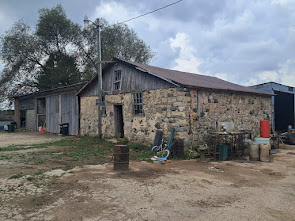
    Truth be told, I was reluctant to take on something of this magnitude. I was pregnant when we bought the property in May 2023, and we gave birth and cared for a newborn while gutting the house. My husband saw the potential first: the grand century farm history, an established apple orchard out back, that stone building one previous owner built stone-by-stone over years. I slowly fell for its charm though.

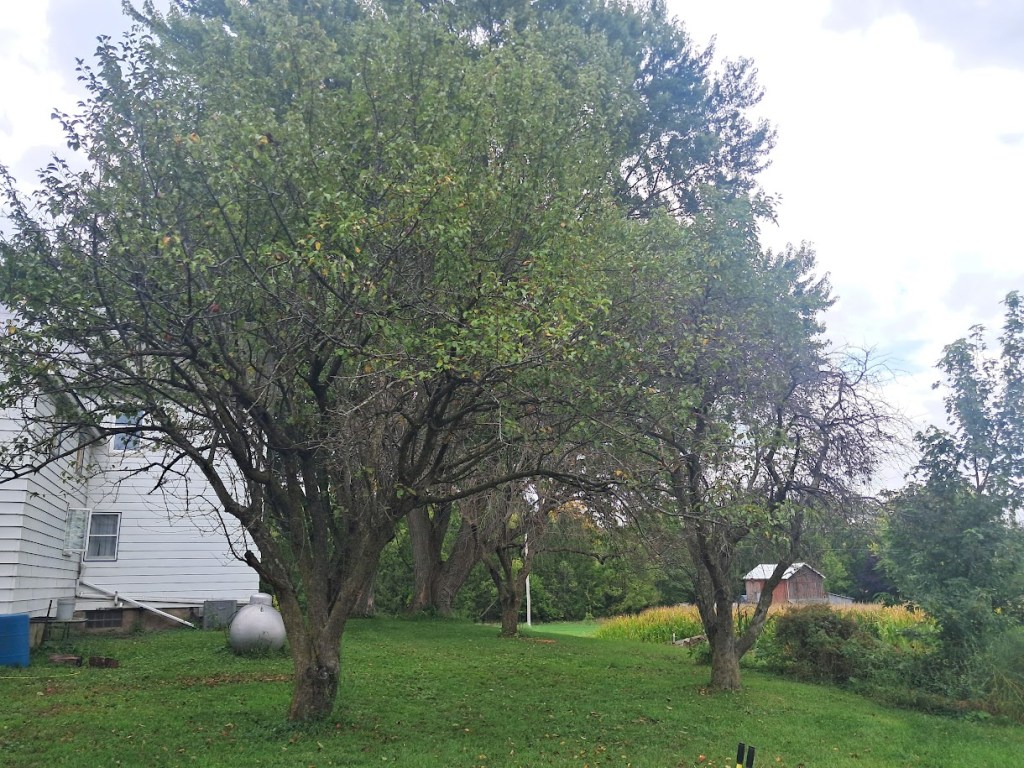
    The established apple orchard was a big draw to the place. There are more trees behind me.
    There’s so much history in this stone building.
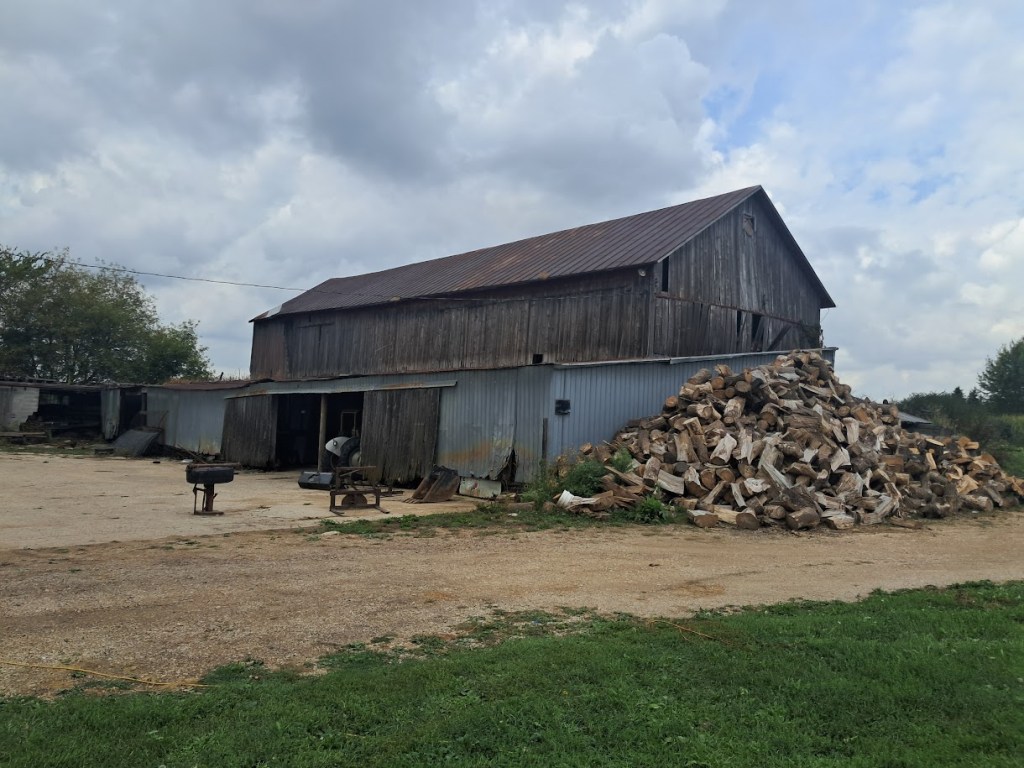
    The barn has a straight roof, but the foundation is crumbling.

    DIY Property Cleanup: The Early Days

    This homestead renovation kicked off with multiple dumpsters and serious elbow grease. And we had huge help from family who pitched in by cleaning inside and outside, gutting the upstairs, drywalling, and painting. A project this big would be impossible to tackle alone.

    Some days it was just hauling—load after load of scrap metal from the barn and yard. We’d sift trash from treasure: broken tools, mystery parts, an old milk can a previous owner painted with a beautiful farm scene. Each dump run made the place feel lighter, easier to breathe.

    We patched dilapidated outbuildings and tamed overgrown grass. Slowly, this century farm started showing its grand history.

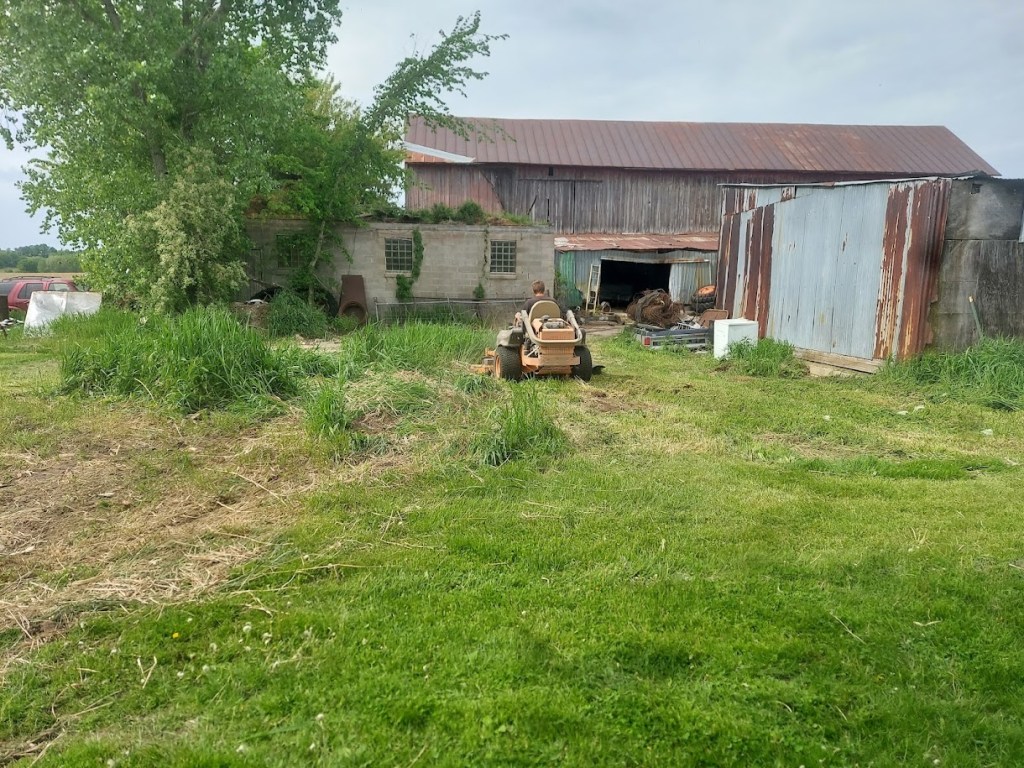
    As we cleaned up the long grass.

    Gutting the Victorian Farmhouse (While Living Here)

    Inside, we gutted the upstairs. We ripped out lath and plaster, those weird tiny rooms, and bizarre “fixes.” As we did so, we uncovered the beautiful Victorian farmhouse bones.

    All while raising little kids (including that newborn!) and working our day jobs.

    My husband handles the heavy DIY homestead projects: hauling, demo, repairs, and those endless “little jobs” that are never little. To us, it makes perfect sense. He loves fixing things, which has been perfect for reviving this tired place. I’ve managed kids, work, and keeping our half-gutted household running.

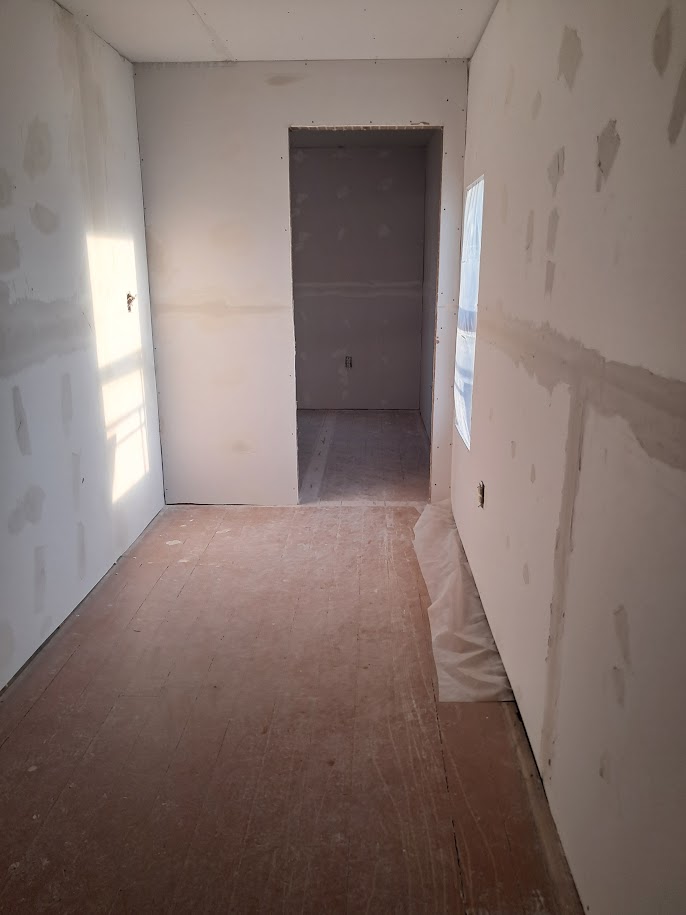
    I never did capture the actual gutting process and removing the lath and plaster. But this is after some drywalling was done on the upper floor.

    3 Years In: Where We Stand

    Three years into this century farm renovation (bought May 2023), two-thirds of the upstairs is done. Every finished room feels like a small miracle. I still pause in doorways thinking, “Remember what this looked like?”

    What’s Next: Future DIY Projects

    Still ahead:

    • Finish the upstairs for a more cohesive feel
    • Remove the downstairs drop ceiling, uncover tall Victorian ceilings
    • Decide what to do with the old barn foundation (it’s caving in on itself). Do we restore or tear down?
    • Construct an outside workshop for my husband’s impressive collection of tools and equipment

    What Living Through Renovation Teaches You

    If I step back and think of it all, it’s incredibly overwhelming. We’re years in, and still have years left. But here’s the thing about ambitious DIY projects you live inside: they grow you while you’re working on them.

    We’ve learned patience, because nothing happens as quickly as we hope. We’ve learned teamwork, because we each bring different strengths to the table. We’ve learned to spot progress in inches instead of miles: a cleared fenceline, a finished room, a barn corner that no longer feels dangerous.

    Most of all, we’ve learned that “ambitious” doesn’t always mean flashy or fast. Sometimes it looks like showing up for the same project, day after day, year after year, believing that it’s worth the time, the money, and the heart it requires.

    So yes, our Victorian farmhouse and century farm renovation is the most ambitious DIY homestead project we’ve ever undertaken.

    But it’s also the one that’s slowly shaping us into the kind of people who can see beauty in broken things and are stubborn enough to try to fix them.


    What’s YOUR most ambitious DIY? Tell me below! 🛠️

    LIKE if you’ve tackled big homestead renovation projects! SHARE with a friend who can relate! 🏡✨

    Loved this? Subscribe for more homesteading stories and tips:

    Read Next: Homestead Budgeting: Annual Lens vs Monthly Stress

  • Why I’d Ban “Should” From Everyday Life (Should Statements)

    Why I’d Ban “Should” From Everyday Life (Should Statements)

    Daily writing prompt
    If you could permanently ban a word from general usage, which one would it be? Why?

    If I could permanently ban a word from general usage, I’d choose “should.” Not for every use, because grammar would fall apart. However, the way we weaponize it in self-talk and conversations: as judgment, measuring stick, and source of quiet shame.

    The Heavy Weight of “Should” Statements

    “Should” rarely arrives alone. It brings judgment riding shotgun:

    • “I should be farther along by now.”
    • “You should really be feeding your kids __.”
    • “We should have known better.”

    In these moments, “should” statements aren’t neutral verbs; they’re verdicts. They imply one right way to live, parent, work, or heal—and we’ve missed it. Overcoming should thinking means recognizing they leave no room for context, growth, or simple humanness.

    How “Should” Poisons Self-Talk

    Most of us don’t need help being hard on ourselves. Yet should statements psychology slips into our inner dialogue, turning observations into accusations:

    “I’m tired and scrolling” becomes “I should be more productive.”
    “We had frozen pizza” becomes “I should be the perfect homesteading mom.”

    Instead of asking what we need, should thinking demands performance. It narrows life to two outcomes: success or failure. Replacing should statements reveals something tender underneath: “I wish” or “I feel insecure about…”

    3 Better Phrases to Replace “Should”

    Banning “should” from casual speech would soften our conversations. Try these replacements:

    Instead of: “I should be farther along”
    Try:I wish I were farther along” or “I expected different progress”

    Instead of: “You should do it this way”
    Try:I’ve found this helpful” or “Have you considered…”

    Instead of: “We should have known better”
    Try: “We didn’t know then what we know now”

    These alternatives to should statements open curiosity instead of guilt.

    Why Banning “Should” Frees Us

    Should statements carry cultural expectations—from family, social media, perfectionism. They turn life into a constant trial where we’re always on trial. Overcoming should thinking creates space to say:

    • “Here’s where I am.”
    • “Here’s what I wish for.”
    • “Here’s what I’m trying next.”

    Without that heavy word whispering, we could treat ourselves—and each other—with kindness we actually need. Should-free living trades judgment for honest desire, fear, and hope.

    Feature Photo by Darius Bashar on Unsplash


    What’s your most toxic “should” statement? Share below—let’s replace it together!

    Caught in should thinking? LIKE if you’re ready to ban “should” + SHARE with someone who needs self-compassion today!

    Loved this? Subscribe for more self-love tips:

    Read Next: Advice I’d Give My Teenage Self After Burn Trauma (You’re Loved)

  • Advice I’d Give My Teenage Self After Burn Trauma (You’re Loved)

    Advice I’d Give My Teenage Self After Burn Trauma (You’re Loved)

    Daily writing prompt
    What advice would you give to your teenage self?

    Content note: Brief mention of burn injuries and trauma recovery


    That is an excellent question. I’ve made many, many mistakes throughout my adulthood, and some of the most painful ones trace back to my teenage years.

    For those who are not aware, I sustained serious burn injuries on my arms and chest at age 17 that led to an 18-day hospital stay and a long recovery. I have not yet told this story online, but I plan to at some point, if only to reach those who may feel alone in their pain.

    At my lowest, I thought that I was unlovable. The accident happened due to my own shortsightedness, and I couldn’t stop blaming myself. If I wear a high-neck shirt and long sleeves, you would never know what happened to me. But the scars—both physical and emotional—run deep.

    Advice to My Teenage Self: You Are Loved

    If I could go back and talk to my teenage self, I would start by telling her the following:

    That you are loved—no matter what.

    Love isn’t something you have to earn by being perfect, pretty, or put-together. Even on days you feel broken, ashamed, or “too much,” you’re still worthy of kindness and care. The people who truly love you aren’t keeping a tally of your mistakes.

    There will be mornings when you wake up thinking about coffee first—not the accident. Laughter will come back without guilt chasing it.

    Overcoming Trauma: Pain Won’t Define You

    Your pain will not be the end of your story.

    Right now, all you can see is this moment: the hospital room, the bandages, the mirrors you avoid. You’ll discover seasons where your life isn’t defined by what happened to you at 17. Overcoming trauma doesn’t erase the scars, but it makes space for new chapters.

    Building Resilience Through Lasting Friendships

    You’ll find lasting friendships even after pain—perhaps because of the pain you endured.

    Those friendships will show you you’re not alone. Some of your dearest friends will be the ones who see your scars and don’t flinch. They won’t treat you like you’re fragile or broken. They also won’t pretend nothing happened. They’ll simply sit with you in it—and that will teach you how to do the same for others.

    Turning Pain Into Empathy and Purpose

    One day you’ll turn all this tenderness into quiet strength.

    You won’t just feel deeply—you’ll learn what to do with those feelings. You’ll walk into a room and sense who else is hurting. You’ll notice the person shrinking into the corner, or laughing too loud to hide their pain. Because you know what it feels like to want to disappear, you’ll make sure others feel seen. You’ll hone your empathy into a skill that helps people feel loved and less alone.

    Finding Meaning After Suffering

    Meaning can be found in suffering, even if it takes time to see it.

    The accident will never become “good.” You’ll always wish it never happened. But goodness will grow out of the mess: deeper compassion, a softer heart, a clearer sense of what matters. Healing from trauma often looks like this—the places where you feel most broken become the places where you can sit with others and say, “Me too. I’ve been there. You’re not beyond hope.”

    Final Words of Self-Compassion

    And finally, I’d tell you this:

    You are not the sum of your worst moments.
    You are not your scars.
    You are not the accident.

    You are loved, held, and still becoming.


    If you’re carrying scars—seen or unseen—what would you tell your teenage self? Share one line in the comments. Someone else may need to hear it today.

    If this touched something in you, please hit LIKE and share with one person who needs to hear they’re loved—no matter what.

    Loved this? Subscribe for my perspective on personal growth and homesteading:

    Read Next: Why I Read Survivor Stories about Strength and Hope

  • How Curiosity Keeps Me From Feeling Bored (Even on Long Car Rides With Kids)

    How Curiosity Keeps Me From Feeling Bored (Even on Long Car Rides With Kids)

    Daily writing prompt
    What bores you?

    I honestly can’t think of much that really bores me. Honestly, it’s not because my life is wildly exciting, but because I’ve learned to stay curious. I try to see the beauty or thought behind most things and find them interesting in some fashion.

    Everyday Curiosity and Boredom

    If I’m in a conversation that might seem dull on the surface, I pay attention to the other person’s body language. Do their eyes light up when they mention one topic but dull when they shift to another? Do their shoulders tighten when they talk about work, even if their words sound cheerful? It becomes less about the subject itself and more about the story their body is telling alongside their voice.

    Finding Beauty in the Ordinary

    Even something like watching television is layered for me. I love noticing the sets and imagining the work that went into them. Someone spent time choosing the wallpaper, the way a bookshelf is styled, the mug a character always uses. None of these choices are accidental. Someone cared enough to place every object, choose every color, and make the scene feel lived in. When I think of it that way, I’m not just consuming content; I’m admiring a moving piece of art.

    Screen-Free Parenting on Long Car Rides

    That same habit of looking deeper has carried into how I approach screen-free parenting, especially in the slow or “boring” moments. When on long car rides with my kids, I largely refuse to rely on screens. I instead point out the “boring” things outside and turn them into something to notice. Some examples are bridges, city water towers, transmission lines, and the way the landscape changes from town to town. When long car rides were more frequent with my two-year-old son, I would keep ordinary containers up front. They could be old spice jars, boxes, and lids. I’d hand them back so he could stack, sort, and explore. Now that he’s six, he loves looking out the window and telling his now two-year-old sister about water towers and power lines. He’s now doing my work for me, passing on this little habit of paying attention. Those drives used to feel endless; now they feel like slow, moving classrooms and one of my favorite forms of simple, screen-free entertainment for kids on long drives.

    If you’re stuck in traffic or in a waiting room, you might try this too. Turn the “background” into something worth noticing instead of reaching for a screen.

    Noticing Design in Everyday Objects

    I even find myself thinking about the engineering and design in everyday objects, like a door handle. Someone had to decide how it should feel in your hand, how much pressure it should take to turn, how it would work for small fingers or tired ones. There’s a whole quiet layer of thought behind things we touch without ever really seeing.

    How Curiosity Keeps Life from Feeling Boring

    So when I ask myself what bores me, I still come up blank. Life is full of tiny details, hidden stories, and quiet bits of creativity. A mindset of everyday curiosity and mindful attention keeps even the most ordinary moments—waiting rooms, car rides, reruns on TV—from feeling dull. When I stay curious, I honestly still can’t think of much that really bores me.

    Feature Photo by Aaron Munoz on Unsplash


    How do you stay curious in the “boring” moments? I’d love to hear your tips!

    If you know another parent who’s trying to cut down on screens or feel less bored in the everyday, please share this post with them or save it for your next road trip.

    Loved this? Subscribe for weekly homesteading tips:

    Read Next: Playing for Keeps: Cozy Winter Game Nights for Family and Friends

  • Favorite Shoes Took Me to Alaska and First Homestead

    Favorite Shoes Took Me to Alaska and First Homestead

    Daily writing prompt
    Tell us about your favorite pair of shoes, and where they’ve taken you.

    Favorite Shoes: My Alaska-to-Homestead Life Journey

    I’d have to say my favorite pair of shoes was a pair of really comfortable sandals. They weren’t fancy, but they were perfect. They were waterproof enough for wet grass and surprise puddles (though they’d get slippery when truly soaked), durable, and so comfortable they practically disappeared on my feet. I bought them the year we got married. As soon as weather warmed, they became my summer uniform—tucked away only when socks and sandals crossed the line.

    Alaska Honeymoon Adventure Shoes

    Those sandals carried me through epic travel adventures. I wore them hiking on our road trip honeymoon to Alaska, when endless roads met impossibly big skies. They took me down trails in Denali National Park and Kenai Fjords National Park, where crisp air made me feel gloriously small.

    I had them on gold panning outside Anchorage (real prospecting is unglamorous!), watching the sun barely dip at 3 a.m. in that surreal twilight, and waiting for grizzlies at Fish Creek Wildlife Observation Site near Hyder. They climbed me to Salmon Glacier’s overlook, where I captured a magical shot—the straps already molded perfectly to my feet by then.

    Homestead Life + Pregnancy Companion

    Then life shifted from road maps to roots. Several months post-honeymoon, those same sandals walked our first homestead property. I squished through soft ground, stepped over pasture patches, and imagined gardens and animal pens. Soon after, pregnant with our son, they carried my slight waddle across that future home—trading Alaskan rivers for tall grass and fence lines.

    Shoes That Lived My Story

    They lasted several more seasons through new-mom routines—feedings, chores, sunset walks on our land. When frayed straps finally gave out, letting go felt like closing a chapter: newlywed adventures, homestead dreams, pregnancy possibility.

    Replacements looked similar but lasted one season, not four. They didn’t live the same story.

    When I think of my favorite travel shoes, they’re about transformation—from glacier overlooks to growing our family and homestead. They carried newly married me toward the life I’d only dreamed of.


    Do your favorite shoes have a story? Let me know in the comments!

    What’s YOUR favorite shoes story?
    ❤️ Like if sandals = life chapters
    👶 Share with someone who loves Alaska travel stories
    💬 Drop below: Hiking boots? Wedding shoes? Pregnancy sneakers?

    Loved this? Subscribe for weekly homesteading tips:

    Read Next: Signed House Contract at Used Car Lot-On our Honeymoon Trip to Alaska

  • I Sold My Dream Homestead: Why Smaller Is Better Now

    I Sold My Dream Homestead: Why Smaller Is Better Now

    Daily writing prompt
    Write about your dream home.

    I lived in my dream home once. Five perfect years on eighteen acres that felt more like a nature preserve than a homestead.

    The property sat so far back from a quiet road you could barely hear traffic. Wetlands hugged the front entrance, a half-acre pond sparkled right outside my kitchen window, and open fields rolled out behind the house. My husband and I would wander at dusk, holding hands, and catch our breath watching deer bound through the brush or minks slip through the water. Early spring mornings, we’d sip coffee at that kitchen window watching territorial geese squabble fiercely over pond space, then just weeks later cheer as fluffy goslings bobbed behind their parents. Our three-year-old thought he’d discovered paradise—he’d spend hours crouched in mud, catching frogs and running them up to the house like Olympic gold medals, muddy hands and all.

    View of our pond outside the kitchen window.

    Inside felt just as special. The split-level house sat partially underground, which kept temperatures steady through brutal summers and icy winters. Downstairs, a stone fireplace became our winter sanctuary. We’d lose entire evenings to its crackle and glow, or turn Sunday afternoons into smoky feasts—grilling chicken right there over a makeshift setup, eating straight off paper plates while the fire warmed our backs.

    Upstairs opened into something magical. Reclaimed board ceilings gave it soul. A balcony hung right over the pond view, helping me transition to work from home as I took phone calls while watching hummingbirds dart past. And the south wall? Pure windows. We called that space the plant room. On the grayest February days, I’d stand barefoot in that flood of sunlight and swear spring had snuck in early. That light. I still miss that light.

    But even dream homes come with strings attached.

    Spring rains turned our long driveway into a lake because of those front wetlands. The previous owners built it themselves, and you could tell—endless quirks and half-finished details everywhere. I called it our “teenage house.” Thirty years old. Just old enough for all the newer systems to start failing, but not old enough to have the solid bones of those century farmhouses I love.

    We stretched our budget to buy it, paying more than we planned. The shed out back could barely fit my husband’s equipment, and there wasn’t realistic room to expand. Slowly but surely, our days shrank down to just three things: parenting, working, fixing. We were running on a treadmill to justify living in paradise, too exhausted for the actual living part.

    After five unforgettable years, we made the hard call. Sold it all. Downsized to a fixer-upper we could actually afford and breathe in. Do I miss that house? Every single day. The pond at sunset. The plant room light. Our son’s frog-hunting grin.

    But here’s what we gained: homestead life with breathing room. This smaller homestead now keeps more animals than those 18 acres ever dreamed of. Our homestead garden produces more than double what we grew back then. Now, we’re outside together—hands in the dirt, teaching kids to plant, actually enjoying the slow rhythm we moved here for.

    My definition of dream homestead changed. It used to be postcard-perfect acreage and a house that bathed you in light. Now? It’s a place that fits how we actually live—room for animals, kids, projects, rest, and each other. Sometimes you walk away from your first dream home to build the homestead life that lets you actually live the dream.


    Have you ever left a “dream” situation for something better? What’s YOUR dream homestead?

    Like + share if this resonates—I’d love to hear your story below!

    Loved this? Subscribe for weekly homesteading tips:

    Read Next: Why I Chose Homesteading

  • Why I Tell Husband Great News First: Working Mom Life

    Why I Tell Husband Great News First: Working Mom Life

    Daily writing prompt
    You get some great, amazingly fantastic news. What’s the first thing you do?

    When great news hits—like that electric “you won” phone ring or the email saying my writing got published in the local paper—I find my husband first. He’s my confidante, best friend, and life partner through every homestead adventure.

    My heart’s pounding, but here’s the thing: I don’t post it on Facebook or call my best friend yet. I track him down right then—whether he’s upstairs sawing away at our renovation project, out back feeding the pigs, or in the kitchen helping our toddler reach for homemade bread.

    “Hey,” I say, grabbing both his hands, “you will not believe this.” His eyes light up instantly, then he pulls me into that familiar hug where the world just quiets. We laugh, do a silly jig right there amid chicken chores or pancake batter splatters—letting that joy multiply before telling the kids.

    Working Mom’s Homestead Wins
    On our homestead, big wins—like selling our pigs at market, getting my writing published locally, or nailing that sourdough starter—feel bigger shared soul-to-soul first. No fanfare needed, just us. Then we plan the family celebration: hamburgers on the picnic table under our maple tree, homemade ice cream under summer stars.

    That’s our slow living rhythm. News shared heart-to-heart first builds everything else—family cheers, neighbor toasts, grateful posts. He grounds my excitement into something lasting, reminding me why we chose this simple, connected homestead life.

    Four reasons he’s always first: Instant emotional anchor. Turns “my” news into “our” victory. Sets joyful tone for kids. Keeps our homestead priorities straight.


    So tell me—who’s your first call when great news hits?

    If this resonated with you, please like and share with others.

    Loved this? Subscribe for weekly homesteading tips:

    If this resonated with you, please like and share with others.

    Loved this? Subscribe for weekly homesteading tips:

    Read Next: The Men Who Shaped Me: Love, Marriage, and Life Lessons from Our Homestead

  • From Gilmore Girls to Growing Food: My Homestead Mom Journey

    From Gilmore Girls to Growing Food: My Homestead Mom Journey

    Daily writing prompt
    Are there any activities or hobbies you’ve outgrown or lost interest in over time?

    Yes, I’ve outgrown my pre-kids habit of Gilmore Girls marathons on quiet evenings.

    My Pre-Kids Gilmore Girls Habit
    Back then, entire Saturdays disappeared into couch time with coffee and comfort shows. It filled the silence when my days felt empty. But I’d always surface feeling guilty—wanting more from my time but stuck in the cycle of TV marathons to beach days.

    Motherhood’s Homestead Mom Journey
    My son (and later daughter) arrived and rewrote my busy mom routine. Beach walks replaced Netflix queues—we’d chase waves and hunt seashells, sandy toes and all. Late-night binging became kitchen nights—flour-dusted noses, kneading pasta dough together while singing silly songs. Quiet alone time transformed into side-by-side seed starting, their tiny fingers pushing basil seeds into soil, then cheering their first sprouts.

    Seed Starting with Kids Changed Everything
    Now our homestead garden feeds us—those basil pots grew into tomatoes, beans, onions. This motherhood shift brought fresh air through beach walks, creative connection through cooking together, and patience through gardening my children can touch.

    No guilt now—just full days growing food, making memories, building our slow living mom rhythm. My pre-kids evenings served their purpose. This hands-on homestead chapter? It’s what my heart was made for.

    Feature Photo by Khanh Do on Unsplash


    What’s one habit you outgrew after kids? Share below—I’d love to hear your transformation story!

    If this resonated with you, please like and share with others.

    Loved this? Subscribe for weekly homesteading tips:

    Read Next: Playing for Keeps: Cozy Winter Game Nights for Family and Friends

  • The Chore That Never Gets Done (and Why That’s Okay)

    The Chore That Never Gets Done (and Why That’s Okay)

    Something on your “to-do list” that never gets done.

    There’s one item that’s been living rent-free on my to-do list for what feels like forever: deep-clean the house. Every week I write it down with the best intentions, and every week it stares back at me, smug and unchecked.

    Sure, I’m great at the daily tidy-ups—the quick resets, leaping over toys, and keeping countertops visible (mostly). But the real deep clean? Scrubbing baseboards, washing curtains, or tackling the mystery stuff in the back of the cabinets? Somehow that always gets bumped down the list by, well… just about everything else.

    Part of the problem is our ongoing upstairs renovation. Two years in, and we’re still coaxing this old house back to life—tearing out lath and plaster, sealing drywall, trying to keep ahead of the dusty evidence. That fine gray film drifts through the house like snow that overstays its welcome. Add two little kids who turn any clean surface into an art project within minutes, and—let’s be honest—deep cleaning doesn’t stand a chance.

    By the time evening rolls around, my energy’s long gone. I look around, spot another trail of cracker crumbs, and think, good enough till tomorrow. Honestly, I’ll take progress over perfection any day.

    My (Somewhat Hopeful) Game Plan

    I keep telling myself there has to be a way to outsmart this never-ending chore. Maybe it’s not about a single heroic cleaning day but smaller, practical wins.

    • Fifteen-minute power bursts. Pick one room, one task, one playlist. Quick sweep, easy win.
    • Recruit the tiny troops. The kids love joining in—with spray bottles and rags, no less. Sure, it takes longer, but at least we laugh through it.
    • Wait for calmer seasons. Once the last coat of paint dries and the drywall dust clears, I’ll finally give this place a top-to-bottom refresh.
    • Keep the dream in mind. A calm, clean space where we can all exhale—that’s the goal. Future me will be thrilled.

    Until then, I’m embracing the real version of home: a little messy, a lot loved, always humming with life. Between raising kids, growing things outside, and building something meaningful in our community, there’s bound to be dust somewhere—and that’s okay.

    Feature Photo by Jason Leung on Unsplash


    So tell me—what’s the chore that never quite leaves your list? Let’s swap confessions in the comments and remind each other that perfect isn’t the point—living fully is.

    If you enjoyed this peek into our real-life chaos, give this post a little love. Like it, share it with a friend, or subscribe for more stories about growing food, raising kids, and building community one messy day at a time.

    Related Posts