Tag: piglets

  • Lessons from Raising Our First 20 Piglets on the Homestead

    Lessons from Raising Our First 20 Piglets on the Homestead

    If you’ve been following along, you know our family welcomed 20 new homestead inhabitants around mid-May. Both of our gilts farrowed 10 healthy piglets each within eight days of one another. You can read more about that in my earlier posts on our first farrowing and the early piglet days, here and here. Today, I want to share what we learned from caring for these first big batches of piglets—from those tiny first days all the way to selling them as feeders.

    Such cute little babies!

    From “Box of Butter” to 20 Pounds in a Month

    When they were born, the piglets were tiny—about the size of a box of butter. It’s hard to describe just how quickly they grew. Within about a month, many of them were already around 20 pounds.

    That first month felt like a blur of:

    • Watching them figure out how to nurse and pile under heat lamps.
    • Checking on them multiple times a day.
    • Being amazed at how much weight they could put on from just milk and a small amount of supplemental feed.

    Within about three weeks, they had expressed their own interest in ground feed, and we let them have as much as they wanted alongside nursing from mom. By the time they were a month old, it was clear we needed to start doing some of the bigger “piglet jobs.”


    Castrating, Deworming, and Marking Each Piglet

    Around that one‑month mark, we:

    • Dewormed all the piglets with an ivermectin shot to help protect them from internal parasites as their appetites—and exposure to the outside world—increased.
    • Castrated the male piglets, using a sharp, clean razor blade. We made small incisions, removed the testicles, and kept everything as quick and clean as possible to minimize stress and reduce the risk of infection. It wasn’t a pleasant job, but it’s part of raising feeder pigs, and it went smoothly overall.
    • Marked their ears so we could tell them apart. With 20 piglets that were all vaguely pink with black spots on their backs, there was no way to keep track of individuals by sight alone. Simple ear marks (the litter number on the first ear, the pig number on the second) let us track treatments, weights, and any piglet that needed extra attention.

    Those tasks were a big emotional hurdle the first time, but we were grateful to have guidance from my brother‑in‑law and to see the piglets bounce back quickly after a short recovery period.

    Their ears are cut to show their litter number and pig number.

    Moving Outside: Life Beyond the Farrowing Area

    After their first month, the piglets began spending time outside. That transition felt huge:

    • They went from the controlled environment of the farrowing area to pens with fresh air, sunshine, and more room to run.
    • They started exploring, rooting around, and acting much more like “real” pigs instead of tiny, sleepy babies.

    They loved it. Watching them tear around outside, pile up in the shade, and investigate every corner of their new space was one of the joys of this whole experience.


    A Hard Lesson: Losing a Piglet to Tetanus

    About a week and a half after castrating and deworming, we noticed that one of the piglets wasn’t acting like the others. It was shaking and losing motor control—stiff, jerky, and clearly in distress.

    By the time we recognized what was happening, it was too late. The piglet had contracted tetanus, and despite our efforts and concern, it died about six hours after we first noticed symptoms.

    It was a hard, heartbreaking lesson:

    • How quickly something can go wrong.
    • How important cleanliness and aftercare are, even when you think you’re being careful.
    • How fragile piglets can be in that window between early procedures and full, robust health.

    We were grateful the other piglets remained healthy, but losing that one still sits heavy with us. We’re considering adding a tetanus shot to our next litter of piglets.


    Growing Appetites and a Brief Underfeeding Mistake

    Once the piglets were settled outside, their appetites climbed faster than we expected. We vastly underestimated how quickly the remaining 19 growing piglets could increase their feed needs.

    For a couple of days, we were accidentally underfeeding them:

    • They cleaned up every scrap of food almost immediately.
    • They started acting more frantic at feeding time, crowding and jostling in a way that told us they were still hungry.

    It didn’t take long to realize our mistake, and we increased their ration quickly. It was another lesson in how fast growth and feed demands can shift—especially when you’re dealing with a large group instead of just a few pigs.

    Our main feed for them was a combination of ground corn and cheese, and once we got the amounts right, they did very well on it.


    Weaning: Piglets Fine, Moms Not So Much

    By the time we fully weaned the piglets at about two months, their independence was obvious:

    • The piglets were more interested in their feed and in exploring than in nursing.
    • When we separated them from their moms, they were not bothered at all. They carried on as usual, focused on food and play.

    The sows, however, had a very different experience:

    • Their udders were engorged, and they were clearly uncomfortable.
    • They were distressed for a couple of days— sometimes boisterous, pacing, and unsettled while their milk dried up.

    It was hard to watch, even knowing it was part of the process. If anything, it reinforced how strong the bond is from the mother’s side and how important it is to give the sows time and care as they transition out of nursing.


    Selling Piglets as Feeders

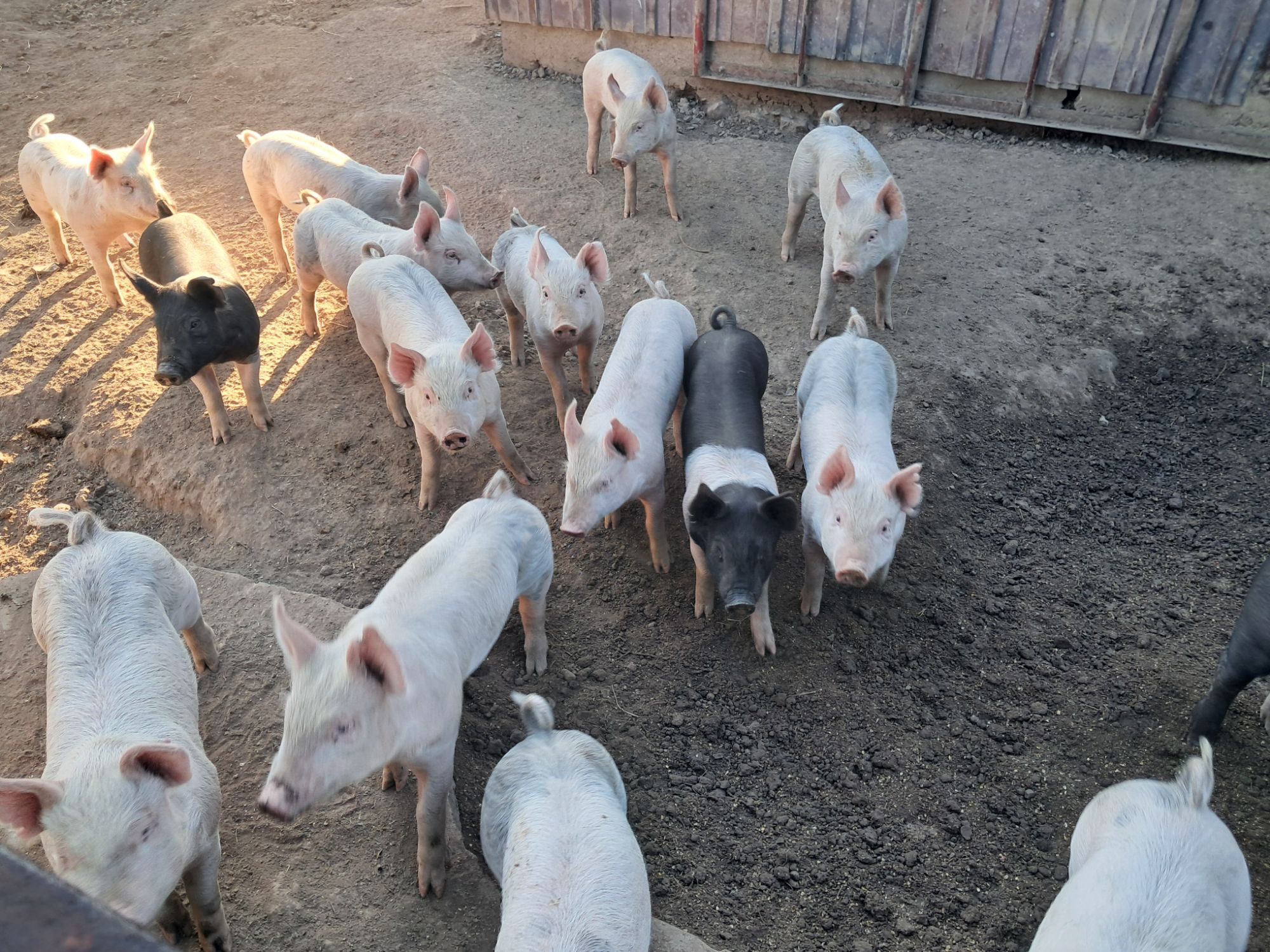
    By the time the piglets approached about 40 pounds, they were:

    • Eating a ton of feed (that corn and cheese mix vanished quickly).
    • Growing steadily and looking robust, active, and healthy.

    That was our window to sell them as feeder pigs. Letting them go was bittersweet—we’d grown attached—but it was also satisfying to know they were going to other farms and families who would continue the work we’d started.

    2 month old pigs! They grow so fast!

    What This First Batch of Piglets Taught Us

    Raising these 20 piglets taught us a lot about:

    • How quickly newborn piglets grow—from “box of butter” size to 20 pounds in a month.
    • The importance of timing and cleanliness around castration and deworming.
    • How fast feed demands can change as pigs move outside and start growing in earnest.
    • The emotional side of weaning—for both pigs and people.
    • How joy and loss can sit side by side in animal husbandry.

    If you’re considering raising pigs, or you’re in your first season with piglets, I hope these pieces of our story help you feel a little less alone in both the hard and the good parts.


    Your Turn

    If you’ve raised pigs before, I’d love to hear: what’s one lesson your first batch of piglets taught you that you still carry with you today?

    If this story was helpful, encouraging, or simply gave you a clearer picture of what raising piglets can look like, would you share it with another homesteader or small scale pig farmer? Your shares and comments help these lessons reach more folks who are learning right alongside us.


    Read Next: June Dairy Month Recap: Stories from the Farmyard
  • First-Time Farrowing on Our Homestead: How Our Gilts Welcomed 20 Piglets

    First-Time Farrowing on Our Homestead: How Our Gilts Welcomed 20 Piglets

    If you’ve been following along, you know our family just welcomed 20 new homestead inhabitants. Both of our gilts farrowed 10 healthy piglets each, within eight days of one another. In this post, I’m sharing the good, the bad, and the “ugly” (if you consider birth in all its rawness “ugly”) from our first farrowing season.

    If you’re a human parent, you may find yourself nodding along—there are a lot of parallels between farrowing and real childbirth.

    Planning for Piglet Due Dates and Farrowing

    Our first gilt was due on Mother’s Day, which felt poetic and slightly nerve‑wracking.

    We estimated her due date by:

    Mr.Eligible boar (pink)

    Just like with human pregnancies, a “due date” for pigs is more like a due window. There’s a grace period on either side, and you quickly learn that the animals don’t read calendars.

    About four days before the due date, we moved our soon-to-be mama into her farrowing quarters—a fixed-up building on our property. Her udder had been noticeably full for about three weeks, but it really expanded in the three days leading up to the due date.

    On the calendar due date itself, she turned…feisty. And by feisty, I mean she was ready to bite anything that got within range of her snout. But she did not actually farrow that day.

    My husband and I were both on high alert. He checked on her several times from Sunday into Monday, but nothing happened. Then, midday Monday, he checked on her again, saw no progress, ran a quick errand, and came back to a surprise: three piglets, mostly dried off and already attempting to nurse.

    Watching the First Piglets Arrive

    He came to pull me away from my home office, and we stood there, just watching.

    It’s incredible how quickly piglets transition from birth to motion:

    • They got up on shaky legs
    • They walked toward mom’s teats
    • They instinctively nuzzled and attempted to latch

    When they wandered too close to her head or drifted off too far, she would grunt, and they would back off. You could see the communication happening instantly between mother and babies.

    Based on how quickly those first three arrived, we expected more piglets to appear almost immediately. But an hour went by with no action.

    We knew there were more piglets in there. A typical first-time gilt can have between 6 and 12 piglets, and we could see our girl straining. But nothing was moving.

    When Birth Doesn’t Go Smoothly

    At this point, we knew we were out of our depth and that simply “waiting” might not be enough. My husband called my brother-in-law, who came over quickly (we still cannot thank him enough) with oxytocin to help speed up the process if needed.

    Oxytocin for pigs is similar to Pitocin for humans. It’s also a hormone our bodies naturally produce to help labor progress and to promote bonding with our young.

    Before he arrived, though, the next piglet finally emerged—and it was stillborn.

    Based on its size, we could tell it hadn’t fully developed in the womb, which is fairly common in pig litters. What I didn’t know beforehand was how much a stillborn piglet can slow down the farrowing process.

    In a normal birth:

    • The sow pushes
    • The piglet wriggles and helps move itself along the birth canal

    When the piglet is stillborn, there’s no wriggling, which reduces the sow’s natural urge to push and makes things much slower and harder.

    The Rest of the Litter and Piglet Safety

    Once the stillborn piglet was out, everything sped up. The next seven piglets arrived within about half an hour. Some came out in groups of three, one right after another.

    We:

    • Caught each piglet
    • Used towels to dry them off
    • Placed them under a heat lamp in a designated corner of the farrowing crate

    We had intentionally designed a piglet-only corner in the crate—an area where the babies could go but the sow could not. This gives them a protected space if mom’s hormones are running high or she’s moving around clumsily during or after farrowing.

    My brother-in-law arrived during this time, showed us how to administer oxytocin, and—equally important—gave us some perspective.

    He reminded us that sometimes you need to “sit on your hands.” The sow often knows what to do, and constant interference can create more problems than it solves.

    Mere minutes before this, we had to sit on our hands as we were nervous the new mom would lay flat on her babies. Imagine 10 little ones walking underneath you, going in front of you as you try not to walk into them, and you can understand our apprehension.

    Instincts, Bonding, and the Early Days

    It was awe-inspiring to watch a first-time mom become a mother in an instant.

    When we picked up a piglet, it squealed, and she would leap up, immediately on guard, ready to defend her baby. That bond is powerful and very, very real.

    In the first week, we watched the piglets:

    • Double, then nearly triple in size
    • Learn to find the warmest spot under the heat lamp
    • Figure out (and fight over) the best spots on the udder

    Because the weather was initially cold, we added a second heat lamp in the piglet-only section to keep them warm enough. Those first days felt like a delicate balancing act between warmth, safety, and giving the sow enough space to relax and recover.

    Just as the first litter was settling into a rhythm, we realized we were about to do it all over again with our second gilt.

    Preparing for Our Second Gilt’s Farrowing

    Five days later, we moved our second gilt into her farrowing crate. In classic Wisconsin fashion, the weather changed dramatically—now it was suddenly warm.

    That temperature swing added a whole different layer of worry.

    Several times, we thought she was laying down to start farrowing. My husband lost more than a few nights of sleep, watching her, waiting for contractions that never came. Instead, she was simply overheated and panting, trying to cool herself down.

    A few things to remember about pigs:

    • They don’t have sweat glands
    • They carry a good layer of insulating fat
    • Dumping excess heat is genuinely hard for them

    We ended up spraying her gently with a hose during the worst of the heat, and it made a noticeable difference. She relaxed, her breathing slowed, and it was a good reminder that not every “change” in position or breathing is labor.

    Sometimes, it’s just a hot pig.

    A Dramatic Second Farrowing

    Naturally, our second gilt chose a wonderfully inconvenient time to start farrowing.

    Right as I was heading out the door for my monthly book club meeting, she decided it was go time. By the time I returned, seven piglets were already out.

    My husband filled me in on what I’d missed:

    • One piglet was born breech (butt first), and he had to help pull it out
    • By the time it emerged, it was struggling to breathe, so he rubbed it vigorously to stimulate it

    Then came another challenge—the largest piglet of the litter got stuck in the sow’s pelvis. It took about an hour for that baby to finally make its way out. Once it did, the remaining piglets arrived quickly, followed by the placenta (what some people call the “afterbirth” or “cleanings”).

    That hour with the stuck piglet felt much longer than sixty minutes. It was one of those situations where you’re walking a line between stepping in and letting nature work, all while trying not to panic.

    Second litter, they also made a dramatic entrance

    What We Didn’t Need—and What We Did

    Looking back at both farrowings, a few specific tools and supplies made a big difference—and a few things we were sure we’d need stayed in the box.

    One small but encouraging discovery: we didn’t end up needing the iodine we had ordered for antiseptic purposes. Both gilts instinctively chewed off their piglets’ umbilical cords on their own, just as nature designed them to.

    During the second farrowing, we did use the sleeve-length veterinary gloves, which my husband used to check the second sow and see where the piglet was in the birth canal. Having those on hand gave us a safer way to assess what was happening without introducing as much risk of infection.

    After each birth:

    • Mom would eventually lay down flat, exposing her full udder
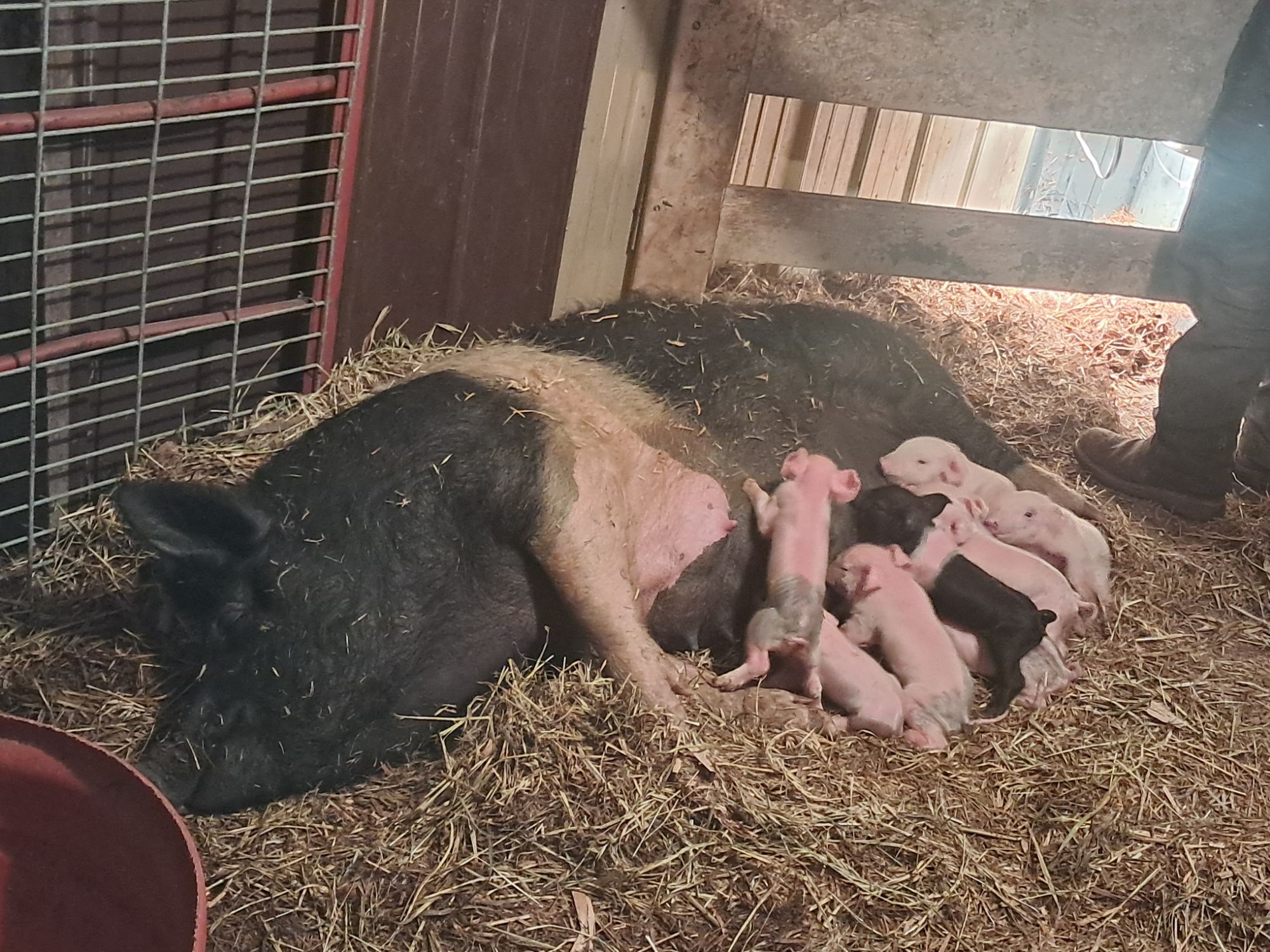
    • The piglets would find their spots and latch on
    • The first milk, just like in humans, was rich colostrum
    • Later, her full milk let-down came in

    The sow grunts to call her babies over and often continues to grunt the entire time she’s nursing. It’s a sound that becomes the background track to your days during those first weeks—steady, rhythmic, and weirdly comforting.

    She nurses about once an hour around the clock, and in between, she rests, eats, drinks, and even teaches her babies where to defecate (in a designated corner).

    Lessons We Learned from Our First Farrowing

    This whole experience left us humbled, exhausted, and incredibly grateful. It also taught us some practical lessons we’ll carry into every future farrowing season.

    We learned:

    • How much can go smoothly without our intervention when we give the sow space
    • How quickly things can go wrong—and how critical it is to have knowledgeable help on call
    • How important it is to be prepared for both cold snaps and heat waves during spring farrowing
    • How valuable a piglet-only safe zone and basic supplies (like gloves and towels) can be
    • How strong maternal instinct is, whether in pigs or humans

    If you’re reading this because you’re considering raising pigs, or you’re just here for the many parallels to human childbirth, I hope this gives you a real, honest picture of what farrowing can look like.

    It’s messy, beautiful, stressful, and holy all at once—and when you’re standing there in a dusty farrowing crate, watching a brand-new piglet wobble toward its first meal, it’s hard not to feel a little awe.


    If you’ve been through your own version of ‘first farrowing’—with pigs, other livestock, or even human babies—I’d love to hear about it. What surprised you the most about birth and early days on your homestead?


    If this story was helpful (or reassuring) as you think about raising pigs, would you share it with a fellow homesteader or save it for later? You can also join my email list for more honest, behind-the-scenes looks at our homestead wins, mistakes, and everything in between.

    Subscribe for weekly homesteading tips:

    Read Next: Buying Meat from a Farmer: A Complete Guide to Bulk Meat, Freezers, and Butchers

  • Our First Gilt Farrowed: 10 Piglets on a Monday Afternoon

    This is a shorter post this week, but it feels like a big one.

    We have piglets.

    On Monday afternoon, our first gilt farrowed 10 piglets (and one stillborn), and it was our first time experiencing pig farrowing firsthand. One minute we were checking on her like we had so many times before, and the next we were in the middle of something real and messy and alive. There’s no easing into it when it starts—you go from waiting to catching babies in what feels like a breath.

    At one point, the farrowing process stalled, which raised our anxiety pretty quickly. From what we’ve learned, pauses can happen during farrowing, but in the moment it’s hard to know when to wait and when to step in. We hovered, second-guessed ourselves, and tried to stay calm. In the end, she worked through it on her own, which was both a relief and a reminder that animals often know exactly what to do if we give them space.

    Once the piglets were here, things shifted into action mode. We cleaned them off, making sure each one was breathing well and able to stay warm. My brother-in-law walked us through administering oxytocin so she could relax and start nursing. Watching those piglets root and latch felt like a turning point—less “are we going to be okay?” and more “okay, this is working.”

    Momma and babies as they attached for the first time.

    We stayed with her for the first couple of hours, keeping a close eye out so no piglets were accidentally crushed. One thing we learned quickly is how important it is to watch the sow’s movements closely, especially when she shifts or lays down. It’s a strange balance of awe and vigilance. Every small movement feels important. Every squeal makes you look twice—and resist the urge to intervene to prevent piglet crushing.

    This is the part of raising animals, and growing food, that doesn’t always make it into the highlight reel. It’s messy, a little nerve-wracking, and very real. But it’s also where the learning happens: in the doing, in the watching, and in showing up before you feel fully ready.

    And maybe that’s the overlap I keep noticing lately—between raising animals and raising kids. You prepare as much as you can, gather advice, set things up the “right” way… and then you step back and let life unfold, staying close enough to help but far enough away to let growth happen.

    Right now, the piglets are tucked in close to momma, and we’re checking on them more often than we probably need to. It feels a little like bringing home a newborn again—equal parts wonder, worry, and watching something new take its first steps in the world.

    Growing food, raising kids, building community… sometimes all three show up at once, in a farrowing pen on a Monday afternoon.


    Have you ever been present for an animal birth on your farm? What surprised you most?


    If this little farrowing story made you smile (or taught you something), please like and share with fellow homesteaders!

    Subscribe for weekly homesteading tips:

    Read Next: First-Time Pig Farrowing Prep: What We’re Doing Before Our Mother’s Day Litter