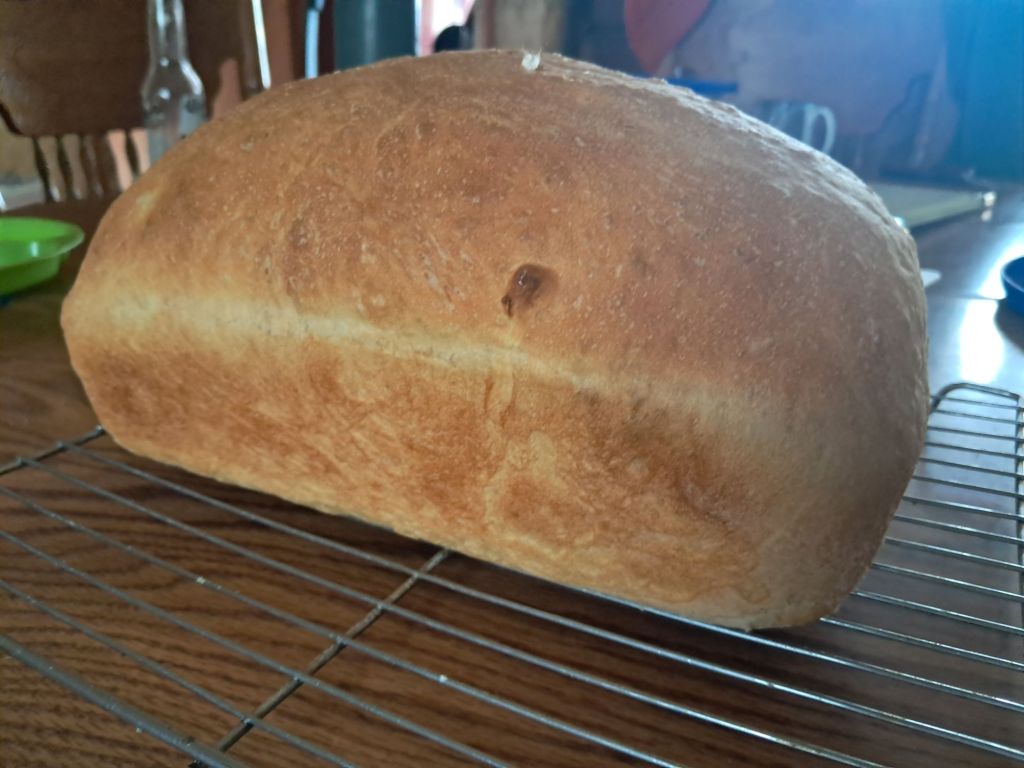
To me, sourdough is both fascinating and frustrating. How can something based only on simple pantry staples: flour, water, and salt, result in such a delicious cornerstone food of society? Once you attempt your first few loaves, you begin to understand. There’s a certain alchemy in the starter, the captured yeast on which the success of your culinary exploits rest. I’ve observed that like all worthwhile things in life, sourdough is not just bread, but a lesson in patience, a crash course in humility, and a reminder that the messiest things in life often taste the best. And even a failure is really just toast, breadcrumbs, or croutons waiting to happen.
You begin by adopting a starter, a sentient lump of flour and water that demands more attention than the most finicky orchid. The starter acts like a child who only communicates via bubbles and guilt. Feed it too much flour and it floweth over, creating a bubbly mess. Forget it for a day, and it develops both the boozy aroma and the clear liquid on top. Nurturing a starter can be unpredictable, expensive, and prone to failure. Meanwhile, your actual orchid withers away in jealousy.
After mixing the dough, you begin the ultimate test of patience. You’ll attempt to stretch and fold the dough, only to end up with a glue-like substance clinging to your hands like wet clay. The dough metaphorically laughs as it oozes across the counter, mocking your attempts at control. After much coaxing over several iterations, the dough relaxes and begins to cooperate.
After stretching and folding, you enter the bulk fermentation phase, where time becomes a myth. The recipe claims four to eight hours, but your dough adheres to its own cosmic clock. If the dough is too cold, it will remain as dense as a rock. If the dough is too warm, it will overproof into an exhausted heap. You’ll obsessively poke the dough, whisper encouragement, and question your life choices as it defies every timeline you’ve read online.
After bulk fermentation, the dough must be shaped into a loaf. It’s the dough’s version of a spa day, where it is pampered, tucked, and rolled into a sleek new outfit before its big debut in the oven. You gently flatten the dough into a rectangle. Next comes the folding, first the top third down, then the bottom third up, creating a snug little dough envelope that’s hopefully ready to rise to the occasion. As you forgot to dust your hands, you now need to scrape dough off your elbows before beginning the roll. After thoroughly cleaning your extremities, you pinch the seams with the seriousness of a detective sealing evidence, tuck in the ends, and flip the dough seam-side down into the loaf pan, ready for its oven transformation.
You’ve shaped your loaf into something resembling art. Because you’re difficult and don’t like the fancy sourdough boule shape, you preheat a roasting pan like an oblong sarcophagus. When you finally score the loaf, your razor either drags like a butter knife or gashes the dough like a horror movie prop. The result is a crust that resembles a topographical map of Greenland. Into the oven it goes, and for the next half hour you pace and agonize more than an expectant parent. Will it spring? Will it split? Or will it burn? The smell of success fills the air. You optimistically crack the lid, only to find a solid brick replacing the airy loaf of bread you expected. Because you always finish what you start, you dutifully lower the oven heat to finish the bake, watching through the glass door as the crust turns darker than your humor.
Sliding the pan from the oven, you wait until the loaf is cool enough to slice. The knife skids across the bread crust as if it is duller than a spoon. After much cajoling, the crumb finally stares back like a party guest trying desperately to impress. Instead of a light, airy charm, the holes are somehow all wrong, tiny, and, tight. The mouthfeel is wet and chewy rather than fluffy and inviting. And yet, I will inevitably try again to make that elusively perfect loaf. Kneading dough is cheaper and tastier than therapy, and I’ve learned to love my finicky starter. It’s part pet, part science experiment, and entirely a reminder that chaos can, occasionally, rise to greatness. Finally, I can bond with fellow bakers over our shared failures. After all, misery loves company, especially if that company brings fresh bread.
If you enjoy content like this, subscribe below to join a circle of readers who understand the frustrations, and joys, of a perfect loaf of bread.
 Practical Homesteading
Leave a comment