Early spring in the hardwood forests of the Midwest brings one of the season’s first wild edibles: ramps, also called wild leeks. For many families across the region, foraging ramps in early spring is more than a pantry project—it’s a seasonal ritual. For our family, ramp season marks the beginning of a rhythm we return to each year—one that ties together growing food, raising children, and learning how to belong to a place.
The forest hums with the quiet magic of early spring. Buds swell on maple, birch, and willow, their tips blushing green and red. Sunlight filters through bare branches, thin but persistent, casting shifting patterns across the damp, leaf‑strewn ground. Moss returns in soft patches, and the stream—freed from ice—chatters over stones as it carries winter’s melt downhill.
I gather my supplies, lift my toddler onto my hip, and take my son’s hand as we step into the woods outside our small town in southeastern Wisconsin, though the rhythm of this season is the same across much of the Midwest. The ground gives softly beneath our boots, releasing the scent of damp earth and last season’s decay. Around us, birds stitch sound into the morning—robins scratching at softened soil, sparrows darting with nesting twigs, woodpeckers tapping their steady rhythm.
How to Identify Ramps
As we walk, I coach my son on what to look for: clusters of broad, smooth, lance‑shaped leaves, bright green with a reddish or burgundy base. Before long, he spots them.
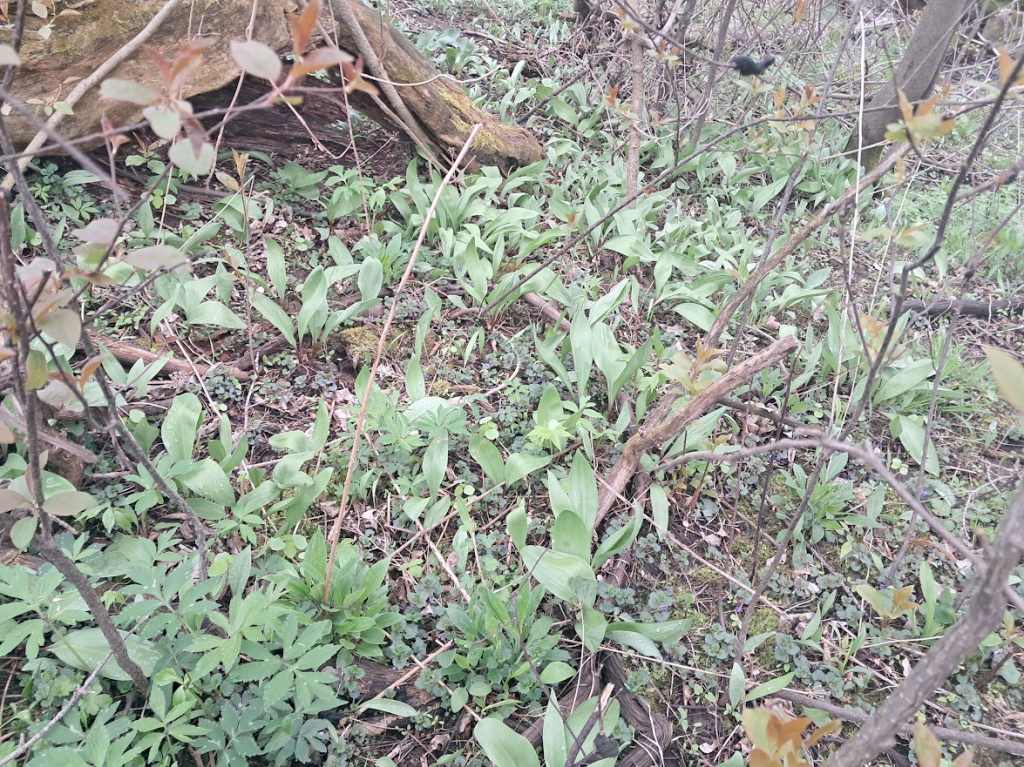
The ramps rise in small patches, their leaves vivid against the brown forest floor. Nearby, trout lilies speckle the ground, their mottled leaves catching bits of sunlight. It feels, as it often does, like the forest is offering quiet clues—if you slow down enough to notice.
If you’re new to foraging, take extra care here. Once you learn how to identify ramps safely, they become a gateway plant for spring foraging in the Midwest with kids. Ramps can be confused with toxic look‑alikes like lily of the valley. The key difference is the smell—ramps have a strong onion‑garlic scent when the leaf is torn and the stem is crushed.
Foraging with Kids
I set my daughter down and kneel beside the patch. The earth is cool and soft under my hands. I pick a leaf, tear a small piece, and pass it to each child.
Their reactions are immediate—the sharp, garlicky bite softened by a fresh green sweetness. It’s a flavor that feels like spring distilled into something edible.
We dig carefully. I show them how to loosen the soil around the base of the plant, how to follow the slender white bulb without tearing it. Their small hands work with focus and excitement, uncovering each ramp like buried treasure.
Foraging with kids requires patience, but it also invites something better than efficiency:
- Slowing down enough to observe
- Letting curiosity lead the pace
- Accepting a bit of mess and distraction along the way
At one point, my daughter tries to eat a blade of grass. We gently redirect and keep going. This is exactly the kind of moment that makes foraging ramps with kids so formative: a small, repeated lesson in paying attention and tasting the world responsibly.
Harvesting Sustainably
Before we gather too many, I pause to explain: we only take what we need. This is one of the most important rules for harvesting ramps sustainably, especially in forests that are already seeing pressure from foragers.
Ramps grow slowly and can be easily overharvested. In many parts of the Midwest, foraging pressure has already affected local patches, so we follow a simple rule—never take more than a small portion from any patch, and leave plenty behind to regenerate.
Sometimes we harvest just a single leaf instead of the whole plant. It’s a small choice, but it reinforces something bigger: we’re not just taking from the land—we’re participating in its long‑term health. Sustainable harvesting teaches kids that food is part of a cycle, not just a product on a shelf.
From Forest to Table
We leave with muddy knees, full hands, and a modest basket of green.
Back home, we rinse the ramps and prepare them simply—sautéed in butter with pasta and a bit of lemon zest. The sharpness mellows into something rich and savory, still carrying the unmistakable imprint of the woods.
After a morning outside, the meal feels earned in a way that’s hard to replicate. The kids recognize the flavor immediately. It’s no longer just food—it’s something they found, touched, and helped prepare. This is how foraging ramps with kids in the Midwest becomes more than a one‑day outing; it weaves into our seasonal food story.
Growing More Than Food
Later, reflecting on the day, I realize that foraging is doing several kinds of work at once.
It feeds us, yes—but it also teaches patience, observation, and restraint. It gives my children a direct relationship with where food comes from, outside of stores and packaging. And it connects us, quietly, to the people who have walked these woods before, gathering the same plants in the same season.
Over time, I hope these small rituals grow into something lasting. Not just knowledge of edible plants, but a sense of responsibility—to the land, to each other, and to the idea that food is something we participate in, not just consume. If you’re curious about starting foraging ramps with kids in the Midwest, begin simply. Go for a walk in early spring. Learn one plant. Bring your kids. Take a little, leave plenty, and pay attention to what’s growing around you.
That’s how it starts.
What’s the first wild food you teach your kids to recognize in spring? Let me know in the comments—I’d love to hear your family’s outdoor food traditions.
If this post resonates with your family’s spring rhythm, I’d love for you to share it with another parent who’s curious about foraging with kids.
You can like or share it on Facebook, pin it on Pinterest, or forward it to a friend who loves hiking and seasonal food.
Every time someone takes a small step toward learning about wild plants, we’re all one step closer to a more grounded, connected food culture.
Subscribe for weekly homesteading tips:
Read Next: Perfect Pan-Fried Fish Recipe | Ice Fishing Family Time
 Practical Homesteading
Leave a comment