Tag: farm stories

  • June Dairy Month Recap: Stories from the Farmyard

    June Dairy Month Recap: Stories from the Farmyard

    As June Dairy Month comes to a close, I’ve been thinking about how much this month’s writing has revolved around farmers, hayfields, and the quiet weight of rural life. It wasn’t a strategic content plan so much as an honest outflow of what’s on my heart—and on my mind—this time of year.

    In case you missed any of the recent posts (or want to revisit them with fresh eyes), here’s a look back at the stories we’ve walked through together.


    The Old New Holland Baler and a Haying Legacy

    In one post, I took you out to the hayfield, where an old New Holland baler still clatters its way across the field, tying bales as steadily as it did in the 1960s. We followed its story from my grandfather’s horse-drawn days, through my dad’s years of frantic shear-pin changes and late‑night repairs, all the way to today’s summers under my father’s care.

    That baler became more than a machine—it stood in for a family legacy of persistence, resourcefulness, and care passed down from one set of hands to the next. Each bale it drops is a small monument to the people who refused to let it quit.


    Learning to Stop Hiding My Farm Roots

    Another post shifted from machinery to identity. I shared my “confession” that, for years, I tried to tuck my farm background away—doing just enough chores, avoiding being “too farm kid,” and choosing choirs over FFA. I wanted the values without the label.

    But homesteading habits kept creeping back: blanching green beans, learning to make sauerkraut, failing (and eventually succeeding) at homemade pizza. A glut of cucumbers and a Facebook post finally opened my eyes to how unusual my access to fresh food really was—and how much others valued what I took for granted.

    Through coworkers’ questions and friends’ enthusiasm, I began to see my rural upbringing not as a liability, but as an asset: a source of work ethic, resourcefulness, and a perspective that still shapes how I parent, homestead, and show up in my community.


    Naming the Hidden Weight Farmers Carry

    We also zoomed out to look more directly at farmer mental health. That post walked through the way farming has changed over the past forty years: fewer, larger farms; bigger equipment; “land rich and cash poor” realities; new diseases and pests; and markets that feel like a roller coaster.

    Layer by layer, we named the unseen pressures—chronic stress, isolation, identity and legacy, and stigma around asking for help. The goal wasn’t to drown anyone in statistics, but to give words to what many farmers and farm families are already feeling: that toughness doesn’t make you immune to stress, and that talking about it is an act of courage, not weakness.

    We also talked about what farmers need to hear (that being exhausted doesn’t mean you’re failing) and what the rest of us can do in small but meaningful ways: listening well, supporting local, sharing resources, and checking in after hard news.


    June Dairy Month from the Farmyard Side

    In honor of June Dairy Month, another piece turned the camera toward what June actually feels like on the farm. While towns see smiling cow posters, ice cream specials, and farm breakfasts, farmers see early alarms, hot barns, hayfields racing storms, and bills riding in their back pockets.

    I shared memories of June as “hold on tight and hope the machinery cooperates,” and explored how it can feel to be “celebrated” while you’re barely keeping up. For some, June Dairy Month is joyful; for others, it’s complicated. We imagined what farmers might actually want this month: fewer speeches and more listening, real prayers for safety and rest, quiet texts that say, “How are you holding up?” and resources that gently say, “You don’t have to carry this alone.”

    I also mention practical ways to honor farmers—asking better questions, dropping off food or encouragement during haying, and telling kids the story behind the milk in their glasses.


    A Barn Roof, a Helping Hand, and a Farm Friendship

    Most recently, I shared a story from before I was born, about how one small act—stopping to help on a red barn roof—turned two neighboring farmers into lifelong friends. A neighbor pulled in, climbed up despite a fear of heights, and offered a hand. From that afternoon on the peak, their lives became deeply intertwined through haying days, shared meals, weddings, and tough seasons.

    As a kid, I joined those hay crews, stacked bales until I was covered in dust, and ate big meals that felt like our own modern threshing bees. Looking back, I can see how that one moment of courage and kindness rippled through decades and shaped the community I grew up in.


    What Threads These Stories Together

    Across all these posts, a few themes keep surfacing:

    • The steady, sometimes unnoticed persistence of farmers and farm families
    • The way small acts—fixing an old baler, sharing cucumbers, stopping to help on a roof—carry forward into generations
    • The tension between public celebrations of agriculture and the private weight many farmers carry
    • The quiet, sturdy beauty of rural friendships and communities

    June Dairy Month may be the official reason to talk about cows and fields, but the stories don’t fit neatly into one month on a calendar. They’re ongoing, season after season.


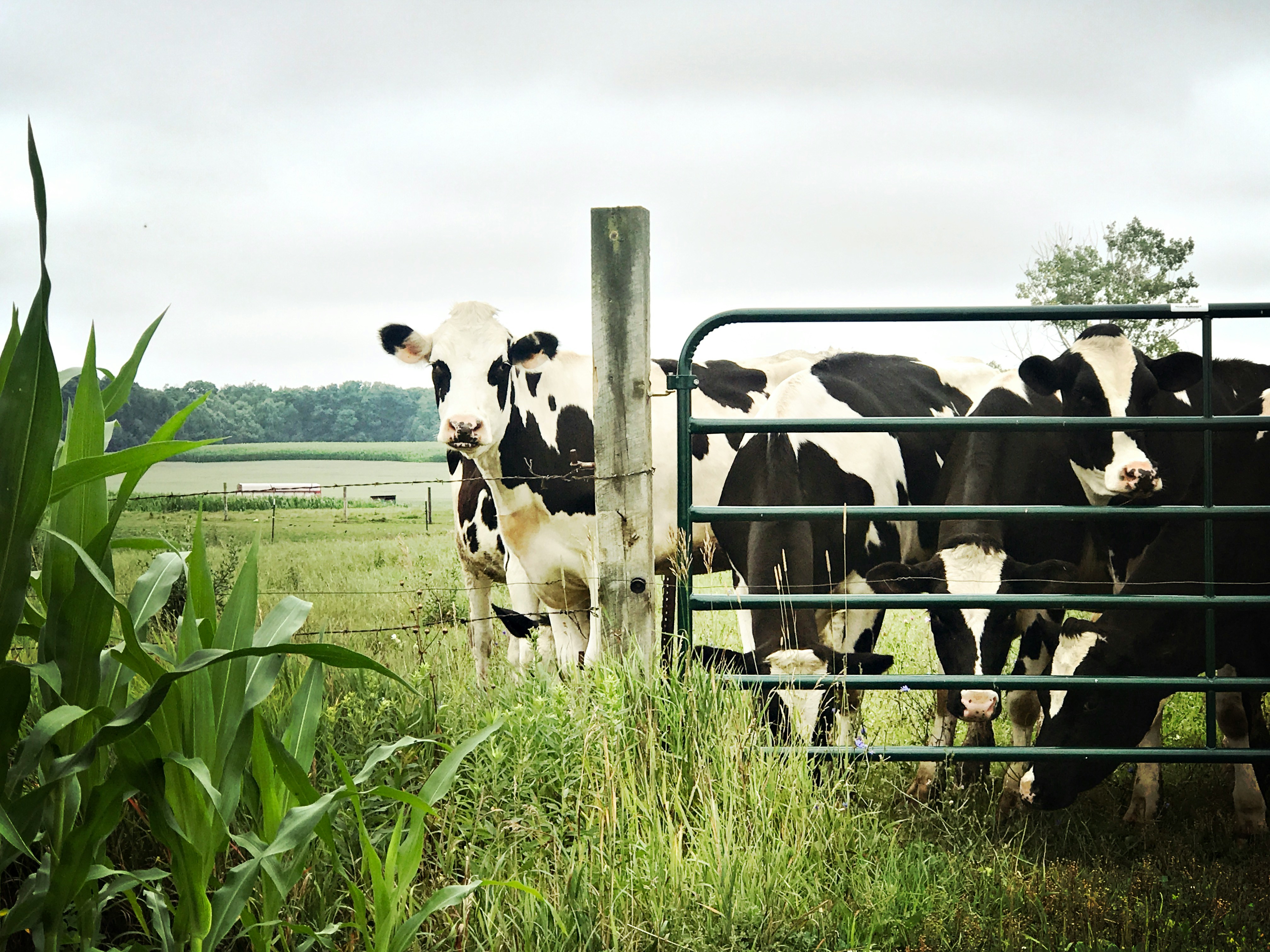
    Feature Photo by GG LeMere on Unsplash


    If one of these posts resonated with you, I’m glad you were here. And if you’re a farmer, or love one, thank you—for the work you do, the courage it takes, and the stories you’re still living.


    If you have a minute, I’d love to know: which of these stories stuck with you most, and what would you like to see more of in the months ahead?

    If you know someone who loves farm stories—or someone who lives them—would you share this recap with them? Your shares and comments help these stories find the people who need them.

    Read Next: Growing Up on a Wisconsin Dairy Farm: Reflections for June Dairy Month
  • First-Time Farrowing on Our Homestead: How Our Gilts Welcomed 20 Piglets

    First-Time Farrowing on Our Homestead: How Our Gilts Welcomed 20 Piglets

    If you’ve been following along, you know our family just welcomed 20 new homestead inhabitants. Both of our gilts farrowed 10 healthy piglets each, within eight days of one another. In this post, I’m sharing the good, the bad, and the “ugly” (if you consider birth in all its rawness “ugly”) from our first farrowing season.

    If you’re a human parent, you may find yourself nodding along—there are a lot of parallels between farrowing and real childbirth.

    Planning for Piglet Due Dates and Farrowing

    Our first gilt was due on Mother’s Day, which felt poetic and slightly nerve‑wracking.

    We estimated her due date by:

    Mr.Eligible boar (pink)

    Just like with human pregnancies, a “due date” for pigs is more like a due window. There’s a grace period on either side, and you quickly learn that the animals don’t read calendars.

    About four days before the due date, we moved our soon-to-be mama into her farrowing quarters—a fixed-up building on our property. Her udder had been noticeably full for about three weeks, but it really expanded in the three days leading up to the due date.

    On the calendar due date itself, she turned…feisty. And by feisty, I mean she was ready to bite anything that got within range of her snout. But she did not actually farrow that day.

    My husband and I were both on high alert. He checked on her several times from Sunday into Monday, but nothing happened. Then, midday Monday, he checked on her again, saw no progress, ran a quick errand, and came back to a surprise: three piglets, mostly dried off and already attempting to nurse.

    Watching the First Piglets Arrive

    He came to pull me away from my home office, and we stood there, just watching.

    It’s incredible how quickly piglets transition from birth to motion:

    • They got up on shaky legs
    • They walked toward mom’s teats
    • They instinctively nuzzled and attempted to latch

    When they wandered too close to her head or drifted off too far, she would grunt, and they would back off. You could see the communication happening instantly between mother and babies.

    Based on how quickly those first three arrived, we expected more piglets to appear almost immediately. But an hour went by with no action.

    We knew there were more piglets in there. A typical first-time gilt can have between 6 and 12 piglets, and we could see our girl straining. But nothing was moving.

    When Birth Doesn’t Go Smoothly

    At this point, we knew we were out of our depth and that simply “waiting” might not be enough. My husband called my brother-in-law, who came over quickly (we still cannot thank him enough) with oxytocin to help speed up the process if needed.

    Oxytocin for pigs is similar to Pitocin for humans. It’s also a hormone our bodies naturally produce to help labor progress and to promote bonding with our young.

    Before he arrived, though, the next piglet finally emerged—and it was stillborn.

    Based on its size, we could tell it hadn’t fully developed in the womb, which is fairly common in pig litters. What I didn’t know beforehand was how much a stillborn piglet can slow down the farrowing process.

    In a normal birth:

    • The sow pushes
    • The piglet wriggles and helps move itself along the birth canal

    When the piglet is stillborn, there’s no wriggling, which reduces the sow’s natural urge to push and makes things much slower and harder.

    The Rest of the Litter and Piglet Safety

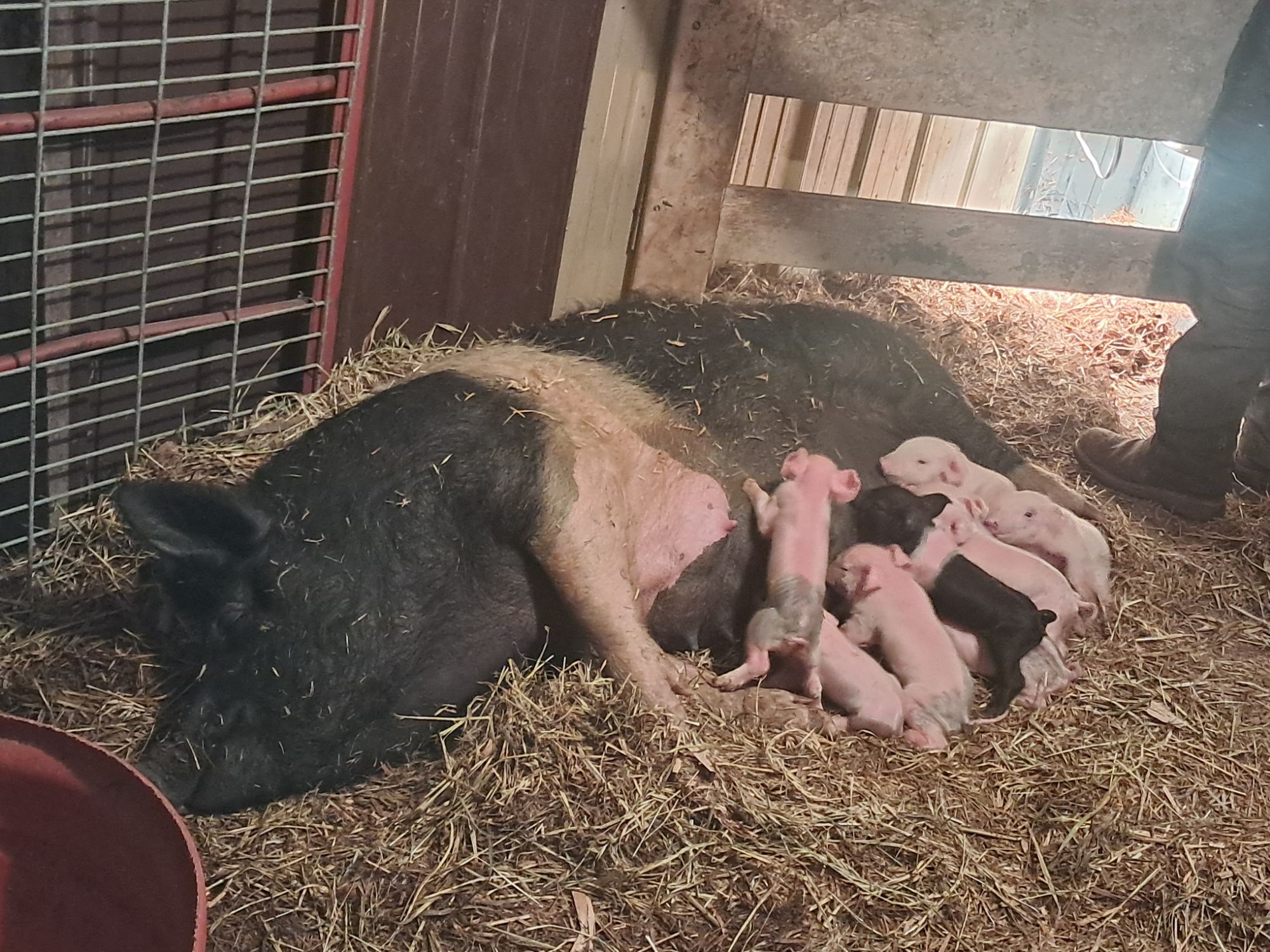
    Once the stillborn piglet was out, everything sped up. The next seven piglets arrived within about half an hour. Some came out in groups of three, one right after another.

    We:

    • Caught each piglet
    • Used towels to dry them off
    • Placed them under a heat lamp in a designated corner of the farrowing crate

    We had intentionally designed a piglet-only corner in the crate—an area where the babies could go but the sow could not. This gives them a protected space if mom’s hormones are running high or she’s moving around clumsily during or after farrowing.

    My brother-in-law arrived during this time, showed us how to administer oxytocin, and—equally important—gave us some perspective.

    He reminded us that sometimes you need to “sit on your hands.” The sow often knows what to do, and constant interference can create more problems than it solves.

    Mere minutes before this, we had to sit on our hands as we were nervous the new mom would lay flat on her babies. Imagine 10 little ones walking underneath you, going in front of you as you try not to walk into them, and you can understand our apprehension.

    Instincts, Bonding, and the Early Days

    It was awe-inspiring to watch a first-time mom become a mother in an instant.

    When we picked up a piglet, it squealed, and she would leap up, immediately on guard, ready to defend her baby. That bond is powerful and very, very real.

    In the first week, we watched the piglets:

    • Double, then nearly triple in size
    • Learn to find the warmest spot under the heat lamp
    • Figure out (and fight over) the best spots on the udder

    Because the weather was initially cold, we added a second heat lamp in the piglet-only section to keep them warm enough. Those first days felt like a delicate balancing act between warmth, safety, and giving the sow enough space to relax and recover.

    Just as the first litter was settling into a rhythm, we realized we were about to do it all over again with our second gilt.

    Preparing for Our Second Gilt’s Farrowing

    Five days later, we moved our second gilt into her farrowing crate. In classic Wisconsin fashion, the weather changed dramatically—now it was suddenly warm.

    That temperature swing added a whole different layer of worry.

    Several times, we thought she was laying down to start farrowing. My husband lost more than a few nights of sleep, watching her, waiting for contractions that never came. Instead, she was simply overheated and panting, trying to cool herself down.

    A few things to remember about pigs:

    • They don’t have sweat glands
    • They carry a good layer of insulating fat
    • Dumping excess heat is genuinely hard for them

    We ended up spraying her gently with a hose during the worst of the heat, and it made a noticeable difference. She relaxed, her breathing slowed, and it was a good reminder that not every “change” in position or breathing is labor.

    Sometimes, it’s just a hot pig.

    A Dramatic Second Farrowing

    Naturally, our second gilt chose a wonderfully inconvenient time to start farrowing.

    Right as I was heading out the door for my monthly book club meeting, she decided it was go time. By the time I returned, seven piglets were already out.

    My husband filled me in on what I’d missed:

    • One piglet was born breech (butt first), and he had to help pull it out
    • By the time it emerged, it was struggling to breathe, so he rubbed it vigorously to stimulate it

    Then came another challenge—the largest piglet of the litter got stuck in the sow’s pelvis. It took about an hour for that baby to finally make its way out. Once it did, the remaining piglets arrived quickly, followed by the placenta (what some people call the “afterbirth” or “cleanings”).

    That hour with the stuck piglet felt much longer than sixty minutes. It was one of those situations where you’re walking a line between stepping in and letting nature work, all while trying not to panic.

    Second litter, they also made a dramatic entrance

    What We Didn’t Need—and What We Did

    Looking back at both farrowings, a few specific tools and supplies made a big difference—and a few things we were sure we’d need stayed in the box.

    One small but encouraging discovery: we didn’t end up needing the iodine we had ordered for antiseptic purposes. Both gilts instinctively chewed off their piglets’ umbilical cords on their own, just as nature designed them to.

    During the second farrowing, we did use the sleeve-length veterinary gloves, which my husband used to check the second sow and see where the piglet was in the birth canal. Having those on hand gave us a safer way to assess what was happening without introducing as much risk of infection.

    After each birth:

    • Mom would eventually lay down flat, exposing her full udder
    • The piglets would find their spots and latch on
    • The first milk, just like in humans, was rich colostrum
    • Later, her full milk let-down came in

    The sow grunts to call her babies over and often continues to grunt the entire time she’s nursing. It’s a sound that becomes the background track to your days during those first weeks—steady, rhythmic, and weirdly comforting.

    She nurses about once an hour around the clock, and in between, she rests, eats, drinks, and even teaches her babies where to defecate (in a designated corner).

    Lessons We Learned from Our First Farrowing

    This whole experience left us humbled, exhausted, and incredibly grateful. It also taught us some practical lessons we’ll carry into every future farrowing season.

    We learned:

    • How much can go smoothly without our intervention when we give the sow space
    • How quickly things can go wrong—and how critical it is to have knowledgeable help on call
    • How important it is to be prepared for both cold snaps and heat waves during spring farrowing
    • How valuable a piglet-only safe zone and basic supplies (like gloves and towels) can be
    • How strong maternal instinct is, whether in pigs or humans

    If you’re reading this because you’re considering raising pigs, or you’re just here for the many parallels to human childbirth, I hope this gives you a real, honest picture of what farrowing can look like.

    It’s messy, beautiful, stressful, and holy all at once—and when you’re standing there in a dusty farrowing crate, watching a brand-new piglet wobble toward its first meal, it’s hard not to feel a little awe.


    If you’ve been through your own version of ‘first farrowing’—with pigs, other livestock, or even human babies—I’d love to hear about it. What surprised you the most about birth and early days on your homestead?


    If this story was helpful (or reassuring) as you think about raising pigs, would you share it with a fellow homesteader or save it for later? You can also join my email list for more honest, behind-the-scenes looks at our homestead wins, mistakes, and everything in between.

    Subscribe for weekly homesteading tips:

    Read Next: Buying Meat from a Farmer: A Complete Guide to Bulk Meat, Freezers, and Butchers