For a long time, that sentence felt like something I needed to tuck away, not lead with. In high school, I carefully sidestepped anything that might mark me as “too farm kid.” I avoided FFA and agriculture classes, choosing instead to spend time with the choir crowd—some of the kindest people you’ll ever meet (and, let’s be honest, who doesn’t love friends who can sing?).
On the surface, I was doing what a lot of teenagers do: trying to blend in. Underneath, I was quietly distancing myself from a way of life that had shaped me more than I realized.
Trying to Tuck My Farm Roots Away
Looking back, I can see how much effort I put into not looking “too farm.”
I did the bare minimum caring for the steers assigned to me.
I half-heartedly tended the garden that had been so generously entrusted to my “care.”
I laughed off my farm chores as “no big deal,” even when they meant missing events or coming to school smelling faintly of silage.
I share more about the steers here, but the short version is this: I wanted the values of my upbringing (work ethic, responsibility, resourcefulness) without the label that came with them. I thought being “the farm kid” made me less interesting, less sophisticated, less…something.
Even in college, I was hesitant to share details about my rural background. I listened to friends talk about their favorite coffee shops and city neighborhoods, and I stayed quiet about gravel roads, hay balers, and cleaning cow yards.
The Homesteading Bug That Never Quite Left
And yet, there was always a part of me that genuinely enjoyed homesteading.
The summer after my freshman year of college, I found myself slipping back into familiar rhythms:
I spent days blanching and freezing green beans.
I asked my dad to teach me how to make sauerkraut.
It was as if my hands remembered what my pride wanted to forget. I loved the feeling of putting food by, the satisfaction of seeing freezer bags full of vegetables, and the simple rhythm of working alongside my parents.
At the time, I still didn’t connect this with identity. It just felt like “what we do in the summer”—use what we have, store what we can, waste as little as possible.
The Cucumber Story That Started to Change My Perspective
I remember clearly when my perspective started to shift.
Shortly before my junior year of college, our garden produced a glut of cucumbers. In a moment of practicality, I posted on Facebook asking if anyone wanted some. Several college friends responded enthusiastically.
I didn’t believe they were serious.
To me, cucumbers were just…there. They showed up in the garden, we ate what we wanted, and the rest sometimes ended up in the compost if we couldn’t keep up. I assumed everyone had access to as many fresh vegetables as they wanted, if they just “put in the effort.”
So I left the cucumbers at home.
When I saw my friends later, their disappointed faces told me I’d made a mistake. They had genuinely looked forward to those garden-fresh cucumbers. In that moment, it hit me: my experience of having plentiful fresh vegetables was not typical. What I saw as ordinary was, to many others, special.
That simple misunderstanding planted a metaphorical seed. Maybe my farm background wasn’t something to hide. Maybe it was something to share.
Realizing My Background Was an Asset, Not a Liability
Later, at my post-college job, that seed grew.
Coworkers would ask the usual small-talk questions: “Where did you grow up?” “What did your parents do?” When I mentioned my agricultural background—dairy cows, hay fields, chores before school—I was surprised by their reactions.
They were impressed.
They asked follow-up questions. They wanted to know what milking was like, how long haying days really were, what it meant to care for animals every single day. They didn’t hear “small town, limited experience.” They heard “work ethic,” “responsibility,” and “a perspective I don’t have.”
Slowly, I began to see that the very things I had once tried to downplay were the things that made my story unique and valuable.
What Farm Life Actually Gave Me
When I think about my farm childhood now, I don’t just see early mornings and missed parties. I see the deeper gifts standing behind them:
A strong work ethic. You show up even when you’re tired, because the animals still need care.
Follow-through. You don’t quit halfway through cleaning the yard or milking a herd.
Resourcefulness. You learn to fix things, make do, and find ways to stretch what you have.
Respect for land and animals. You see firsthand that your choices affect living creatures and the soil under your feet.
Community awareness. You understand that your work feeds people you know by name.
Those values follow me into parenting, into how I manage our small homestead now, and into how I show up in my community.
Sharing the “Confession” with Pride
Today, I share my “confession”—that I grew up on a farm—not as something to gloss over, but as something I’m proud of.
I’m proud of:
My parents, who modeled consistency and care when no one was watching.
My extended family, who have been (and still are) stewards of the land.
The countless farmers who live out the same story in their own quiet, steadfast way.
I’m also grateful for the friends and coworkers who helped me see my background differently—those who wanted the cucumbers I thought were nothing special, and those who lit up when I shared stories about dairy cows and hay fields.
A Note of Thanks for June Dairy Month
So, in the spirit of June Dairy Month, consider this post a small thank-you:
To the farmers who are up before dawn, again.
To the families who build their lives around the needs of animals and land.
To the kids who might someday feel tempted to hide their farm roots, just like I did.
If you’re one of those kids, I hope you’ll come to see what I finally did: your story matters, and your background is a strength—not something to be smoothed over.
Happy June Dairy Month—to all the hardworking farmers out there, and especially to the friends and family who keep showing up, season after season.
If this story resonated with you—or reminded you of your own farm kid days—would you share it with a friend or save it for later?
I’d also love to hear from you: did you grow up on a farm, or are you just now learning where your food comes from? Your perspective matters too.
I always knew about chamomile tea. I’d heard people talk about winding down with a mug before bed and mention the health benefits—things like calming the nervous system, easing digestion, and supporting better sleep.
What I didn’t know was that you could forage your own chamomile blossoms…until I watched my husband’s grandmother do it.
She walked right out into the driveway and started picking what I had always thought were just little white-and-yellow weeds. It was like a lightbulb went off in my head. These “weeds” I’d seen growing all over the driveway actually produce a delicious tea? Mind officially blown.
If you’re not familiar with foraging your own chamomile, this is a simple guide to help you:
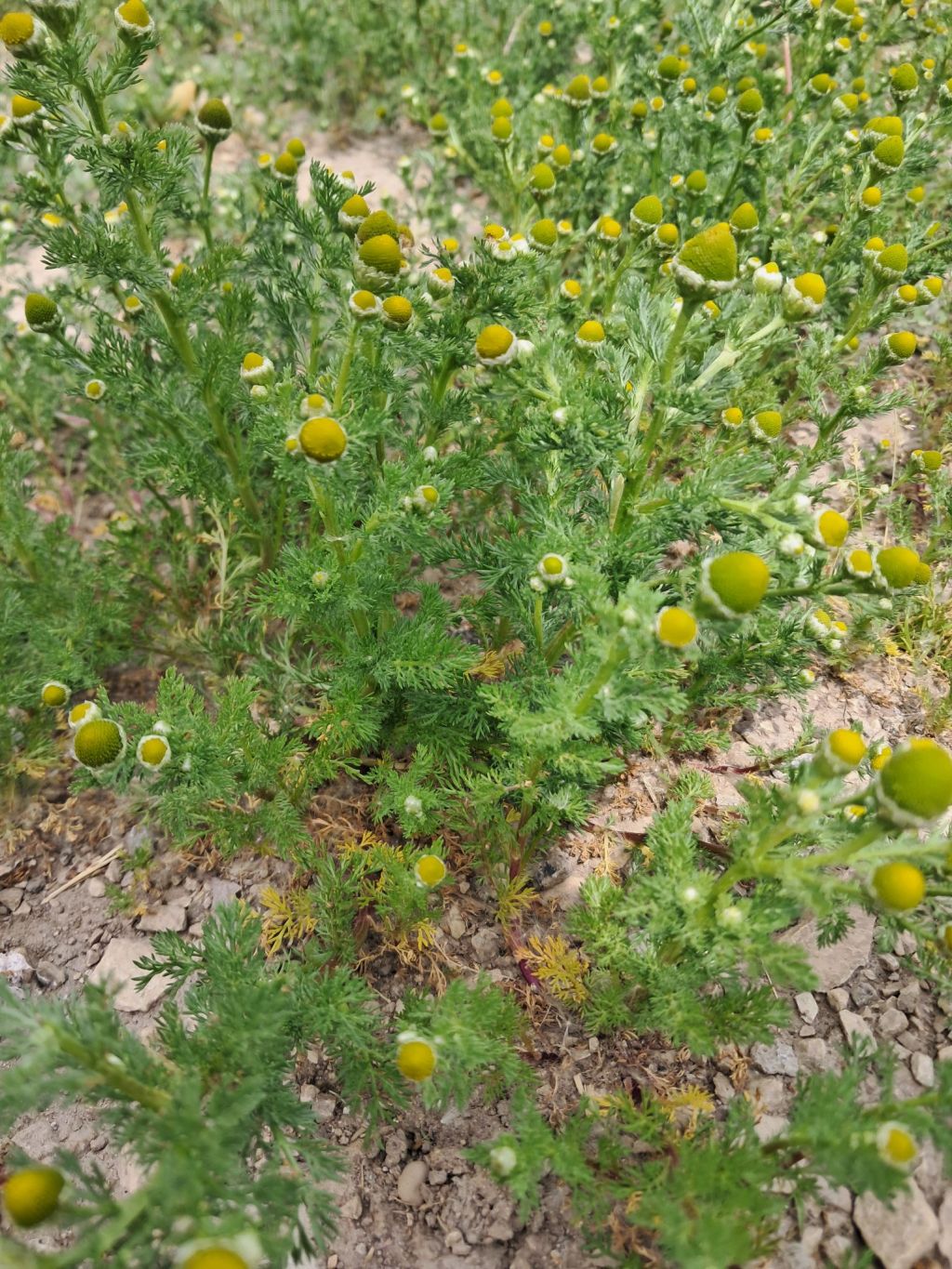
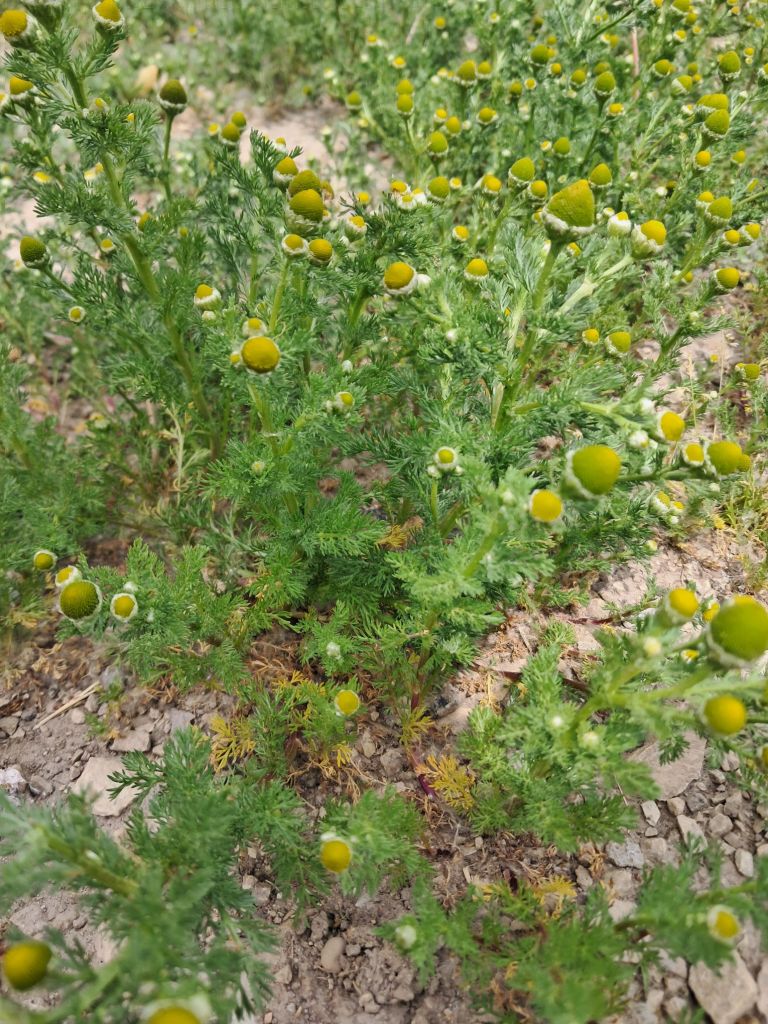
Recognize chamomile in the wild
Harvest it (bonus points if you involve kids)
Dry and store it
Brew your own homemade chamomile tea whenever you want—without the grocery store bill
As always, I’m sharing our experience for informational purposes; it’s not medical advice.
Where Chamomile Likes to Grow
One of the most surprising things about chamomile is where it chooses to grow. It doesn’t always show up in neat garden rows or carefully tended herb beds.
You’ll often find it in:
Gravel driveways and along the edges of paths
Road ditches and disturbed soil
Around barnyards, fence lines, and well-traveled areas
Sometimes in garden beds if it’s self-seeded or naturalized
It seems to have a soft spot for tough, compacted, “nobody wants to grow here” spots—which is part of its charm. Once you know what you’re looking for, you may start seeing it everywhere.
Chamomile typically blooms through much of the warmer season, often late spring into summer depending on your climate. That’s the time of year you’ll want to start scanning those driveways and ditches for blossoms.
If you’re foraging near roads, be mindful of:
Spraying (avoid areas that may have been treated with herbicides)
Pet or livestock traffic (look for cleaner patches)
Traffic dust and grime (driveways and paths on your own property are usually a safer bet)
What Chamomile Looks Like (and Smells Like)
Before you start picking anything, it’s important to be confident in what you’re harvesting.
Chamomile generally has:
Small daisy-like flowers
White petals
Yellow, dome-shaped center
Fine, feathery leaves
Light, airy, almost carrot-top-like foliage
A sweet, apple-like scent when you crush the flower heads between your fingers
A few simple tips:
Look for patches of low-growing plants with lots of little white-and-yellow flowers rather than single, tall stems here and there.
Rub a flower gently between your fingers and smell it. That sweet, apple-y scent is a good sign you’re in the right place.
There are a few different chamomile and chamomile-lookalike species out there, and some “daisy” weeds can be mistaken for chamomile at first glance. If you’re unsure, start in a spot where you know chamomile has already been identified correctly (a family member’s patch, a friend’s garden, or your own yard from purchased seed), and cross-check with a field guide or trusted resource before branching out into roadside foraging.
How to Harvest Chamomile Blossoms
When you’re ready to harvest, focus on the flower heads rather than the stems and leaves.
Basic harvesting steps:
Choose a dry day. Harvest when the flowers are dry (late morning or afternoon is usually best, after the dew has evaporated).
Look for open flowers. Pick blossoms that are fully open and cheerful-looking—not browned or fading.
Pinch or snip. Gently pinch the flower head between your fingers and thumb and pop it off the stem, or use small scissors if you prefer.
You don’t need the whole stem for tea—just the flower heads. Stems and leaves can be a bit more bitter and aren’t necessary for a nice cup of chamomile.
In a short picking session, you can easily gather enough blossoms to fill a small bowl or two, which will translate into several jars’ worth of tea once they’re dried.
Make It a Family Foraging Activity
Chamomile harvesting is a perfect kid job.
Why it works so well with children:
The flowers are low to the ground and easy to reach.
The “popping” motion of picking the flower heads is actually fun.
There’s a clear, satisfying end product: “We’re picking these to make tea we’ll drink later.”
Give each child:
A small basket, bowl, or container
A simple instruction: “We’re picking the little white flowers with yellow centers—no leaves, no grass.”
It’s a gentle way to:
Teach plant identification
Talk about where our food and herbs come from
Connect everyday “weeds” to real, useful things in your kitchen
How to Dry Chamomile for Tea
After you’ve picked a bowl of blossoms, it’s time to dry them so they don’t mold and will keep well through the year.
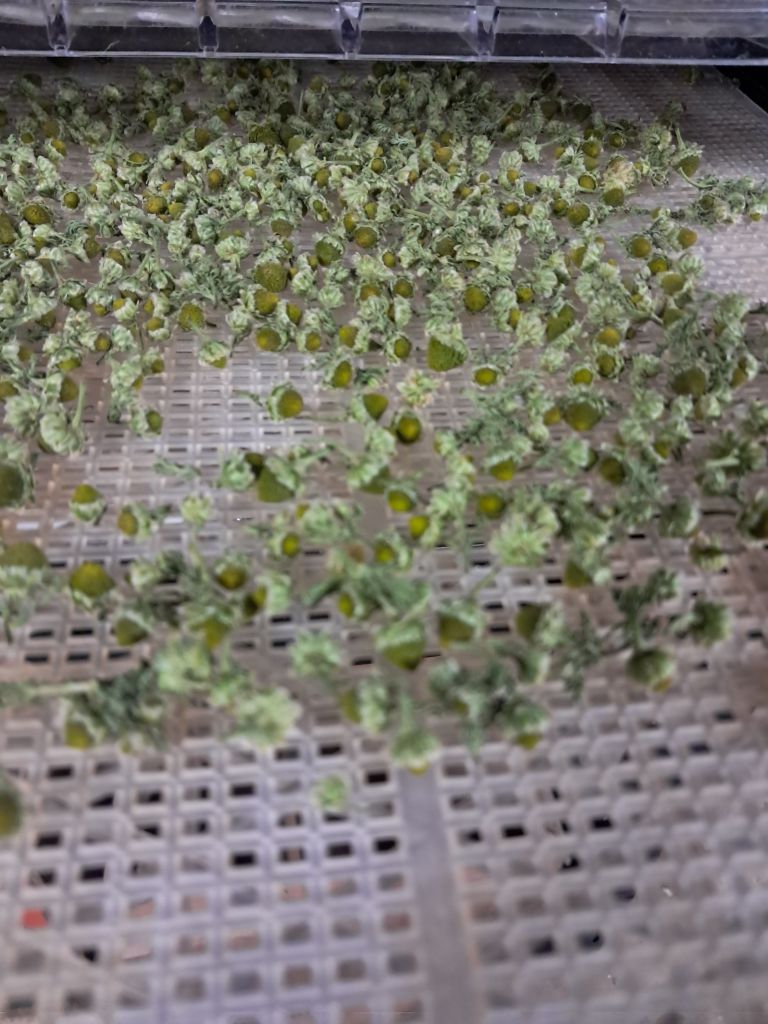
Option 1: Using a Dehydrator
Ready to steep and drink!
If you have a dehydrator, this is the most controlled method.
Spread the blossoms in a single layer on your dehydrator trays.
Set the temperature to around 95°F (a low, gentle setting to preserve flavor and color).
Dry for about 24 hours, or until the flowers are completely dry and papery to the touch.
Test a few by crushing them between your fingers—there should be no softness, just a dry crumble.
Option 2: Air-Drying or Sun-Drying
If you don’t have a dehydrator, you can still dry chamomile.
Spread the blossoms in a single layer on a clean screen, rack, or baking sheet.
Place them in a warm, dry place out of direct rain and heavy dew.
Make sure there is good airflow—near a sunny window or in a protected, breezy spot outside works well.
Gently stir or turn them once a day so they dry evenly.
Depending on humidity, it may take several days. Again, you want the blossoms fully dry and crisp before storing.
How to Store Dried Chamomile
Once your flowers are fully dry, you can store them for months.
Simple storage options:
Glass jars with lids (mason jars work great)
Clean, food-safe containers with tight-fitting lids
Or, going old-school: something like a washed and dried Cool Whip container, just like my husband’s grandmother used
Whichever container you choose, keep it:
In a cool, dry place
Out of direct sunlight
Labeled with the contents and date
Properly dried and stored, your chamomile should keep its flavor and gentle fragrance for a year or more.
Brewing Your Own Foraged Chamomile Tea
Now for the best part: turning those foraged blossoms into a cozy mug of tea.
I have chamomile tea, the kids are drinking other tea tonight!
On a cool winter night (or whenever you need a moment to relax), you can:
Take a tea ball, reusable tea bag, or small infuser.
Add about 1 tablespoon of dried chamomile flowers per cup of water.
Pour boiling water over the tea.
Let it steep for about 5 minutes (longer if you like a stronger flavor).
Remove the infuser, let the tea cool slightly, and enjoy.
You can drink it:
Plain
With a drizzle of honey
With a splash of milk or cream, if you like it a little softer
For us, it’s become a go-to when someone needs to unwind or has a slightly unsettled stomach, and there’s something extra special about knowing you picked those flowers yourself.
A Few Gentle Reminders
As with any foraged herb:
Make sure you’ve correctly identified the plant before consuming.
Avoid areas that may have been sprayed or heavily contaminated.
If you’re pregnant, nursing, or on medications, it’s always wise to double-check with a trusted healthcare provider before adding new herbal teas regularly.
From “Weed” to Teacup
Watching my husband’s grandmother bend down in the driveway and start picking “weeds” for tea completely changed how I look at what grows around us.
Chamomile went from being a box on a grocery shelf to a living, growing plant that shows up in the unlikeliest places—and now, to something our family can gather, dry, and sip together.
If you’ve ever wondered whether you could forage your own tea, chamomile is a gentle, beginner-friendly place to start.
Have you ever foraged something you used to buy at the store?
If this chamomile guide gave you some ideas (or a little confidence to try foraging), would you share it with a friend or save it for later?
Somehow, May is already almost over. If you plant a garden, have you gotten yours in yet?
We’re in Zone 4B, and by late May our garden is finally in full swing. If you’re looking for ideas for your own Zone 4B vegetable garden, here’s exactly what we planted this year and why. In this post, I’m sharing what we planted in our garden this year and the order we planted it in (spoiler: it definitely did not all happen in one day). Think of this as a walk-through of our garden rows, plus a few notes on what’s working, what isn’t, and what we’re excited to try.
Strawberries: The Semi-Permanent Front Row
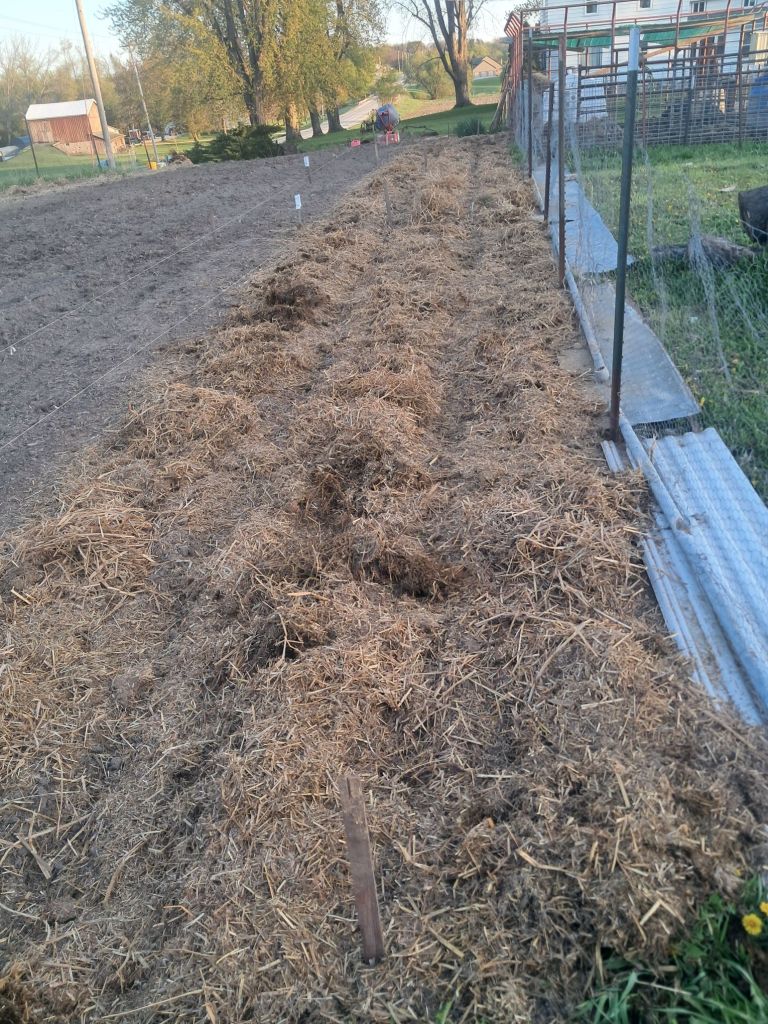
We started about a month ago by dedicating the first two rows of our garden to strawberries. This will be a semi-permanent location for them.
Here’s our basic setup:
Transplanted strawberry plants into two full rows.
Plan to layer straw on top to help suppress weeds and hold moisture in during the warm months.
I’m pinching the blossoms off all the plants for the first two months.
The blossom-pinching feels a little cruel in the moment, but it lets the plants focus on strong root and leaf growth. If all goes well, we should be enjoying delicious berries by July or August from the everbearing varieties.
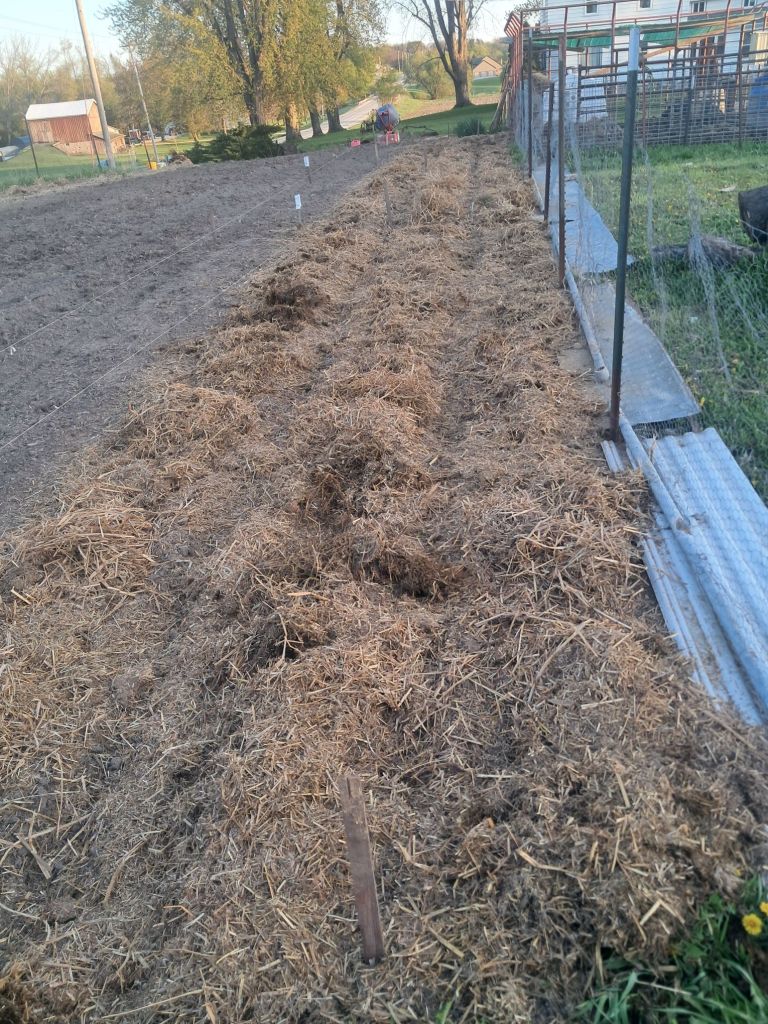
Strawberries plants are hidden amongst the straw (for now)
Root Vegetables: Fresh Salads Now, Storage Roots Later
Next, we planted our root vegetables and salad greens. This is one of my favorite parts of the garden because it gives both quick wins and long-term rewards. (You’ll notice I have a lot of “favorite” parts—my garden just brings me that much joy.)
In this section we planted:
Parsnips – for fresh roots next March and April.
Radishes – for quick crunch and color in early salads.
Lettuce and spinach – fast growers, so we can enjoy fresh greens in just a couple weeks.
Carrots – for fresh eating in the next couple months and for later winter storage.
Beets – for roasting, pickling, and everything in between.
I plan to share in a future post how we keep garden-fresh carrots through the Wisconsin winter, and also how we turn all of these roots and greens into actual meals (rather than just “good intentions” in the crisper drawer).
Radishes, we just harvested our first bunch last night!
Onions: The Powerhouse Vegetable (and a Confession)
After the root bed came two full rows of onions—both red and yellow.
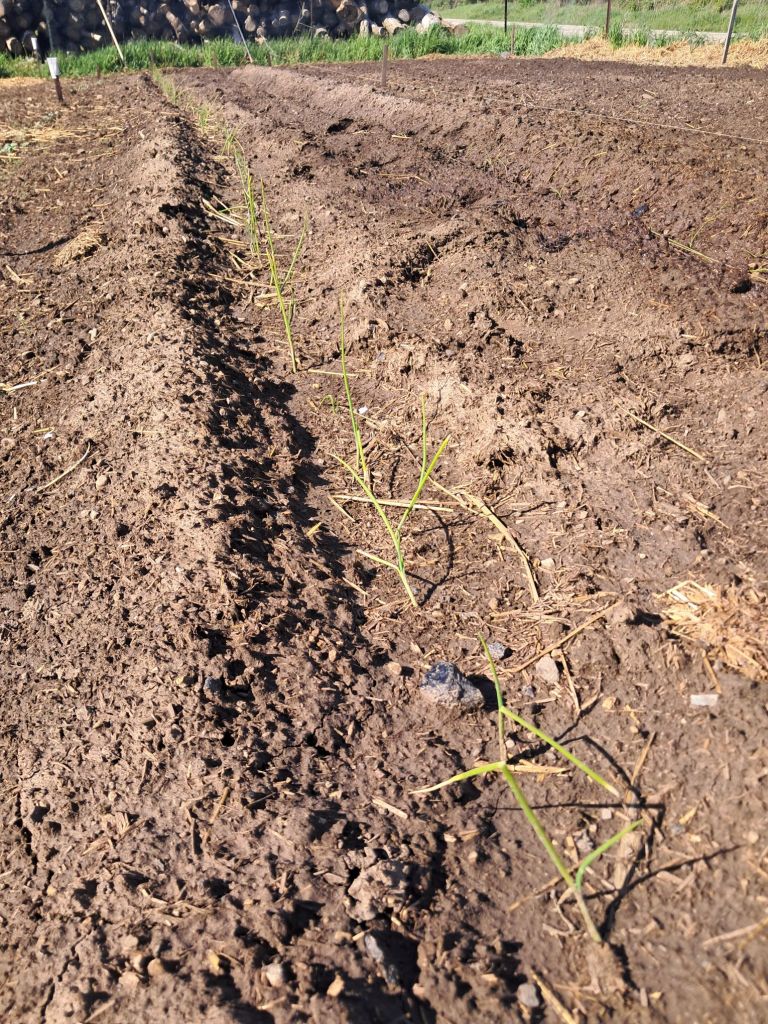
I prefer transplanting onion plants rather than using onion sets. That was the plan this year too…in theory.
Between poor starting soil, my “casual” watering habits, and not trimming the tops, my onion starts never made it to the garden.
Instead, my dad kindly shared some surplus onion plants he purchased from the Amish, and they became our onion rows.
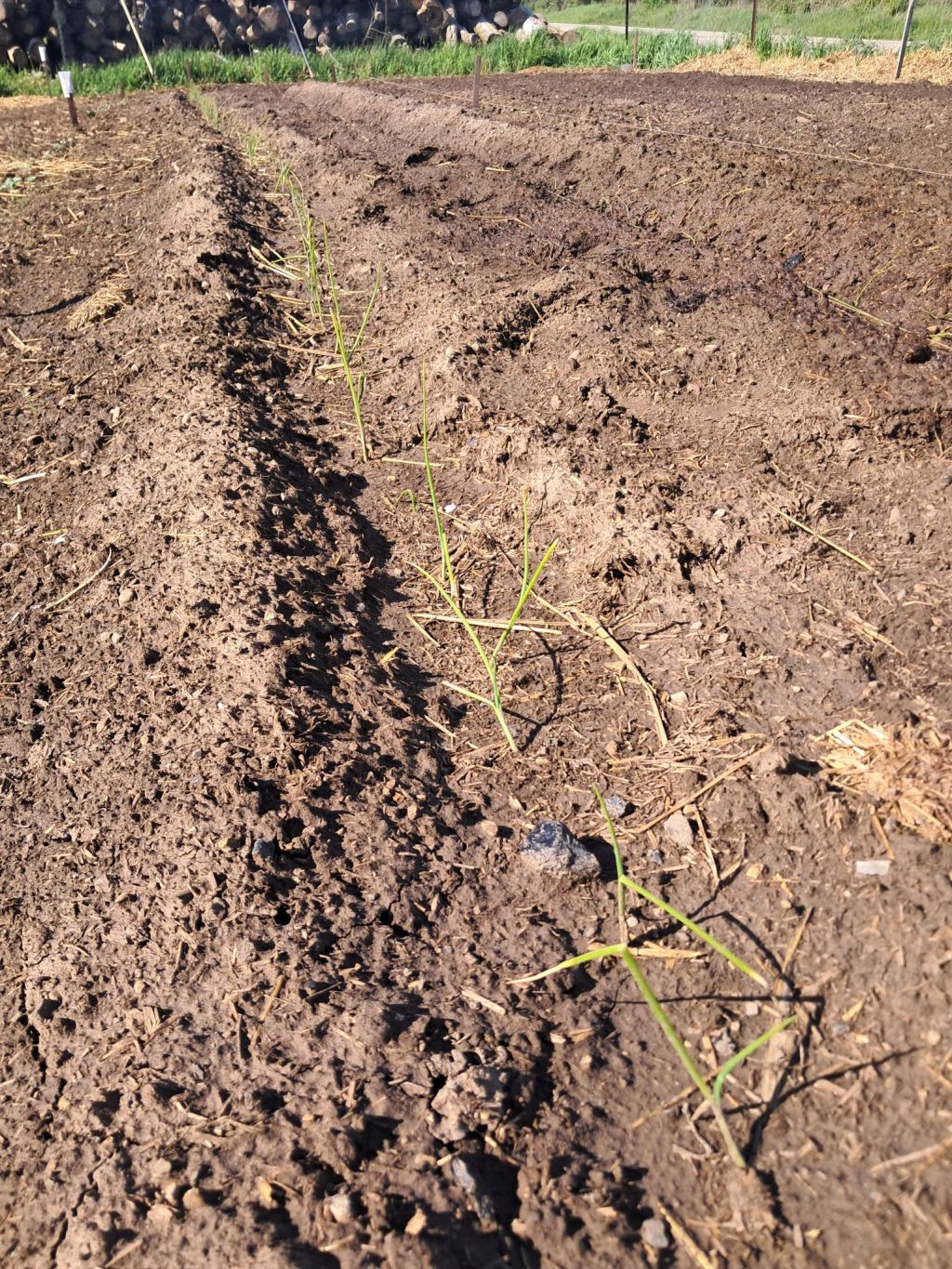
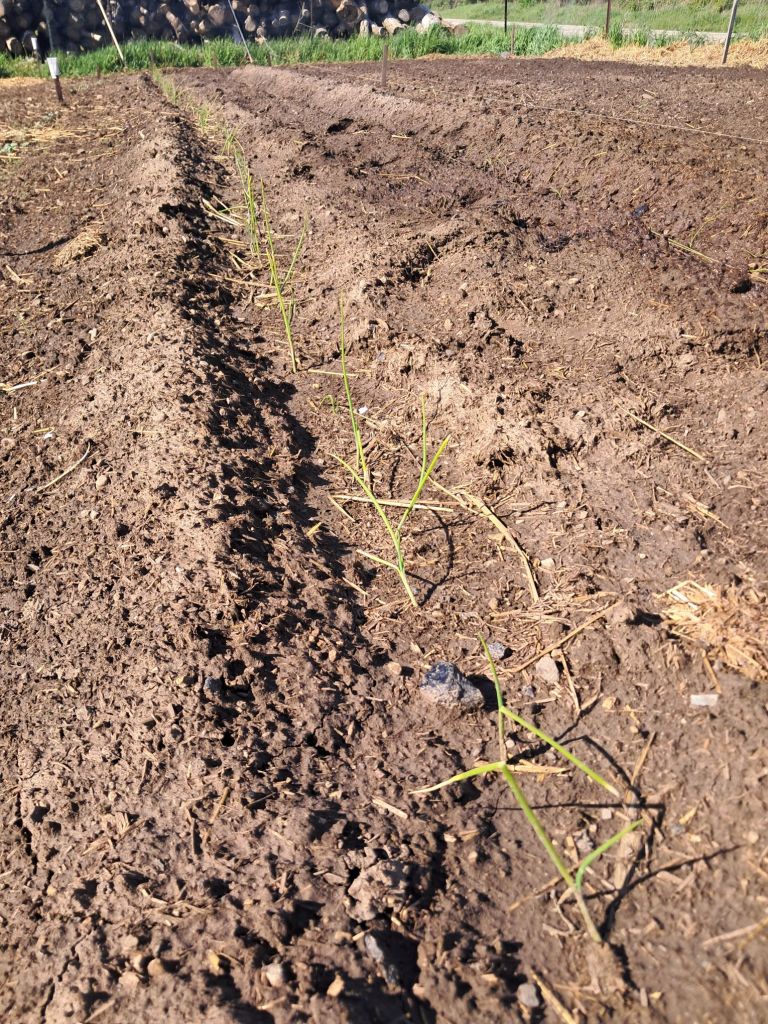
Don’t judge me too harshly for the crooked row. I was planting with a toddler in tow…
Why we love onions:
They’re a true powerhouse vegetable in the kitchen.
They store well when kept under the right conditions.
Even in our less-than-perfect storage setup, I pulled my last onion from last year’s harvest about a month and a half ago.
We plant:
Red onions for fresh eating and pickling (they’re fantastic pickled).
Yellow onions for long-term storage and everyday cooking.
Peas: Kid-Favorite Garden Candy
Next up: peas.
Peas are one of our family’s favorite vegetables to eat right in the garden. The kids love:
Picking them straight off the vine.
Popping the pods open.
Eating the peas fresh, still warm from the sun.
They disappear almost as soon as they ripen.
We installed a trellis right away, but “trellis” might be a generous term. In true homestead fashion, we used:
An old corn crib side as the main panel.
Old fence posts to hold it in place.
We love recycling old farm implements wherever possible—it saves money, reduces waste, and gives these materials a second life.
Somewhere in the sky, an old farmer is smiling down on our resourcefulness (I hope)
Cucumbers in the Middle (On Purpose) + Tomatoes and Peppers
Next came cucumbers.
Some gardeners might be clutching their pearls at this, but yes: we plant our cucumber patch in the middle of the garden.
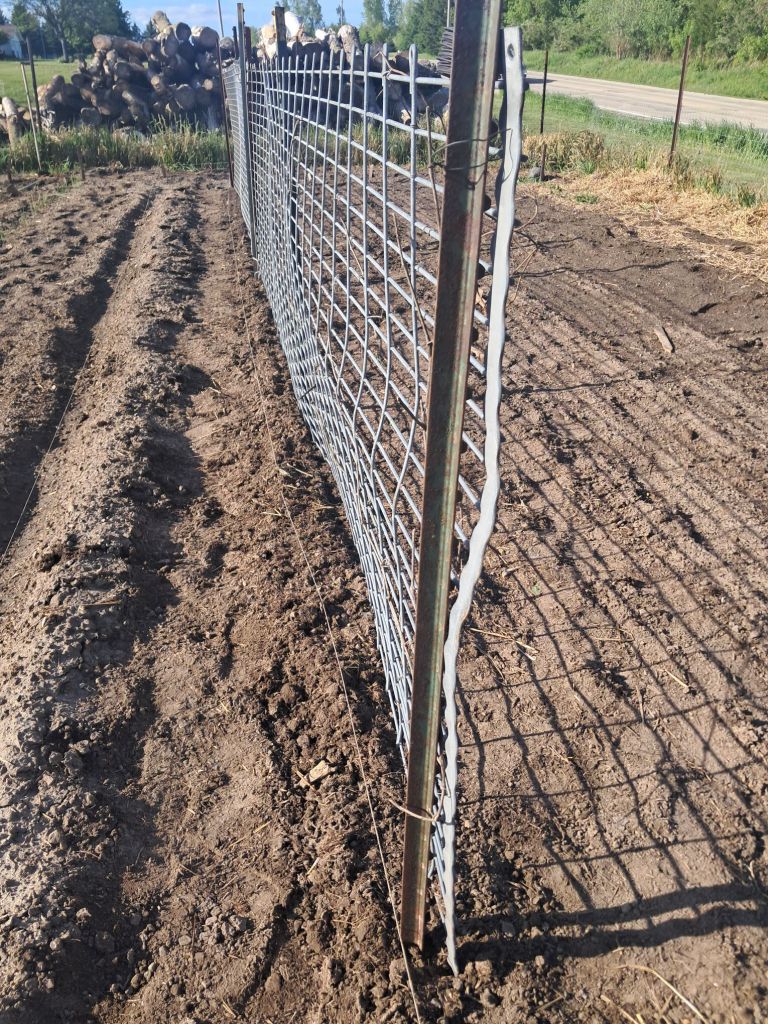
The reason we can get away with this is our trellis. Instead of letting the vines sprawl everywhere, we:
Use an old cattle panel as a trellis.
Hold it in place with old fence posts.
This keeps the vines mostly vertical and contained, which makes it easier to walk around the garden and keeps the cucumbers cleaner and easier to harvest. It might not be traditional, but it works for us.
Once the cucumbers were in, we filled the rest of that row with transplanted veggies:
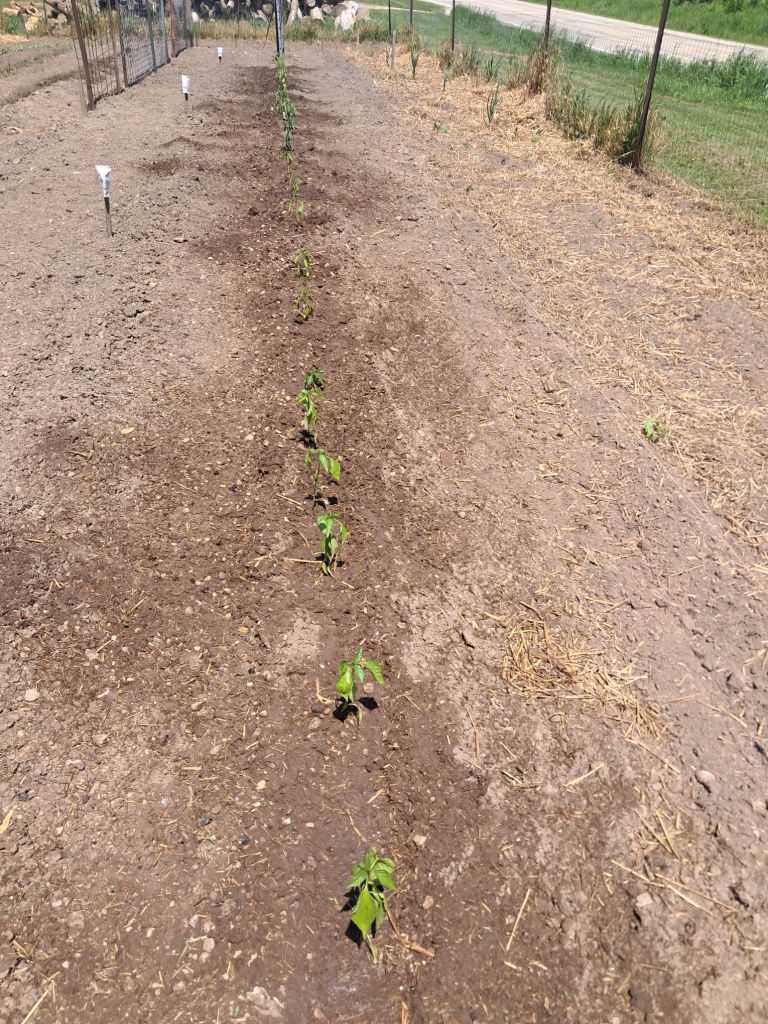
Peppers (both bell and hot).
Tomatoes – a mix of early-ripening varieties, Romas (for sauce), and Mortgage Lifters (for big slicing tomatoes).
Peppers galore!
Cruciferous Row: Cauliflower, Kale, Broccoli, and Brussels Sprouts
The next row is devoted to some of my favorite vegetables: cauliflower, kale, broccoli, and Brussels sprouts.
I love cruciferous veggies for a few reasons:
They’re incredibly versatile in the kitchen.
They freeze beautifully, which makes them a big part of how we keep eating vegetables all winter without visiting the grocery aisle.
They’re hardy and forgiving once established.
In a future post, I hope to share exactly how we prep and freeze these so they stay tasty and usable.
Quick kale note: I may be late to the party, but I also love kale soup. I’m still not sold on kale chips—mine tend to swing between soggy and burnt—but I’m open to conversion if someone can show me the magic method. Shoutout to my friend who shared her Zuppa Toscana (and the recipe!) and officially turned me into a kale-soup person.
Cabbage, More Cauliflower, Bok Choy, and Kohlrabi
The next row is a mix of:
Cabbage – destined for sauerkraut.
More cauliflower – because we’re not sure how well the older seed in the other row will germinate.
A quick note about kohlrabi: the name literally translates from German as “turnip cabbage,” describing its shape. I grew up with it, but I don’t know how many people outside German ancestry know what it is.
Why I love kohlrabi:
It grows above the ground and matures in about two months.
Around the 4th of July, it’s usually ready, and it’s one of my favorite veggies to snack on then.
It’s delicious raw—peeled and sliced.
The flavor is like a cross between a mild radish and broccoli.
I’ve experimented with cooking it, but honestly, we usually eat it raw before I get a chance to cook or roast it. I’ve also pickled it with great success.
If you’ve never tried kohlrabi and you love cruciferous veggies, I’d highly recommend grabbing some seed and giving it a spot in your garden.
Summer Squash and Rutabagas
In the back corner of the garden, we planted summer squash—three hills of it.
In my unsolicited opinion, three hills is about two hills too many. If you’ve ever been buried in zucchini or summer squash, you know exactly what I mean.
The rest of that row holds garlic and rutabagas.
The garlic was planted way too late last October, and it shows; it didn’t come up well.
To make better use of the space, we interplanted rutabagas.
Rutabagas are another veggie I’ve only recently fallen for. They make a great “potato” replacement in mid-summer and are wonderful:
Sautéed.
Roasted.
In pot pies.
Sweet Corn and Cantaloupe at the Front
The front of the garden holds our sweet corn patch.
Full honesty: I have not had the best luck with sweet corn in recent years. The local raccoons and possums seem to love it even more than we do. We’ll see how it goes this year.
On the other side, we planted cantaloupe. In my experience (Zone 4B), you don’t need to transplant cantaloupe:
When you plant seed directly into soil that’s warm enough (late May here), it catches up quickly.
Direct-seeding saves time and space in the seed-starting area.
If you’re curious about how we store carrots, freeze broccoli and cauliflower, or use bok choy in dumplings, those posts are coming (or, in the case of Chinese dumplings, are already here).
Potatoes, Pumpkins, and Future Plans
Beyond the main garden rows, we have two additional patches:
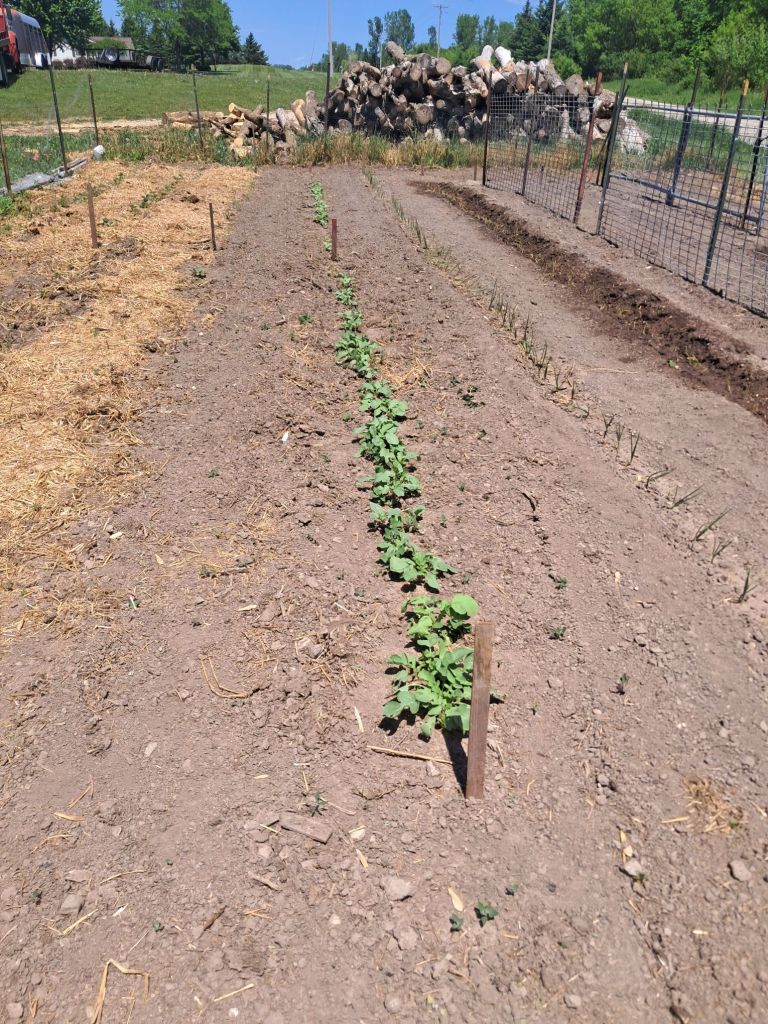
My husband planted a patch of potatoes using a restored potato planter, which was a fun bit of old-meets-new on the homestead.
Behind our barn, we plan to establish a pumpkin patch.
I’m already dreaming of fall pumpkins, roasted seeds, and maybe even some homegrown pumpkin purée for baking.
That’s our lineup for this year’s Zone 4B garden, from strawberries in front to pumpkins out back.
Planning a garden that works for your real life?
Download the free Grow What You’ll Use planner to map out your crops, expected harvests, and how you hope to use them.
What’s growing in your garden this year, and which veggie are you most excited to harvest first?
If this little garden tour gave you some ideas (or just made you feel less behind on planting), would you share it with a fellow gardener or save it for later?
You can also join my email list for more honest, Zone 4B garden updates, planting ideas, and what’s actually working for us from season to season.
The process of purchasing meat directly from a farmer is a little different than grabbing a package from the grocery store. It takes more planning, dependable freezer space, and a willingness to think about your food in a new way.
But in return, you get so much more than just meat.
If you’ve ever wondered how to buy a quarter beef or half pig from a local farmer, this guide walks you through the whole process.
Knowing How Your Meat Was Raised
There’s something powerful about being able to visit the animal that will eventually feed your family.
When you have a good relationship with a farmer, you can:
See where the animals live
Watch what they eat
Notice how they’re handled and treated
To be a good farmer is to be empathetic. You’re working with living beings that deserve dignity. They don’t deserve to live in filth, inside all the time, never able to root, scratch, or roam according to their instincts.
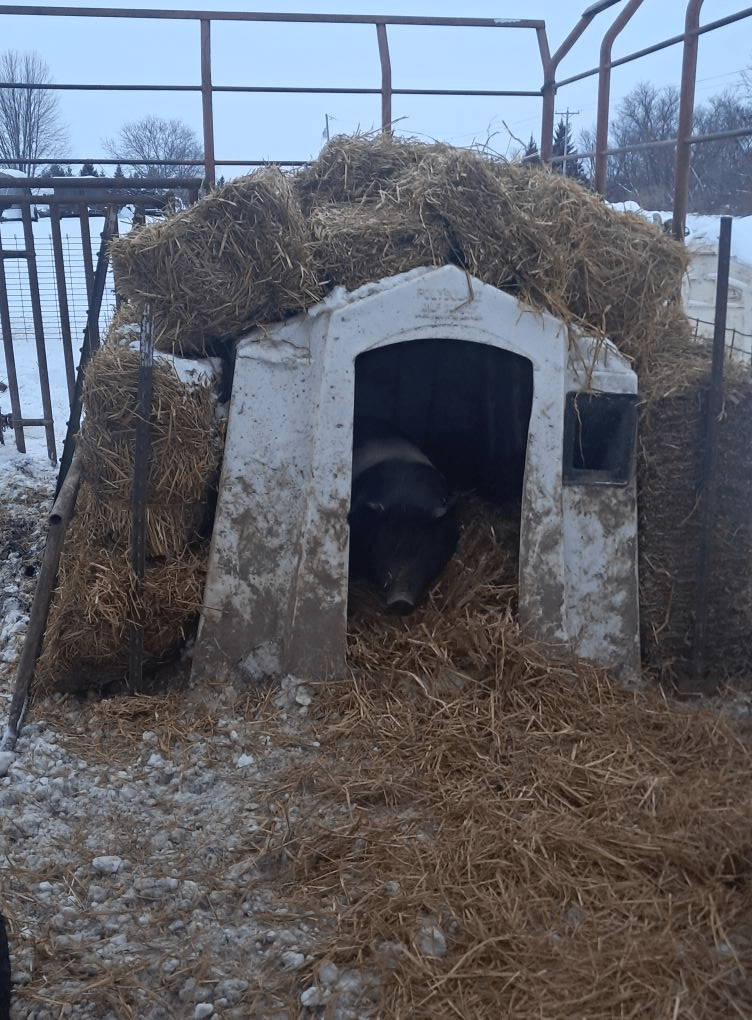
On our homestead, for example, our pigs are raised outside all the time. They can root, eat grass, make mud puddles, and scratch. We don’t dock piglets’ tails because we let them nurse from mom long enough that they don’t get frustrated and chew on each other. In winter, we help them stay warm in a few ways: we feed them extra so they can build up fat reserves, and we add plenty of straw and insulation around their pig hut (which, for us, is an old calf crate). Think of it like the house of straw from the three little pigs—but this one is reinforced with solid supports and a lot more intention.
Little Pig, Little Pig, Let me in!
When you buy meat from a farmer whose practices you know and trust, you’re not just buying a product. You’re choosing a story you feel good feeding your family.
Bulk Meat, Full Freezer, and Creative Cooking
Buying meat in bulk pushes you to think beyond just bacon, sausage, and ham.
Pigs, for example, are so much more than the “usual” cuts. Have you ever had:
A well-cooked pork steak or pork chops
Homemade uncased breakfast or Italian sausage (not at all difficult to make)
Marinated side pork (uncured bacon) cooked over a grill or campfire (this one is a total game changer)
There’s a whole world of flavor and texture in a single animal, and learning to cook those different cuts can actually be fun. I plan to share more recipes and cooking ideas in future posts if you’re interested in exploring beyond the basics.
There’s also the very practical side: having a full freezer of meat means:
Fewer last-minute grocery runs
Less impulse spending on convenience food
One less thing to juggle when life is busy
With a little forward planning, you’re essentially building your own little “store” at home that you can shop from all year. When you’re tired, sick, or snowed in, knowing you have meat on hand for soups, roasts, tacos, casseroles, and quick meals is a huge relief.
Planning to Fill Your Freezer?
Get the free Grow What You’ll Use planner to think through what your household actually uses, how you want to store or preserve food, and what will make the most of your freezer space.
Helps a neighbor maintain their land, care for animals, and keep going another season
Ideally, this relationship grows beyond a simple transaction. Over time, you get to know each other. You learn their rhythms and challenges; they learn about your family and your needs. Maybe they text you pictures of new piglets, or you bring your kids out to see the calves.
You’re not just “a customer”—you’re part of the farm’s story too.
In other words, you’re trading a little extra planning upfront for better meat, deeper connection, and a more secure pantry.
How Buying Meat in Bulk from a Farmer Works
Now that we’ve talked through the benefits, let’s look at how this actually works in practice.
When you purchase meat directly from a farmer, you typically buy a portion of an animal, not just an individual package. You’ll usually be offered:
A quarter
A half
A whole
The exact options depend on the type of animal and the farmer.
Buying a Quarter or Half Beef
A beef animal (steer) is large, so it’s commonly broken into quarters.
One quarter of beef usually equals around 200 pounds of freezer meat (this can vary based on size and breed).
A half or whole animal would, of course, be proportionally more.
This sounds like a lot—and it is—but once you break it down into ground beef, roasts, steaks, stew meat, and soup bones, most families are surprised how quickly they use it over the course of a year. For many four-person families, a quarter beef can comfortably supply most of their beef for many months, if not close to a full year, depending on their eating habits.
You’ll sometimes hear people call this a “quarter cow,” but “quarter beef” is the more accurate term.
Buying a Half or Whole Pig
Pigs are smaller, so they’re often sold as halves or wholes.
A half pig usually yields around 100 pounds of freezer meat.
A whole pig is roughly 200 pounds, give or take.
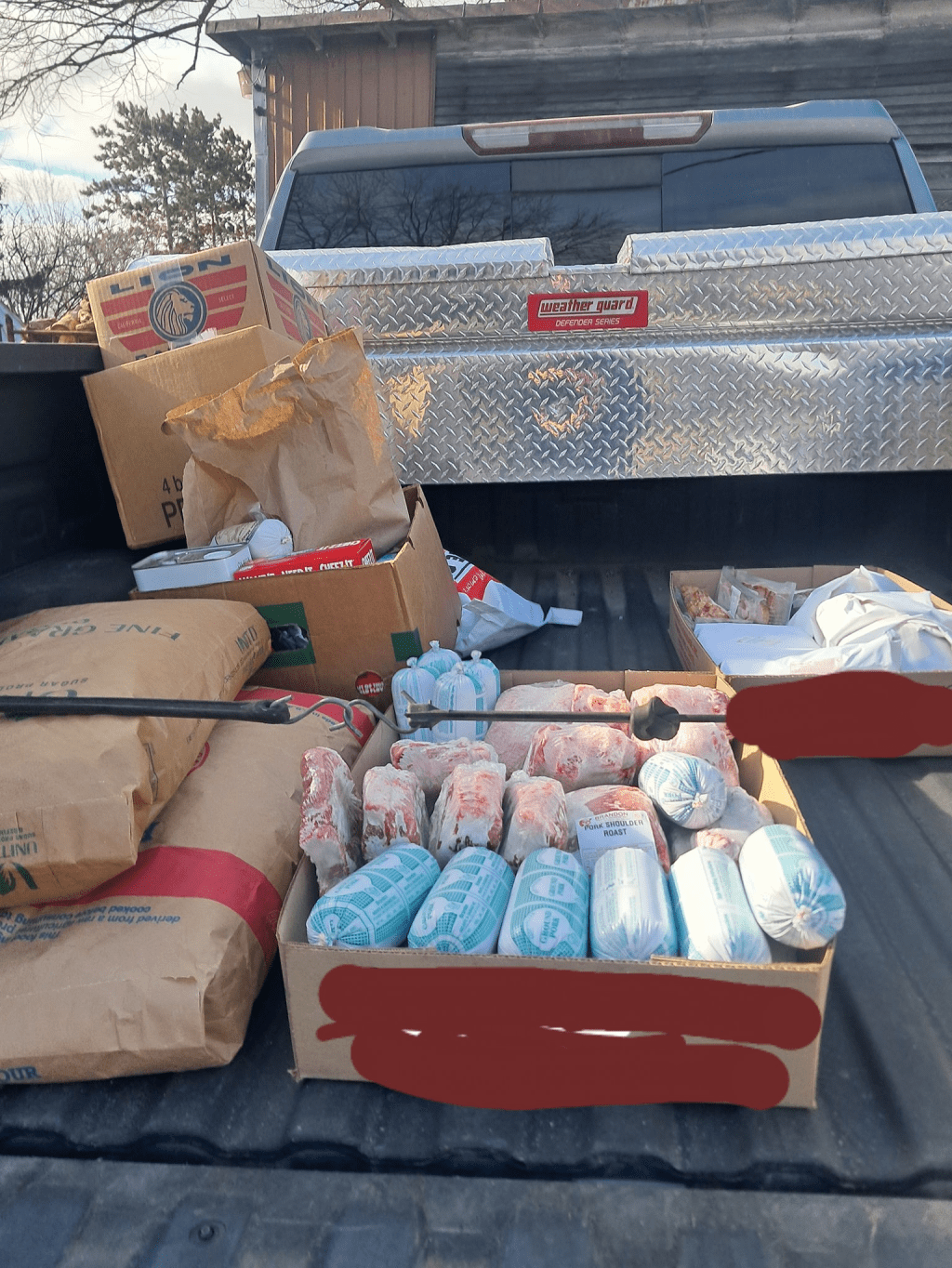
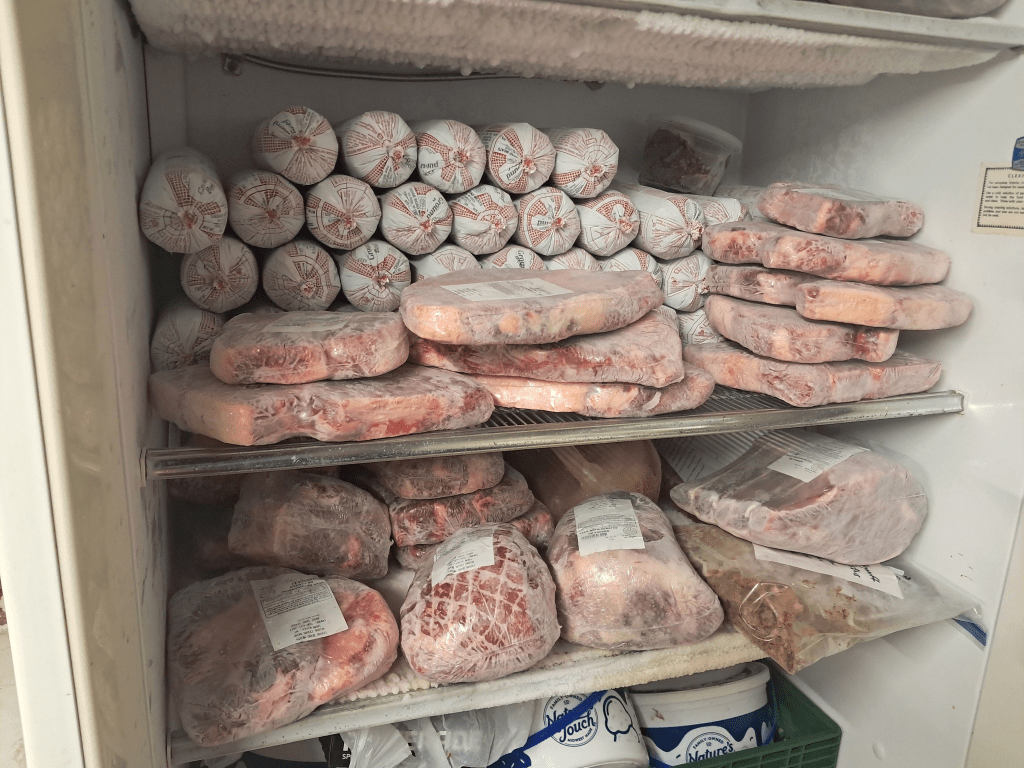
The 2 boxes on the right show what a half pork looks like, labeled and packaged. The rest is my Amish suppies.
The pork is split between bacon, ham, ground pork or sausage, and various cuts. For our four-person family, a whole hog is enough pork to last us about one year. Your experience may vary based on your family’s eating habits.
Again, these are ballpark numbers, but they’re helpful for planning. You can always split a half or a whole with another family if that feels more manageable.
Freezer Space for Bulk Meat Orders
Buying a quarter of beef or a half pig means one very practical thing: you need somewhere to store it.
A few things to consider:
Freezer Type
We use both a chest freezer and an upright freezer between our beef, pork, frozen garden vegetables, and other grocery store finds (yes, I do still grocery shop, but more like monthly). Either style works; it often comes down to space and personal preference.
Chest freezers tend to be more energy-efficient and stay cold longer if the power goes out.
Upright freezers are easier to organize and access because everything isn’t stacked on top of everything else.
Our chest freezer full of frozen beef (this is what a quarter beef looks like).
Finding a Freezer
You can often find secondhand freezers at a bargain on places like Facebook Marketplace or local buy/sell groups if you’re willing to watch for deals and clean them. Just make sure you can test that it gets and stays cold before you bring it home.
Electric Considerations
Ideally, your freezer should be on a dedicated electrical circuit to reduce the risk of tripping a breaker and silently losing everything. If you’re unsure, it’s worth asking someone handy or an electrician to check.
Power Outages
If there is a power outage, resist the urge to open the freezer “just to check.” A closed, full freezer will stay cold much longer than you’d think. If your area loses power frequently, having a small generator on hand for your freezer might be worth considering.
Think of your freezer as a savings account: that meat is your hard-earned money in frozen form. You want to protect it.
Planning Ahead with Your Farmer
Farmers can’t just create finished animals overnight. It takes time to raise them to a good butcher weight, and many farms book processing dates months in advance.
As a rough guide:
A beef animal takes about 2 years to raise.
A pig takes about 6 months.
Most farmers plan their processing schedule well ahead of time. If you’re thinking of buying meat in bulk:
Reach out to a farmer several months (or even a season) in advance.
Ask when they typically send animals to the processor.
Get on their list early, especially if they’re a smaller operation.
You can also ask about breed and feeding practices (grass-fed, grain-finished, pasture-raised), so you know exactly what you’re getting.
Building a Relationship While You Wait
During that time, you can do more than just wait for a phone call.
Visit the farm if that’s an option.
Ask questions about how they feed and house animals.
Let your kids (if you have them) see where their food comes from and ask their own questions.
Every farmer I know—and I know quite a few, thanks to my agricultural background—loves to talk about their animals. They’ll tell you about personalities, quirks, and challenges. For most of them, farming is a vocation, not just a job. They’re in it because they care.
Understanding the Two Bills: Animal and Processing
When the processing date gets closer, your farmer will reach out with more details, such as:
Which butcher/processing facility they’re using
The approximate hanging weight of the animal, and the price per pound for their part
The approximate date you can expect to pick up your meat
This is also when you’ll want to understand how payment works. When you purchase directly from a farmer, you’re usually paying two separate bills:
The animal itself – paid directly to the farmer
The processing/butchering – paid directly to the butcher or processing facility
The farmer can tell you their rate structure (per pound, flat rate, etc.), and the processor will have their own fee schedule based on your preferences—cutting, wrapping, curing, sausage-making, smoking, and so on.
Working with the Butcher on Cut Choices
Once the farmer takes the animal to the butcher shop, their part in the story is essentially done. Next, the butcher shop (to whom the farmer has passed along your contact information) will reach out with questions about how you want your meat processed.
A good butcher will walk even the least experienced person through the process. Some examples of decisions include:
More roasts or more ground?
How thick do you want steaks or chops cut?
What kinds of sausage would you like, and in what size packages?
Do you want soup bones, organ meats, or extras like lard or fat?
The possibilities are truly endless, and you can customize it in the way that works best for your cooking. One year, you might prefer 1‑pound packages of ground beef or pork; the next year, you might decide you’d rather have 1.5‑pound packages to better fit your favorite recipes. You can adjust as you learn what your family actually uses.
Picking Up Your Bulk Meat Order
The last part is picking up your meat from the butcher.
The processor will contact you when everything is cut, wrapped, and frozen, and they’ll share the total cost due to them.
It’s important to ask whether you need to bring coolers or boxes to store the meat on the way home. Some butchers provide boxes; others do not.
There’s nothing worse than showing up unprepared and having 200 pounds of meat rolling around loose in your vehicle. Don’t ask me how I know.
A few final tips:
Bring sturdy boxes or coolers so you can stack and carry the meat easily.
Bring a pair of gloves—the meat is cold and pre-frozen, and you don’t want frozen fingers by the time you’re done loading and unloading.
Make sure you have your freezer space ready and cleared before pickup day, so you’re not rearranging everything with a car full of thawing meat.
It can feel more complicated than grabbing a package at the store, but once you’ve done it, it starts to make sense. And the reward is a freezer full of meat you feel good about, with a story you actually know—and a farmer you can call by name.
Common Questions About Buying Meat from a Farmer
Is it cheaper than grocery store meat?
It depends on what you’re comparing it to.
If you usually buy the cheapest grocery store meat and the bargain cuts, buying from a farmer may cost a bit more per pound.
If you usually buy higher-quality or “natural” meat, buying in bulk from a farmer is often the same price or cheaper—and you’re getting better quality and supporting a local family.
One important consideration is that you pay one price per pound of processed meat. This includes the more expensive cuts like pork belly or tenderloin, and the “lesser” cuts like spare ribs and pork hocks. The more expensive cuts come down in price compared to the grocery store, and the “lesser” cuts are typically at or slightly higher than grocery store prices.
The biggest difference is that you’re paying for a large amount at once instead of spreading it out over many small trips—and all the tempting last-minute impulse purchases grocery stores are so good at encouraging.
Do I have to take cuts I don’t know how to cook?
No—and also, not forever.
You can customize your order a lot. For example, if you don’t like roasts, you can ask for more ground.
You can skip certain things (like organ meats) if you know you won’t use them.
Over time, you might decide to try one or two “new” cuts each year as your confidence grows.
You’re not locked into one way of cutting forever; you can adjust each time you order.
What if I don’t have enough freezer space for a whole or half animal?
You have options:
Split a quarter or half with a friend or family member.
Ask your farmer if they know anyone looking to “share” an animal—many do.
Start smaller (for example, a quarter beef instead of a half, or half a pig instead of a whole).
You don’t have to jump straight into a full animal on your first try.You have options:
Split a quarter or half with a friend or family member.
Ask your farmer if they know anyone looking to “share” an animal—many do.
Start smaller (for example, a quarter beef instead of a half, or half a pig instead of a whole).
You don’t have to jump straight into a full animal on your first try.
How long will the meat last in the freezer?
If it’s wrapped well and kept consistently frozen:
Most cuts are best within 12–18 months, though many will last longer and still be safe to eat.
Ground meat is typically best within 6–12 months for peak quality.
Labeling packages with the date and type of cut makes it much easier to rotate and use things in a good timeframe. A good butcher will do that for you.
What if I’m nervous about making the wrong choices?
You’re not alone—almost everyone feels that way the first time.
A few reassurances:
Farmers and butchers are used to first-timers. They expect questions.
A good butcher will walk you through the options and explain what’s common for families like yours.
You can keep things simple your first time (basic steaks/chops, roasts, and ground), then get more adventurous with sausage, specialty cuts, and smoking on your next order.
Think of your first bulk order as a learning experience. You’ll quickly figure out what your family uses most.
If You’re Local and Want to Buy from Us
If you’re local (Southeastern Wisconsin) and interested in buying pork from our homestead, we’d love to connect.
Because raising and processing animals is a big investment, we use a simple reservation and deposit system so everyone knows what to expect:
You reserve a portion (half or whole) with a small non-refundable deposit.
We raise and deliver the animal to the butcher on the scheduled date.
Once we know the hanging weight and processing cost, we send you a clear invoice.
After payment, you pick up your meat at the butcher.
If that sounds like something you’d like to explore—or if you just have questions—feel free to reach out. We’re happy to talk through the process and see whether it’s a good fit for your family.
Have you ever bought a quarter beef, half pig, or other bulk meat from a farmer—or is it something you’ve been curious (or nervous) to try?
If this helped answer some questions—or made buying meat from a farmer feel a little less intimidating—please like and share it with a friend who’s been talking about “finding a local farmer.” It makes a bigger difference than you think.
This spring on our homestead has been both chaotic and full of life. Between new animals, fresh plantings, and long-awaited property upgrades, it feels like everything is waking up at once. If you’re curious what real-life spring homestead projects look like for us—or looking for ideas for your own place—here’s what we’ve been up to.
Spring Planting: Fruit Trees, Strawberries, and Garden Beds
This spring, we’ve focused heavily on long-term food production. We planted new fruit trees, added strawberries, and finally started planting the garden.
Fruit Trees
We put in three apple trees to start planning ahead for the day when our older orchard slows down. Our established apple trees are slowly starting to die off, so these new trees are our way of making sure future us still has apples to harvest. In addition, we’ve planted two pear trees (because my 6-year-old son absolutely loves pears, and we love them too). All the fruit trees should start producing a small amount of fruit in about three years, with bigger harvests in the years after that. The kids are already talking about how they “can’t wait” to pick our own apples and pears someday.
Strawberries
We also planted 75 strawberry plants in three different varieties. About two-thirds are everbearing strawberries, which produce fruit throughout the growing season. The remaining third are June-bearing strawberries, the kind that give you that big flush of berries in June—what most people know from U-pick strawberry farms.
Hard to see, but the strawberries are there!
We’ll pinch the blossoms off the everbearing strawberries for the first couple of months while their root systems establish, then we’ll start letting them fruit. For the June-bearing strawberries, we’ll pinch all the blossoms this year so they can focus on roots, and we should start seeing fruit next summer. The kids are already excited, asking when they’ll get to pick strawberries and dreaming aloud about “strawberry snacks” straight from the garden.
Field and Garden
Out in the field, my husband planted our two-acre plot of oats, then tilled up a 120-foot by 30-foot field behind our barn (I know, cute) where we planted high population corn (planted more closely than typical field corn). These crops are intended to become feed for our pigs, chickens, and turkeys, which feels like a big step toward growing more of our own animal feed.
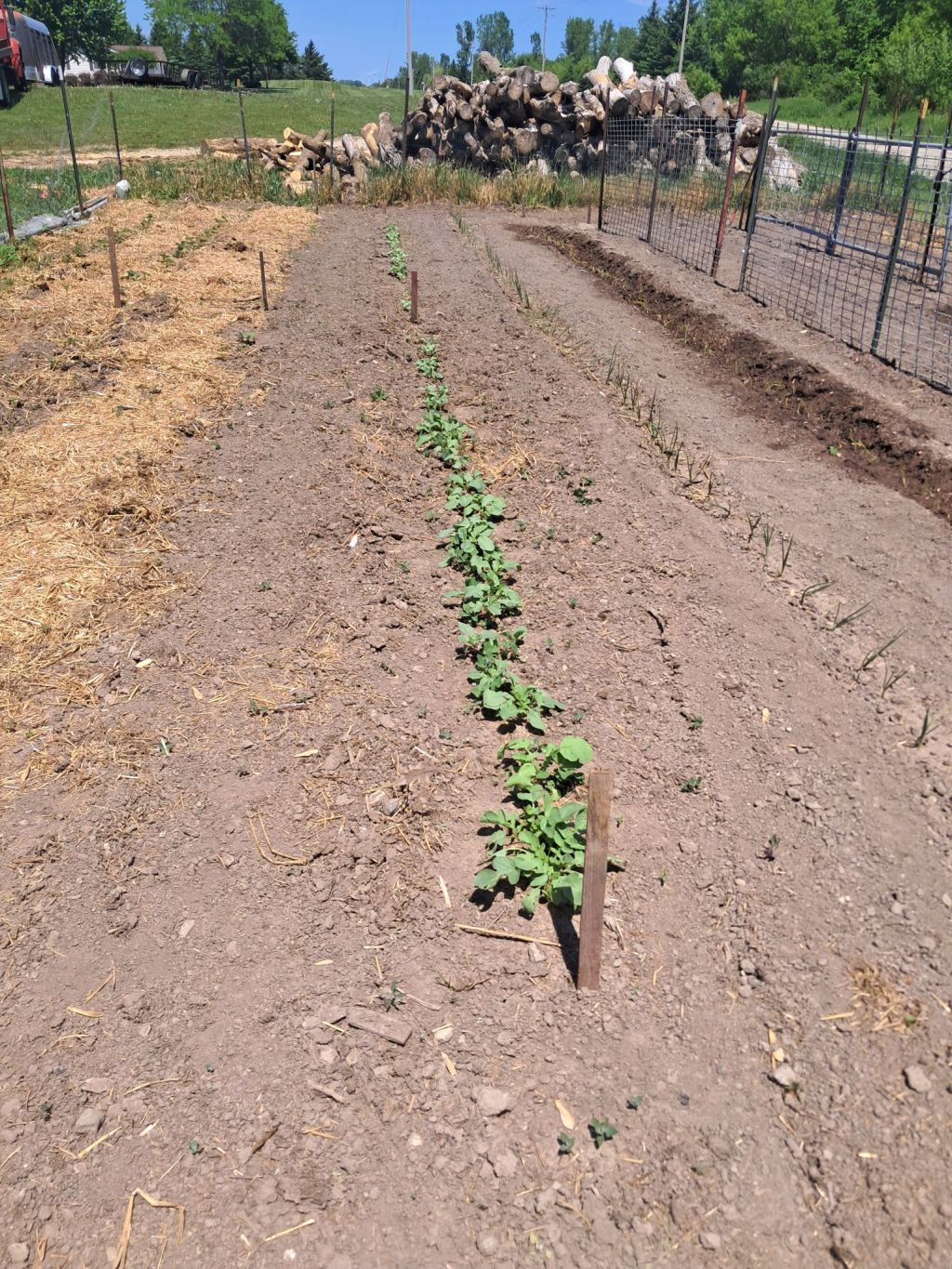
Once the April flooding finally receded, we started planting the main garden. So far we’ve gotten radishes (the perfect cool-weather crop), rutabagas, parsnips, and transplanted onions in the ground. There’s still plenty more to do, but it feels good to see those first rows planted.
Don’t judge my not-too-straight row of onions too harshly please!
Spring Animal Projects: Piglets, Chicks, and Turkeys
Anyone with animals knows that adding more livestock takes planning, patience, and a little bit of risk.
Piglets
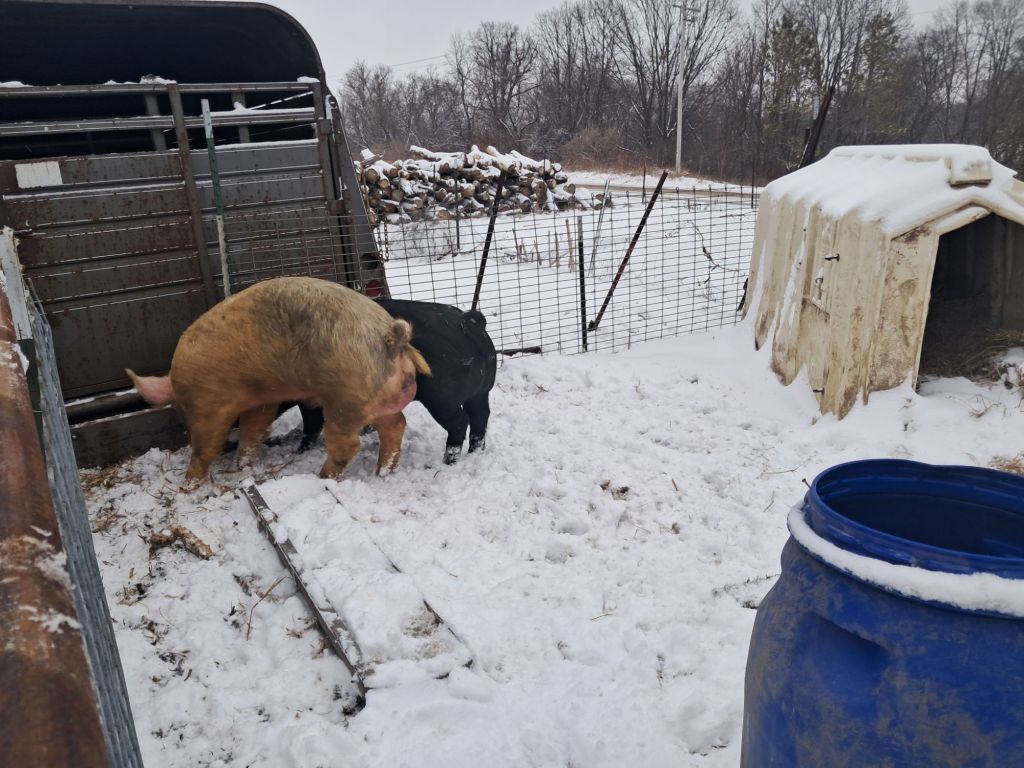
Last year, we added two gilts to our pig herd and decided—almost on a whim—that we wanted to try farrowing piglets. Of course, biology says you can’t have piglets without a boar, so my brother-in-law graciously lent us his boar for two weeks in mid-January. In return, we helped him by cutting down a tree. Homestead barter at its finest.
Mr. Eligible Bachelor (pink) as he wooed his lady.
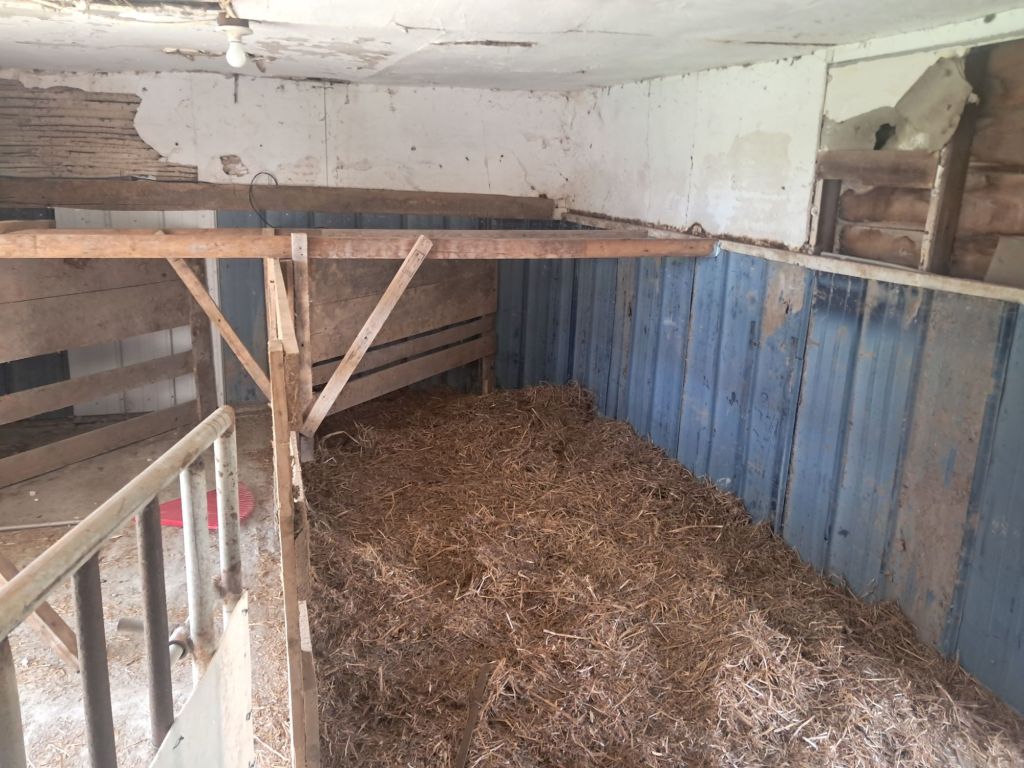
Next, we needed a safe space for piglets to be born and grow for the first several weeks. My husband converted an old dilapidated shed into functional farrowing quarters. He shored up rotten sections, set used silo staves in cement to make a makeshift floor, and built a farrowing crate from reclaimed wood. He even added lights, knowing we’d be checking on her at all hours until she finally gave birth.
All ready for some babies!
So far, one gilt has farrowed 10 piglets, and the second is due any day. We love having little babies around the homestead—it’s noisy, busy, and pretty wonderful.
Our plan is to either sell some of the piglets as feeder pigs or raise them for pork that’s grown outside on pasture. If you’re local (SE WI) and interested in either, feel free to reach out.
Chicks
About a month ago, we also added to our poultry flock. We purchased 15 straight-run Wyandotte chicks and set them up in our basement. At the same time, I set up my incubator with 22 eggs.
My first attempt at incubating eggs was a complete failure—I didn’t hatch a single chick from 47 eggs. Lesson learned: the orientation of the eggs in the incubator matters. They can’t be placed upright in egg cartons; they need to lie horizontally or they simply won’t develop.
This time, with the eggs properly positioned, 10 chicks hatched and 9 survived. That gives us 24 new chicks total. In theory, about half will be roosters and half hens. We plan to keep one rooster as our new stud, and the rest of the roosters will eventually head to “freezer camp” and become shredded chicken for soups, broth, and casseroles (yes, I’m from Wisconsin, and we call it casserole). The kids love checking on the chicks in the brooder, counting them, and reporting back on who’s sleeping, who’s eating, and which one is “their” favorite.
Turkeys
Our turkeys have their own spring plans. Both turkey hens found separate hidden spots around the property to sit on nests—despite the small detail that there are no toms currently on the homestead. My husband decided to do a little switcheroo and swapped one turkey’s eggs for fertile chicken eggs. We’ll see if any of those end up hatching. There’s never a dull moment with birds.
Property Improvements: Upstairs Progress and Cleanup
Spring hasn’t been all about plants and animals; we’ve made progress on the house and property, too.
Upstairs Progress
For those who don’t know, we bought our house in 2023 with an unfinished upstairs. Earlier this month, carpet was finally installed in most of that space, and now we’re down to finishing touches like closet doors and furniture. The last third of the upstairs still needs to be completed, and we’re planning to add a bathroom upstairs so we don’t have to navigate steep stairs in the middle of the night.
Outside Cleanup
Outside, my husband has been on a mission to clean up the property again, hauling away loads of scrap metal. The plan for this summer is to shore up one of the existing buildings so we can use it as temporary cover for our equipment while we demolish old structures and replace them with something more functional.
It’s a lot—but it’s the good kind of work.
Spring on a homestead is always busy, but seeing these projects come together—fruit trees in the ground, piglets in the barn, chicks in the brooder, and an upstairs that finally feels like it’s becoming livable—makes all the mud, mess, and chaos feel worth it.
It’s one more season of growing food, raising kids alongside all this work, and slowly building the kind of place we want to call home.
What spring projects are you working on around your home or homestead right now—plants, animals, or house upgrades?
If this gave you ideas—or just made you feel less alone in the spring chaos—tap like and share it with a friend who’s also growing, raising, or rebuilding something this season.
This is a shorter post this week, but it feels like a big one.
We have piglets.
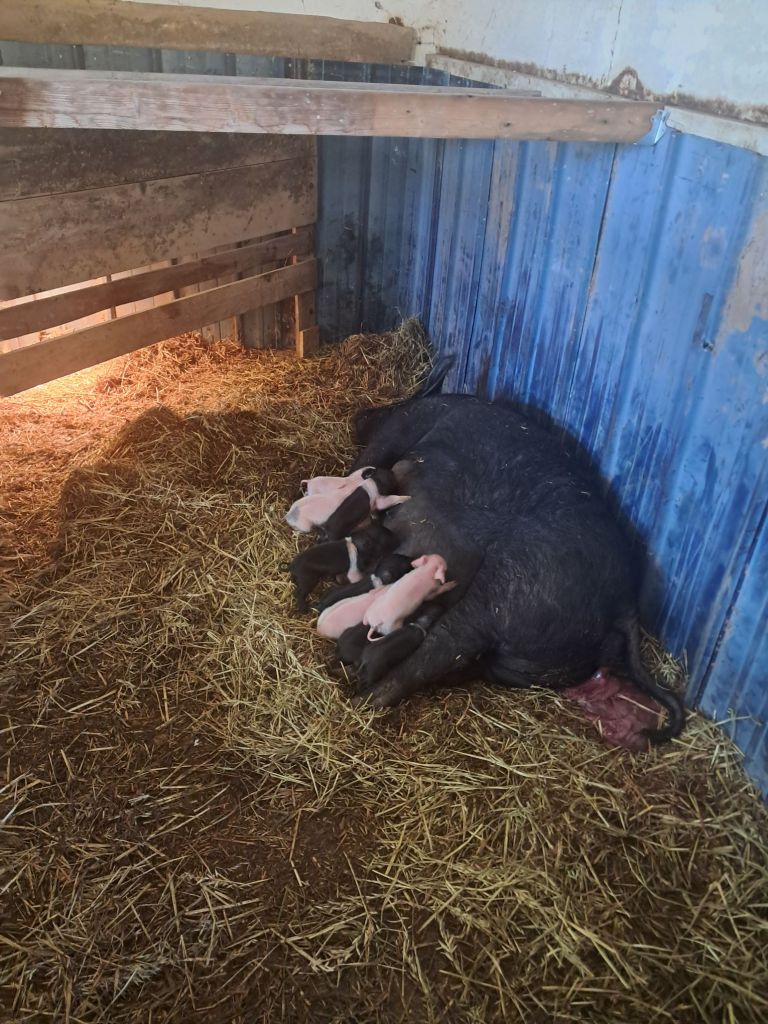
On Monday afternoon, our first gilt farrowed 10 piglets (and one stillborn), and it was our first time experiencing pig farrowing firsthand. One minute we were checking on her like we had so many times before, and the next we were in the middle of something real and messy and alive. There’s no easing into it when it starts—you go from waiting to catching babies in what feels like a breath.
At one point, the farrowing process stalled, which raised our anxiety pretty quickly. From what we’ve learned, pauses can happen during farrowing, but in the moment it’s hard to know when to wait and when to step in. We hovered, second-guessed ourselves, and tried to stay calm. In the end, she worked through it on her own, which was both a relief and a reminder that animals often know exactly what to do if we give them space.
Once the piglets were here, things shifted into action mode. We cleaned them off, making sure each one was breathing well and able to stay warm. My brother-in-law walked us through administering oxytocin so she could relax and start nursing. Watching those piglets root and latch felt like a turning point—less “are we going to be okay?” and more “okay, this is working.”
Momma and babies as they attached for the first time.
We stayed with her for the first couple of hours, keeping a close eye out so no piglets were accidentally crushed. One thing we learned quickly is how important it is to watch the sow’s movements closely, especially when she shifts or lays down. It’s a strange balance of awe and vigilance. Every small movement feels important. Every squeal makes you look twice—and resist the urge to intervene to prevent piglet crushing.
This is the part of raising animals, and growing food, that doesn’t always make it into the highlight reel. It’s messy, a little nerve-wracking, and very real. But it’s also where the learning happens: in the doing, in the watching, and in showing up before you feel fully ready.
And maybe that’s the overlap I keep noticing lately—between raising animals and raising kids. You prepare as much as you can, gather advice, set things up the “right” way… and then you step back and let life unfold, staying close enough to help but far enough away to let growth happen.
Right now, the piglets are tucked in close to momma, and we’re checking on them more often than we probably need to. It feels a little like bringing home a newborn again—equal parts wonder, worry, and watching something new take its first steps in the world.
Growing food, raising kids, building community… sometimes all three show up at once, in a farrowing pen on a Monday afternoon.
Have you ever been present for an animal birth on your farm? What surprised you most?
If this little farrowing story made you smile (or taught you something), please like and share with fellow homesteaders!
About every two months, I make the hour-long trip to the nearest Amish settlement to stock up on bulk groceries. It’s a steady rhythm in our homesteading life—bringing home 50-pound bags of bread flour, dried vegetables, bulk pasta, and active dry yeast that stock our pantry and turn into loaves of bread, tortillas, and buns in the weeks that follow.
But if you ask my kids, the highlight of every trip is the same: the Amish bakery.
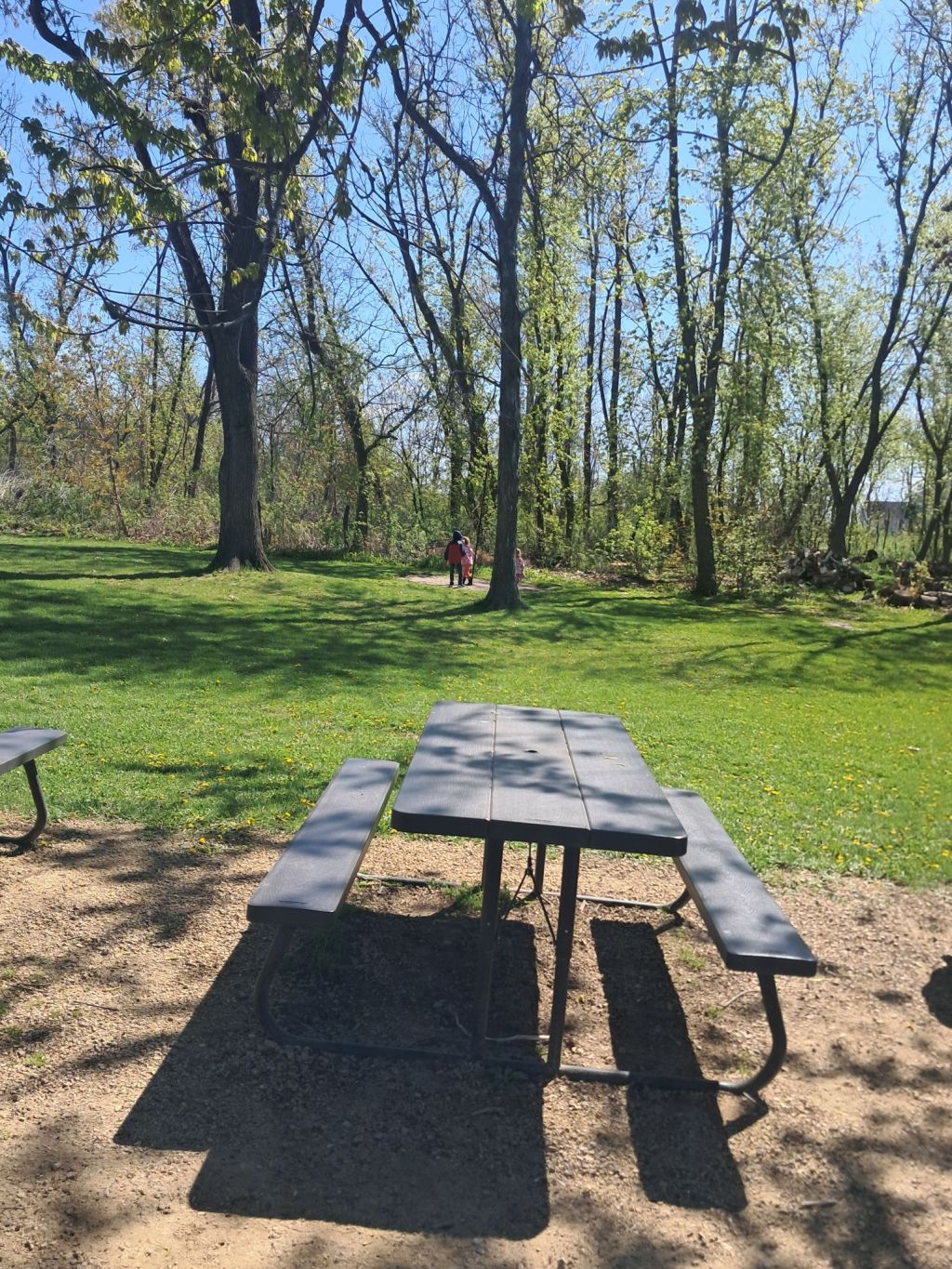
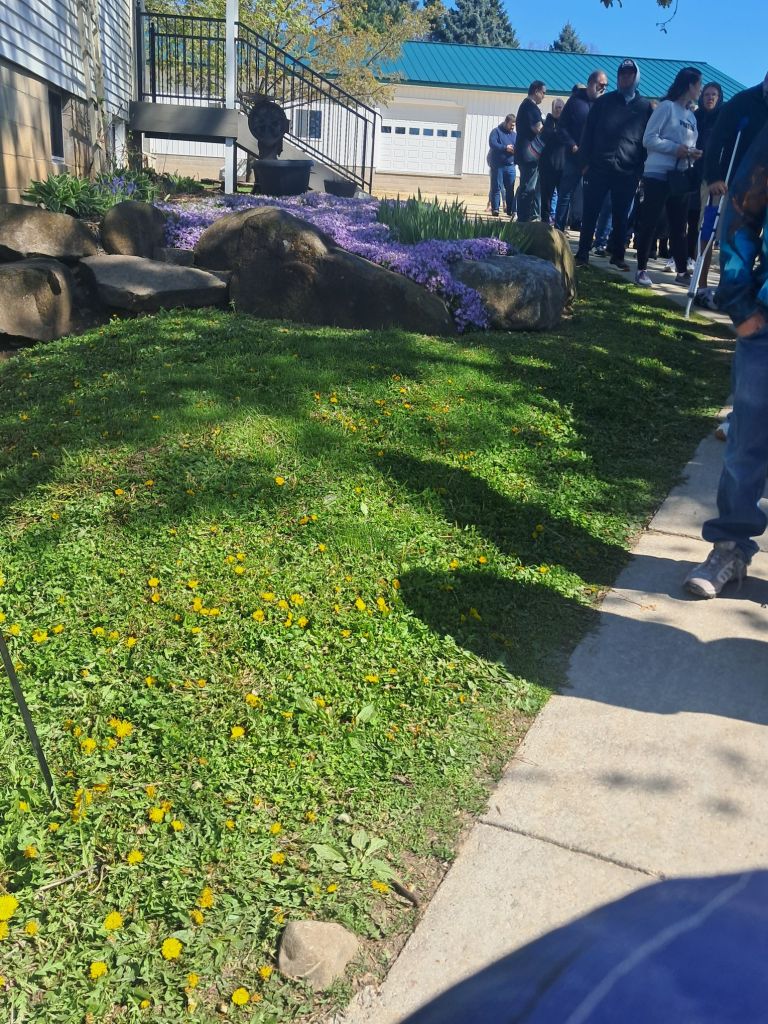
On this particular Saturday, it seemed like everyone else had the same idea. The parking lot was full, and the line stretched halfway across the gravel lot. For a moment, I considered turning around—but one look at my 6-year-old son and 2-year-old daughter made it clear we were staying.
So, we settled in.
There was a chill in the wind, but standing in the sun made it feel like a perfect spring day. Nearby, a little Amish boy—maybe three—chased a chicken across the yard, getting just close enough each time to keep trying.
We started with a round of “I Spy,” which didn’t last long. Soon, we were watching horses in the pasture, sheep grazing in the distance, and pigeons circling overhead—much to my daughter’s delight, who confidently called them all “ducks.”
As the line slowly moved, the wait began to shift. What felt long at first softened into something slower and more enjoyable. People started talking. A couple behind us—one from Sun Prairie, another from Watertown—struck up an easy conversation about travel, baking, and everyday life.
The line as I got closer to the entrance. The smell of freshly baked bread and pastries was intoxicating.
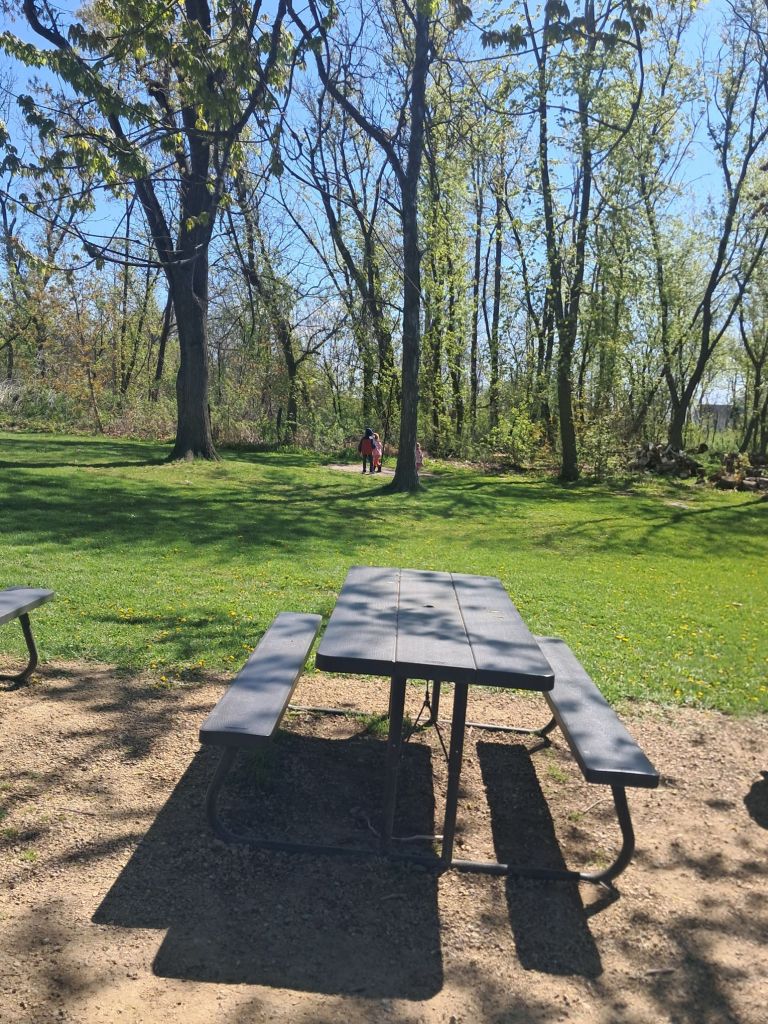
Meanwhile, my kids wandered off and found a little girl to play with, disappearing into their own world for nearly twenty minutes.
My kids found a little girl to play with while I waited in line.
By the time we reached the door, the smell of the Amish bakery had already found us—warm bread, sweet glaze, and something deeply comforting. Inside, shelves were lined with cakes, pies, and fresh-baked goods, but there was no question what we came for.
We walked out with warm donuts in hand—chocolate for my daughter and me, glazed for my son—and barely said a word as we ate them back at the car.
Somehow, the hour-long wait didn’t feel long at all.
Trips like this are never just about bulk groceries or even the Amish bakery itself. They’re about filling a pantry that feeds our family, giving our kids space to grow and learn patience, and finding small moments of connection with people we might not otherwise meet.
It’s growing food, raising kids, and building community—sometimes in the most unexpected places.
And yes… the donuts help, too.
Have you ever stuck out a long wait and realized it was actually the best part of the day?
If you’re trying to slow down, raise your kids a little differently, or build a more intentional life—like and share this with someone on that path too.
Here’s what foraging stinging nettles looked like for me this spring, and how I turned them into a safe, nourishing meal for my family.
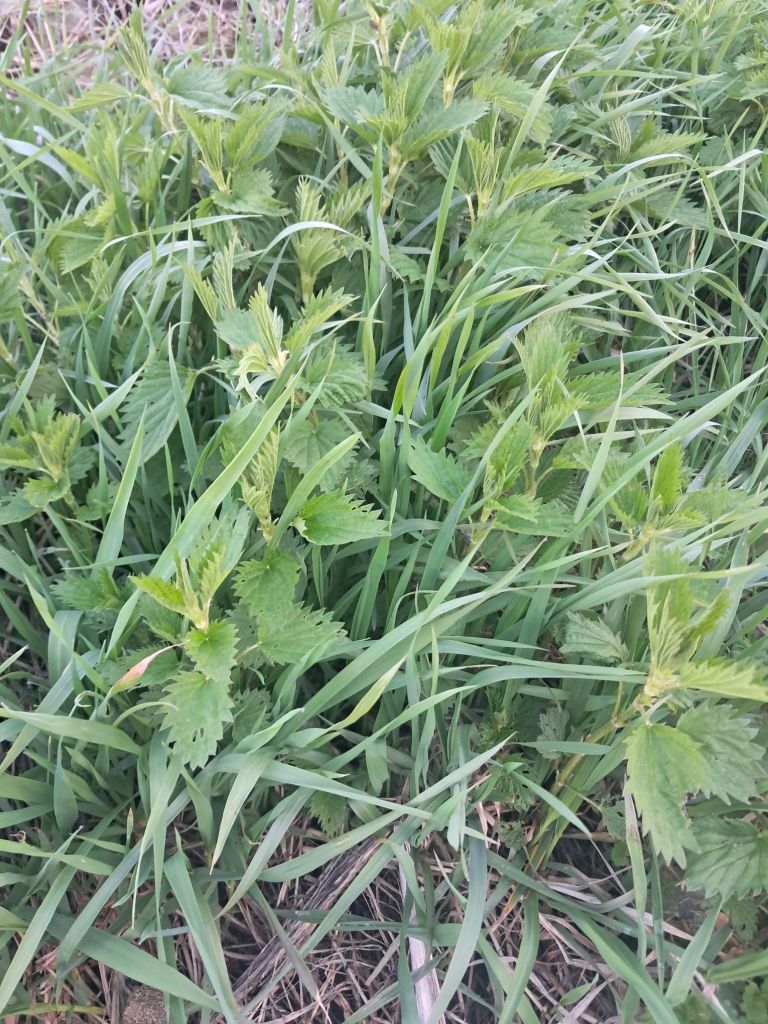
As I walk outside armed with a plant identification book, rubber gloves, and an open mind, I can’t help but feel that I’m about to violate a fundamental law of food. Among the waterlogged ground, I scan for juvenile stinging nettles—those tough, serrated leaves covered in tiny, hair‑like stingers. This spring, I’ve begun foraging stinging nettles on our property, turning a backyard “weed” into a free, nutrient‑dense green for our family. It’s especially welcome in the early months of the year, when fresh vegetables are harder to come by.
Nettles nestled among grass
Foraging Nettles Safely
From experience, I know that if I’m not careful, I’ll quickly become aware that the plant has grazed my skin: the stingers bring an immediate, sharp pain and soon after a scattering of blisters. As someone who is slowly learning to step away from the industrialized food system, I feel hesitant to collect food that can actually hurt me. Yet there’s also a quiet humility in working with a plant that demands respect—this is nothing like reaching for a plastic‑wrapped bunch of lettuce at the grocery store.
I chuckled at the thought of how hungry the first person must have been to discover how to disable the stingers and savor this tasty, nutritious wild larder hiding in plain sight. On the other hand, there’s a childlike wonder in identifying a “weed” that others avoid. That sense of discovery encourages me to continue my quest.
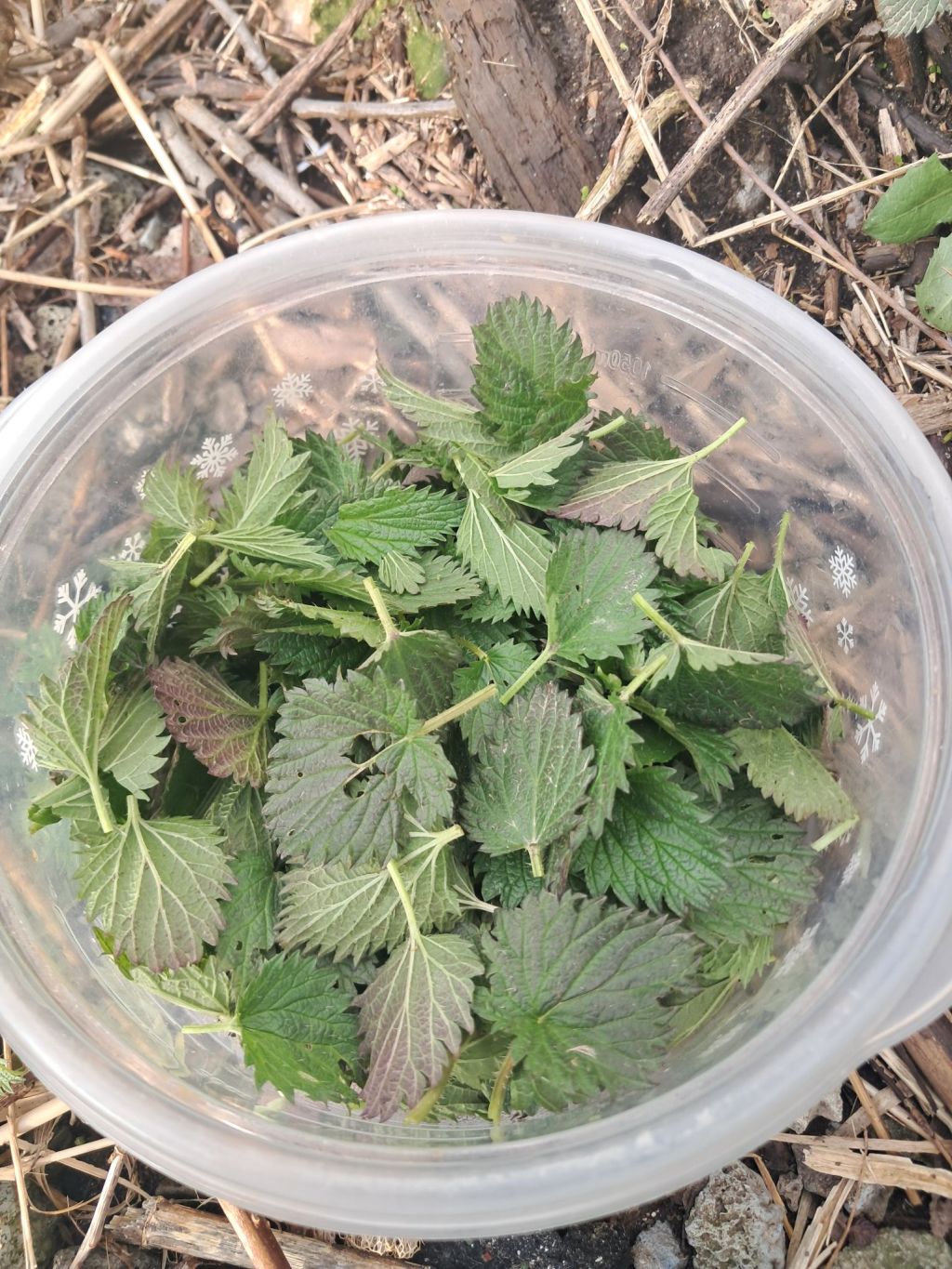
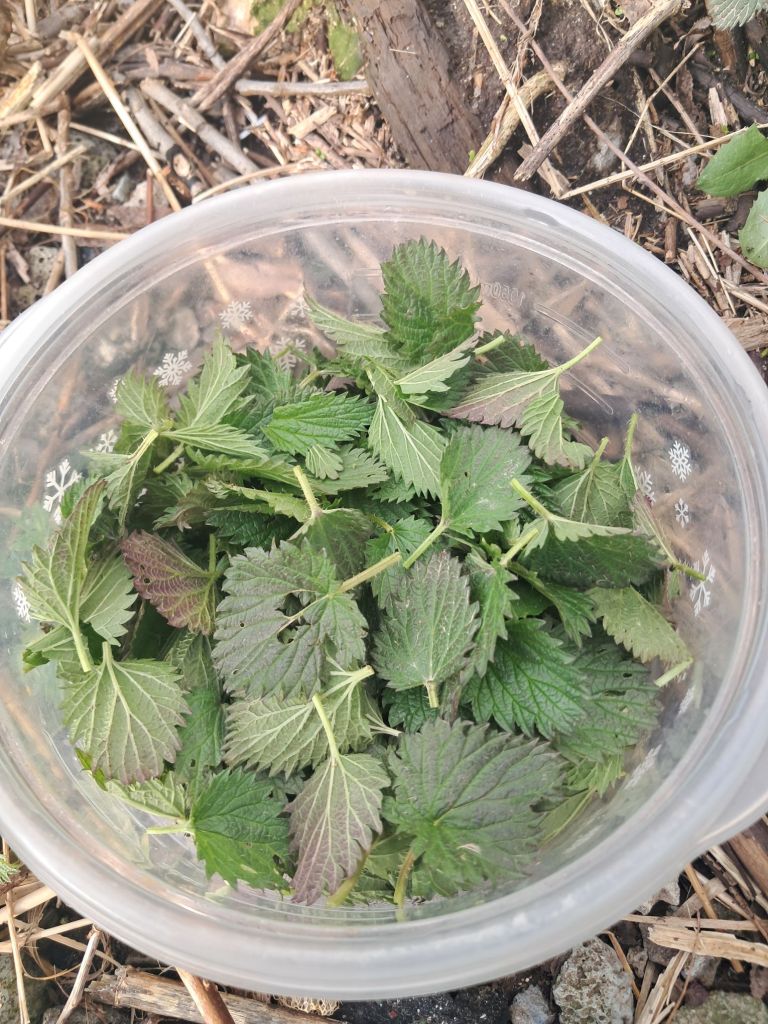
Harvesting becomes a mindful ritual. I crouch down and gently collect the plants, pinching off the leaves just above the stem. Where nettles grow most aggressively, I pull them from the ground—our property is overgrown with nettles that spread via rhizomes. The plants rustle as I work, releasing a faint, green herbal aroma into the air.
A bowl full of nettle leaves
In a moment of carelessness, my arm grazes the plant, and I receive several painful blisters in turn. The soreness is uncomfortable, yes, but it also feels like a badge of honor. The temporary sting is a small price for the nutritional bounty. As my basket fills, I marvel at the efficiency of nature, at its pure, unmediated abundance.
To keep myself and my family safe, here are the practical steps I use to handle stinging nettles while working with them:
Wear long sleeves and long pants to keep as much skin as possible covered.
Use thick rubber or leather gloves that fully cover the wrists.
Pull the gloves over the cuffs of long sleeves so stingers can’t slip in between.
Avoid touching your face or neck while harvesting.
If a sting happens, rinse the area with cool water and mild soap, then apply a soothing cream or cool compress as needed.
If you’re foraging with kids, let them wear gloves and long sleeves too, and keep them close by so you can guide their hands and steps.
These simple precautions make the experience feel less intimidating and more like a teachable moment, not a painful surprise.
Cooking Nettles Safely: How to Neutralize the Sting
By the time I’m back in the kitchen, the nettles are in a vibrant heap in the sink. Before I wash them, I remind myself: Stinging nettles must never be eaten raw. The stingers release a mildly irritating compound that can cause discomfort and a burning sensation in the mouth and throat.
To make them safe to eat, I always use one of these two methods:
Blanch in boiling water:
Bring a pot of water to a boil.
Drop the nettle leaves into the boiling water for 1–2 minutes.
Drain and rinse with cool water.
The leaves will feel soft and silky and will no longer sting.
Sauté in a hot pan:
Add the fresh nettles to a hot pan with a bit of butter or oil.
Stir constantly for 2–3 minutes until the leaves wilt and darken.
The heat neutralizes the stingers and turns the leaves into a tender, spinach‑like green.
Both methods are quick and simple. The important point is: any stinging nettle serving larger than a small nibble should be processed with heat. That’s the non‑negotiable rule if you don’t want a painful, unpleasant experience.
Once the sting is gone, the nettles are ready to shine. I usually sauté them in garlic and butter, then season with salt. The simplicity of the dish is empowering; the only extras are salt, garlic, and butter to let the flavor of the greens shine. They taste grassy and slightly nutty, with a depth that store‑bought greens rarely match.
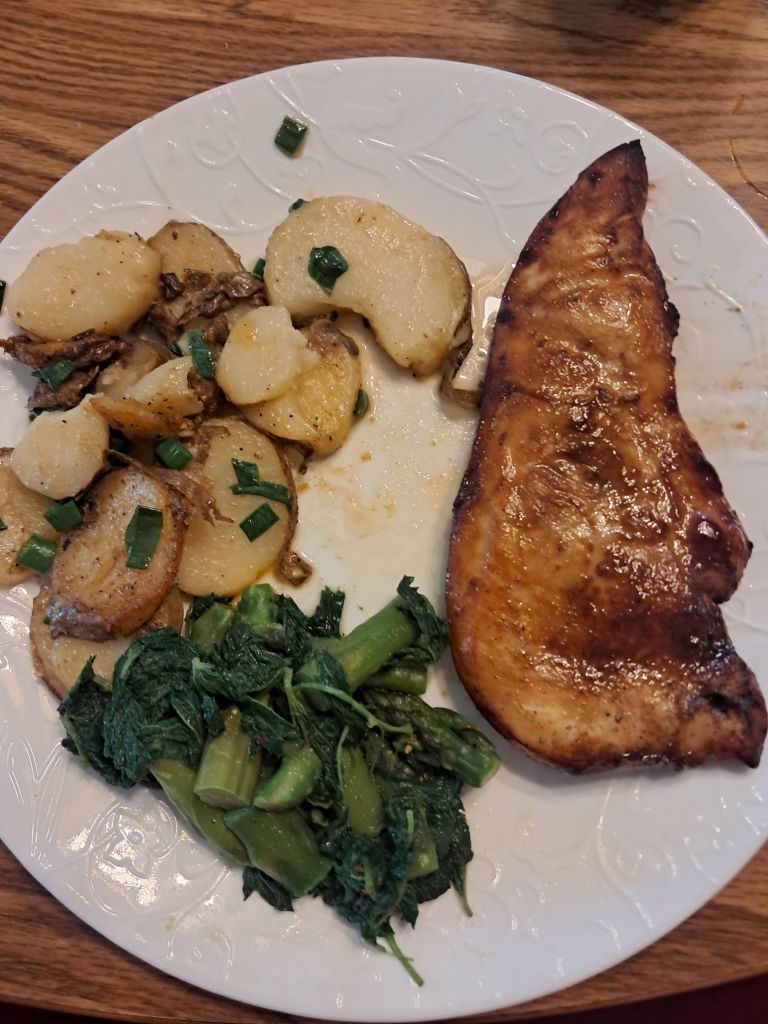
A recent dinner, the vegetable was asparagus and nettles boiled in salted water, seasoned with butter and pepper. Delicious!
Every bite carries the satisfaction of knowing that at least some of the food on our table comes directly from the land, unmediated by plastic packaging or price tags and paid for instead with time and attention. This is the kind of meal I want to share with my children, teaching them that “weeds” can become dinner and that food is something the earth offers, not just something we buy.
Nutritional Benefits of Nettles
Stinging nettles are often called a “wild supergreen” for good reason. A small serving of cooked nettles delivers a surprising amount of important nutrients, including:
Iron (useful for supporting energy and blood health)
Calcium (beneficial for bones and teeth)
Vitamins A and C (supporting immune function and skin health)
Magnesium and other trace minerals
A moderate amount of plant‑based protein for a leafy green
Nettles have also been traditionally used for their gentle antihistamine‑like properties, especially when prepared as an herbal infusion.
In a world where we often think of “healthy food” as something expensive or packaged, nettles remind me that deep nourishment can emerge from the edges of the yard, if we’re willing to learn how to use it.
Reflections on Foraging and Community
Later, I ponder the experience, which was more rewarding than I imagined. Supplementing my diet with nettles shrinks my food miles while my pantry is enriched by the seasons. Grocery store runs feel less urgent when the yard offers a free, nutrient‑dense green harvested in spring. There’s a quiet pride in crafting meals from plants many call weeds, a small act of rebellion against the idea that all good food must be bought.
On a deeper level, I’m participating in a cycle that predates grocery stores, rekindling a bond with the earth that modern life often severs. I’m learning to see my yard—and my children’s yard—as a living pantry, not just a backdrop to our days. And when I share a pot of nettle soup or a plate of sautéed greens with a neighbor, the act of foraging becomes part of a small, quiet web of community, where knowledge and food move between people instead of only through registers.
Defiance, Devotion, and the Gift of the Land In a world built on convenience, foraging for nettles becomes an act of both defiance and devotion. It roots me in the present, reminds me that the earth provides—often lavishly, and often in plain sight—for those willing to look, learn, and gratefully receive.
Have you ever foraged stinging nettles or another wild green? Or would you ever try nettles in your family’s meals? Let me know in the comments—I’d love to hear your stories and tips!
If this post inspires you to look at your yard a little differently, I’d love it if you shared it with another parent or forager who’s curious about wild food. You can like or share it on Facebook, pin it on Pinterest, or forward it to a friend who loves seasonal, hands on food adventures.
Right now, our days overflow with three big works. I’m writing this when I’m 36 years old. I hope you’re looking back on this time fondly, with a loving husband, two beautiful young children, and a growing homestead and writing hobby that is starting to bear some fruit.
Raising Emotionally Intelligent Kids
I’m working hard to help my children grow into emotionally intelligent, successful people who can easily integrate into society. I’m working internally on myself before I radiate love out to them. All while making sure they pick up their socks and eat their dinner. Will my work be worth it, and will they look back on their childhood fondly?
Building Our Homestead
My husband and I are also working on building our homestead. Last year, I learned how to grow mushrooms (the logs are colonized!), and this year we’re learning how to farrow pigs (first litter due Mother’s Day). Things don’t always go smoothly, but every homestead lesson learned is one that we can apply to the next set of skills. Will we continue to build and expand our homestead?
Growing My Writing Community
I’m also working hard on a writing hobby. Ever since I was a little girl, I loved to write. My first short story was about a herd of cows that escaped and exacted revenge on their owner (I was 8, and I grew up on a farm). And now I’m sharing homestead stories about my family and my hobbies. And people are listening and writing back! It is amazing to find kindred spirits out in the world. I hope we meet in person someday. Will I become a successful writer and continue building this community?
Mastering a homemade Reuben sandwich from scratch taught me that real learning comes through patient layers—sauerkraut, rye bread, corned beef. Each step built skills I didn’t know I needed.
From Garden to Ferment
It started last fall with Megaton hybrid cabbages from our garden. Shredded fine, salted at 2% by weight, packed into our antique Red Wing crock with a water-filled garbage bag seal. Three and a half months later in the basement, it emerged tangy, crisp, golden—pure magic. This homemade sauerkraut became the tangy heart of every bite.
Curing Corned Beef at Home
Winter freed up freezer space for a 4-lb sirloin tip roast from Gruenberger Farms. Brined 5-7 days in kosher salt, pink curing salt, brown sugar, and pickling spices (ground + whole), flipped daily at first. Slow-cooked 6 hours low in the crock pot, finished high for tenderness at 195-205°F. Sliced thin against the grain, it was pink, flavorful—worked as well as a brisket for this homestead experiment.
Rye Bread Reality Check
Rye dough is sticky and stubborn—no big lift like wheat. Mixed bread flour, rye flour, honey, yeast, olive oil; proofed twice, baked in a steam-trapped roasting pan setup at 425°F. Flatter than ideal, but the hearty tang paired perfectly with no caraway on hand. Homemade rye bread held up under melty Swiss and Thousand Island (store-bought, no shame).
Reuben Night Triumph
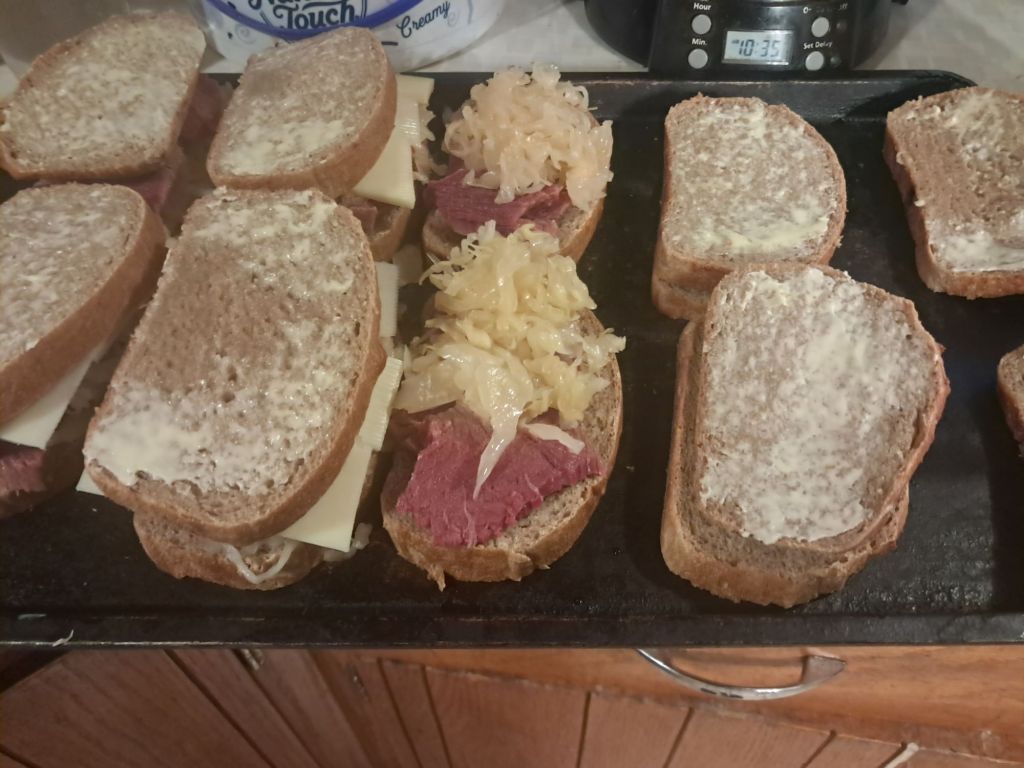
Twelve sandwiches baked golden on sheet trays: rye, corned beef, sauerkraut, cheese, dressing. Family devoured 10 immediately—only two leftovers by lunch. The kitchen smelled like a deli dream.
The Real Lesson Learned
This homemade Reuben quest showed me iteration through failure—soggy ferments avoided, lean cuts perfected, stubborn dough humbled. Homesteading scratches teach that last lesson sticks deepest when you taste the payoff. Garden to plate, one sandwich at a time.
What’s the last thing you learned making food from scratch? Share below!
Loved this Reuben quest? Like + share so fellow homesteaders can taste the scratch-made magic! 💚 What’s your latest kitchen win?
Loved this? Subscribe for more homestead reflections:






 Practical Homesteading